
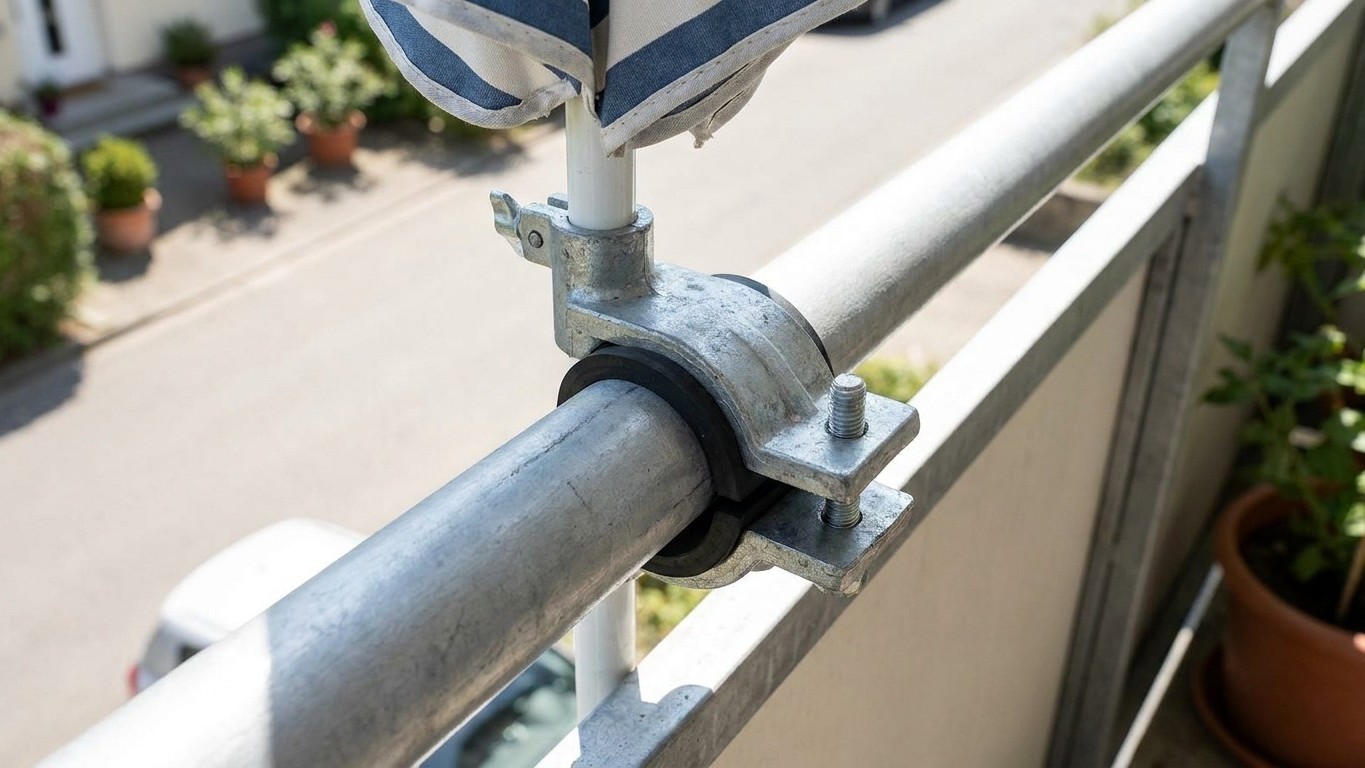
There is a very good reason balcony railing clamp brackets for parasols are flying off the virtual shelves this summer. A standard parasol jammed into a heavy base on a tiny flat balcony wobbles in the mildest breeze, takes up half the usable floor space, and has a rather unsettling habit of toppling sideways when you’re not watching. The no-drill railing clamp panel, a compact steel bracket that grips directly onto your balcony rail with adjustable screws — solves all three problems at once, leaves no trace when you move out, and typically costs around £20 to £30. For renters, that is something close to a small miracle.
Key takeaways
- Why traditional parasol bases are secretly dangerous and wasteful on modern UK balconies
- The hidden physics that makes a railing-mounted bracket five times more stable than a weighted base
- How the 2026 Renters’ Rights Act is about to make drilling into walls far riskier for renters
Why the wobbly parasol problem is worse than it looks
The old approach, a weighted base planted in the corner of the balcony, was always a compromise. Railing clamps are a simple, elegant solution to mount a patio umbrella or shade sail without drilling, and a genuine alternative to the heavy, bulky umbrella stands that most of us have been putting up with for years. The physics here are not complicated: a parasol sitting in a base on the floor has very little lateral resistance. The pole is only held at a single point, low down, which means any gust of wind applies enormous leverage at the canopy, easily toppling a 3-metre parasol even when the base weighs ten kilograms.
Furniture accidents can pose a danger to those below if furniture topples over the balcony edge. That is not a far-fetched concern for upper-floor flats facing a street. A railing-mounted bracket changes the geometry entirely, because it grips the rail at two separate points and transfers the load directly into the railing structure rather than relying on the floor area beneath. Security features such as a stable clamp, anti-slip padding, and tight screws help prevent movement or accidental dislodging during wind or foot traffic near the balcony.
Space is the other issue. Most UK flat balconies are modest, a large proportion of UK flats, particularly those built since the 1990s, have Juliet balconies: the full-height glass or metal railing panels set into the exterior wall, with no usable floor space beyond the doorway. Even on balconies with a proper floor, a bulky base eats into the already limited room for a chair or a small table. A parasol holder attached to the upper part of the balcony railing saves space and creates additional room for tables and chairs.
How these brackets work, and what to look for
The design is satisfyingly straightforward. The bracket clamps around the railing bar using one or two sets of adjustable bolts, with rubber or EVA padding between the metal jaws and the rail to protect the surface. A second clamp, positioned on the parasol pole itself, locks the umbrella shaft into the correct angle. No holes, no rawlplugs, no drill. The clamp-on mounting system installs in minutes using built-in thumb screws, no tools, no drilling, and no damage to your railing.
Double clamp fixation with integrated protective caps securely fix the umbrella pole, suitable for diameters from 2.2 to 4.2 cm. Most round and square railing profiles used on UK balconies fall well within the compatibility range of a good bracket. Flexible mounting options handle round railings between 2.5 and 4 cm and square profiles up to 6 cm by 4 cm, with horizontal and vertical mounting both possible. The better models are made from galvanised or powder-coated steel, which handles the damp British climate considerably better than cheap painted iron. Crafted from weather-resistant galvanised steel, these brackets provide secure shade without the need for a bulky base.
One detail worth checking before you buy: thanks to adjusting screws, the holder can be quickly moved to another location as the sun moves during the day, though some models are only suitable for square railings and will not hold securely on round ones. So measure your railing profile before ordering. Round tube railings and flat rectangular railings each require a slightly different jaw design. It takes thirty seconds to check; it saves a return delivery.
These brackets are also versatile beyond parasols, suitable for flagpoles, privacy screens, balcony nets, or sun sails. That flexibility makes them rather good value for a single item sitting in the bracket all summer. Several buyers use them through the season to hold a shade sail, switching over to the parasol when they want more targeted coverage.
The renter’s angle, and why the timing matters
The surge in interest among renters is not accidental. The Renters’ Rights Act has changed how landlords let out private properties, with these changes coming into effect on 1 May 2026. The new rules strengthen tenants’ rights around reasonable home improvements, but the critical word is “reversible.” Wall-bracket mounting requires drilling into the masonry or render of the building; for renters, this is generally not advisable without explicit written landlord permission, both because of the lease implications and because any damage to brickwork or render can result in deductions from your deposit.
A railing clamp sidesteps that problem completely. A residue-free clamping mechanism makes these products ideal for rental properties. There is nothing to fill, nothing to paint over, nothing to explain to a landlord. You fit it in minutes at the start of summer, remove it in minutes at the end, and the railing looks exactly as it did before. Easy installation with a quick and tool-free clamping system means the umbrella holder can be repositioned or removed at any time if required. For anyone who has anxiously photographed every mark on a rental wall before moving out, that removability has real emotional value, not just financial.
Most real-world balcony problems come from improvised mounting: weak fixings and no allowance for wind uplift. A responsible setup prioritises non-penetrating, removable mounting that clamps to railings or parapets instead of drilling into the structure. The railing clamp bracket is precisely this: purpose-designed rather than improvised, doing the job properly without compromise.
Getting the most out of yours
Fitting takes less than ten minutes the first time. Open the railing clamp, slide it over the balcony bar, and tighten the hex bolts until the rubber pads grip firmly, you want resistance without over-tightening, which can distort the bracket over time. Then feed your parasol pole into the upper collar and tighten that clamp to hold the pole at your chosen angle. Position the holder by opening the clamp and sliding it over the balcony balusters, insert the umbrella pole, turn the thumb screw until the holder sits firmly and level, then angle your umbrella as needed and relax.
A few things make a genuine difference in practice. Position the bracket towards the outer edge of the railing, so the parasol canopy clears the top of the balcony parapet when tilted, otherwise you lose shade where you actually sit. In very exposed locations, bring the parasol in or close the canopy when strong winds are forecast; a railing bracket is secure for everyday use and moderate breezes, but no mounting system turns a 3-metre canopy into a fixed structure. The adjustable clamp system feels secure without damaging the railing, and once tightened, the umbrella does not wobble or shift even with a breeze.
One often-overlooked bonus: the compact design saves space and allows for quick repositioning of the parasol as the sun moves across the sky through the day, something that was never straightforward with a floor-standing base. That alone justifies the modest outlay. And if you move flats, the bracket moves with you. Unlike that 12-kilogram concrete base you will quietly abandon in the communal bin store, this one fits in a shoebox.
Sources : etsy.com | walmart.com