
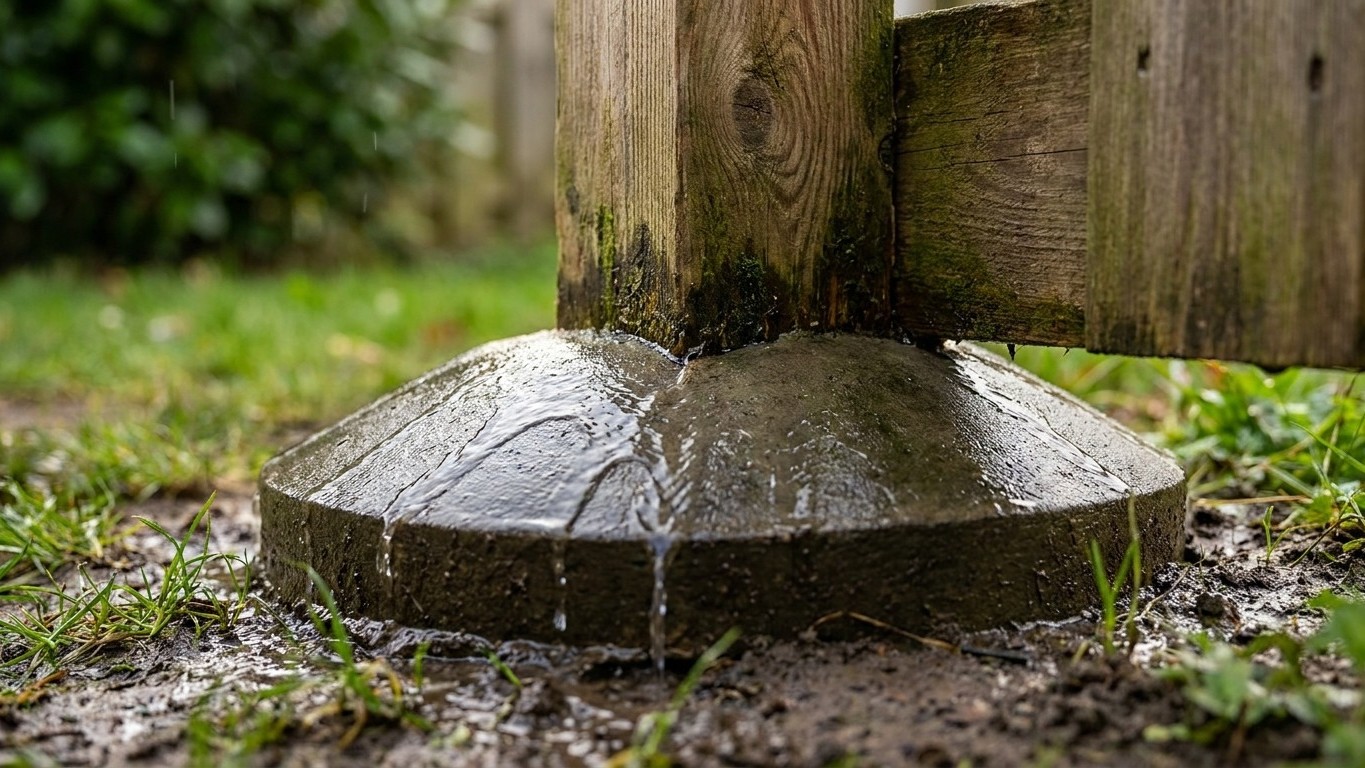
The concrete around a fence post does far more than hold it upright. That smooth, slightly domed finish you see on well-set posts, the kind your grandfather would tap with satisfaction before walking away — is actively shedding water away from the timber every single time it rains. Without it, every shower drives moisture straight down the post-concrete interface, straight to the buried wood, and straight into a rot problem you won’t notice until the post wobbles.
My own posts were proof of this. I’d packed the concrete in fairly well, left the top roughly level with the soil, and considered the job done. Two summers later, two posts had gone soft at the base. Not dramatically rotten, just spongy enough that a firm push made them shift. The concrete hadn’t failed. The shape of it had.
Key takeaways
- Flat concrete around fence posts creates a hidden water trap that rots timber from the inside out
- A simple dome shape—taking 90 seconds to create—redirects water and extends post life by decades
- The real danger isn’t below ground; it’s the zone just above soil where posts endlessly soak and dry
What that domed finish is actually doing
Water, given any opportunity, will pool. A flat concrete collar around a post sits flush with the surrounding ground, which means rain settles on it, and the lowest point of that puddle is the gap between the concrete and the timber. Even pressure-treated wood has a vulnerability there, the treatment penetrates the outer fibres, but the endgrain and any small checks in the wood absorb moisture readily. Over months and years, this produces the classic “ring rot” pattern where timber decays from a point six to ten centimetres below ground level, right where the wet zone sits.
A properly finished concrete collar solves this with pure geometry. The surface slopes away from the post at roughly a 10-to-15 degree angle, just enough that water runs off rather than sitting. It doesn’t need to be steep; it needs to be consistent. A small raised dome, highest at the post and tapering outward, means the post itself is always sitting on the driest part of the concrete surface rather than the wettest. Timber in contact with damp concrete deteriorates roughly three times faster than timber that dries between rain events, which explains rather neatly why my two-summer posts were already struggling.
How to get the finish right, without any special tools
The technique takes about ninety seconds per post, and you do it while the concrete is still workable, typically fifteen to thirty minutes after mixing depending on the weather. You want the mix to have lost its initial slump but still respond to pressure, the consistency of stiff porridge, if that helps.
Heap the concrete very slightly above ground level around the post, then use a trowel or even the back of an old spoon to smooth it outward and downward in short strokes, working around the post in a circle. The motion is something between spreading butter and sculpting, pressing down as you sweep outward. Keep the high point touching the post itself. Once you’ve gone around once, wet your trowel blade lightly and make a second pass to close any surface cracks and give a smoother finish. That’s genuinely all there is to it.
One thing worth knowing: don’t try to achieve perfection when the concrete is too wet. A mix that’s too sloppy will slump back flat within minutes of you finishing it. If your concrete is running off the trowel, let it stiffen for another ten minutes before attempting the dome. Patience here saves a re-do.
What to do if your posts are already in
If you have existing posts with flat or sunken concrete collars, the fix is more straightforward than you might expect. You don’t need to dig everything out. A product called hydraulic repair mortar (available at most builders’ merchants) can be pressed directly onto an existing concrete surface that’s been cleaned and dampened first. It bonds reasonably well to cured concrete and sets quickly. Build it up around each post, shaping it into that dome profile while it’s still pliable, then leave it to cure for 24 hours before any rain hits it if you can manage the timing.
Where posts have already begun to rot at the base, there are steel post repair spikes designed to be driven into the ground beside the existing post, clamping around it to restore rigidity without requiring the whole post to come out. This is a sensible interim fix for a post that’s structurally sound above ground but compromised below. It won’t reverse the decay, but it buys time and stability while you plan a proper replacement on your schedule rather than the fence’s.
Gravel around the base is another layer worth considering alongside the concrete finish. A ring of coarse grit or pea shingle, ten to fifteen centimetres wide around each post, improves drainage at soil level and helps the exposed timber just above ground dry out more quickly after rain. This is the zone that takes the most abuse, not underground where the concrete sits, but just above it, where the post alternately soaks and dries with every weather change. Letting that zone breathe properly makes a measurable difference to post longevity.
The timber choice matters too
No concrete finish, however well executed, can fully compensate for the wrong timber. Fence posts should be pressure-treated to UC4 specification, this is the treatment class intended specifically for ground contact, and it’s worth confirming rather than assuming. Some garden centre posts are treated to a lighter specification suitable only for above-ground use. The labelling isn’t always prominent, so asking directly or checking the end stamp is a reasonable habit.
Hardwoods like oak and sweet chestnut have natural durability in ground contact and were historically the default for rural fencing in Britain for exactly this reason. A properly finished oak post in well-drained soil can outlast a softwood post by decades. The cost difference is real, but spread over fifteen or twenty years of service life, the arithmetic often favours the more durable timber. My replacement posts are oak. I’ve domed the concrete carefully. I’m not expecting to revisit them anytime soon.