
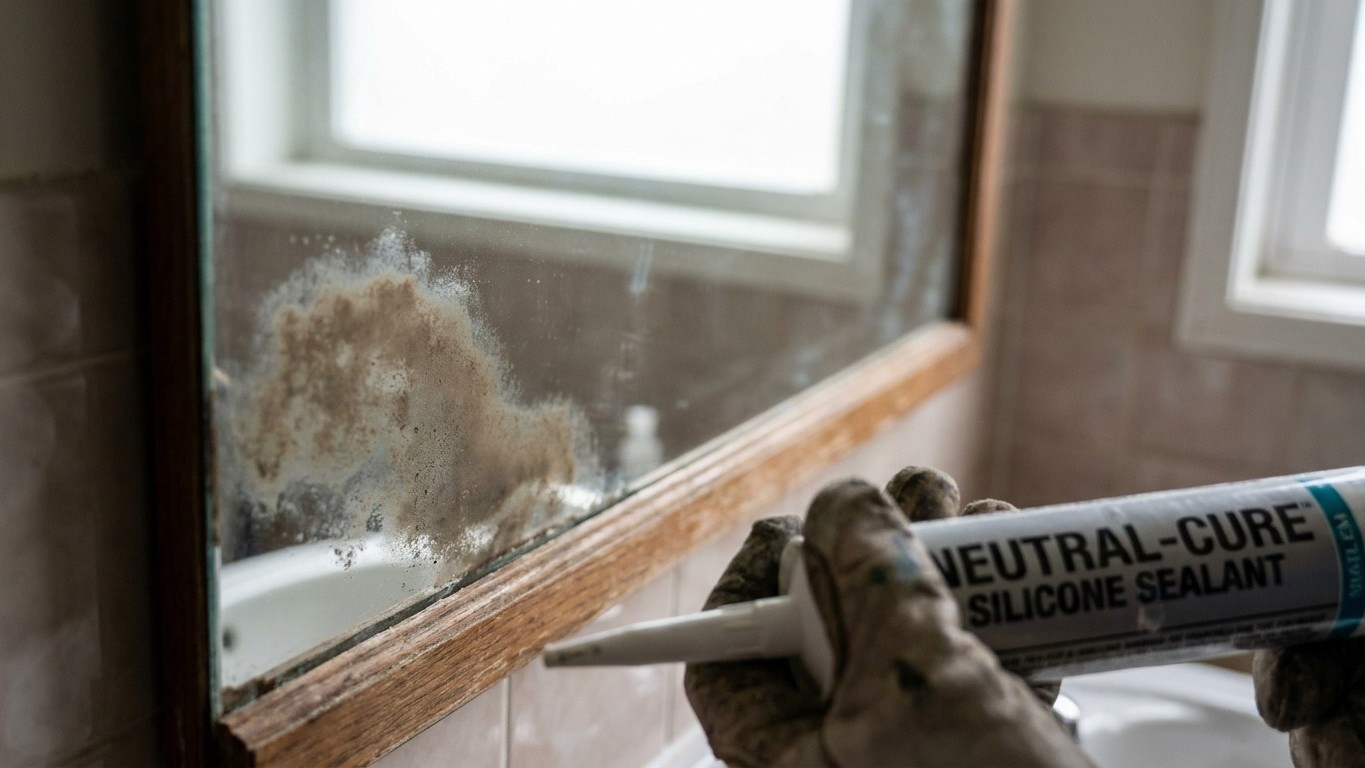
Reach for the wrong tube of adhesive on a glass shower door or bathroom mirror and you won’t find out you’ve made a mistake until weeks later, when a dark, cloudy stain creeps in from the edges and never budges again. That cloudiness isn’t dirt, and no amount of vinegar spray will shift it. It’s chemical damage, and it happens because certain adhesives release acid as they cure, quietly eating into the wafer-thin silver layer behind the glass.
Key takeaways
- A vinegar-smelling adhesive is eating away at your mirror’s silver backing right now—and vinegar spray won’t help
- Two completely different chemical dangers lurk in the DIY aisle, each one capable of ruining glass in different ways
- The fix costs just a pound or two more, but skipping it means buying an entirely new mirror in two years
Why That Vinegary Smell Spells Trouble
Most of us have squeezed a tube of clear silicone sealant and caught a whiff that smells uncannily like a chip shop. That smell is acetic acid, and it’s the tell-tale sign you’re holding an acetoxy (acid-cure) silicone. Chemistry buffs and cooks alike will remember that acetic acid is, aside from water, the main component of vinegar, and while that’s harmless on your chips, it’s a different story pressed against a mirror or shower screen day after day.
A mirror’s reflective layer is astonishingly delicate. A mirror’s back silver layer is an extremely thin layer of silver film, typically only tens to hundreds of nanometers thick. When you seal that mirror with an acid-cure silicone, the fumes it gives off as it sets go to work on that silver. Acetoxy or oxime-type silicone sealants release byproducts like acetic acid or methyl ethyl ketone oxime during the curing process, and these chemicals can corrode the fragile silver film, leading to tarnishing or discoloration. That’s the fogging you’re really seeing: not condensation, but a mirror slowly losing its silver from the back.
It isn’t only mirrors, either. The same acid attacks metal fittings and certain stone. Acetic cure silicone sealant releases acetic acid on curing, smells a bit like vinegar and would corrode metallic surfaces, such as iron, bronze, brass, mercury, copper and zinc. If your shower door has chrome or brass trim sitting anywhere near your bead of sealant, an acid-cure tube can leave pitting and staining on that too, quite apart from what it does to any mirrored glass. My late mother-in-law always kept an old tin of “special mirror glue” in her tool box, and I never understood why until I learned The Science Behind it, decades later.
The Neutral-Cure Alternative, and Why It Costs a Bit More
The fix is refreshingly simple: buy a silicone labelled “neutral cure” rather than standard bathroom sealant, especially for mirrors and shower screens. Unlike acetic-cure formulas that release acetic acid as they cure, neutral formulas cure by releasing alcohol or other mild substances, meaning they won’t etch mirrors, dull the shine on natural stone, or corrode metals like brass, copper, or steel. Within the neutral family, look further and you’ll find alkoxy-cure silicones described as the gentlest of all. Within the silicone sealant family, the Alkoxy type is widely recognised as the most mirror-friendly option, releasing mild, non-corrosive alcohols with a low odour and excellent compatibility with the silver layer, and its low shrinkage rate prevents both chemical and physical stress on the silver backing.
Neutral cure does have trade-offs. It’s pricier than the acid stuff, and it takes its time. Acetoxy silicone usually becomes tack-free within minutes, although it will not be fully cured for up to 24 hours, whereas neutral formulas set more slowly still. Worth the wait, though, when the alternative is replacing an entire mirror in two years’ time.
Grab Adhesives Bring a Second Trap of Their Own
Silicone sealant isn’t the only culprit on the shelf. Plenty of us reach for a “grab adhesive” or “gap filler” tube instead, and here the danger isn’t acid, it’s solvent. Solvent based adhesives may not be suitable for sensitive materials like polystyrene or mirrors, as the aggressive solvent can attack the sensitive materials and even melt them in some cases. That’s not a slow chemical process either; it can happen within hours of application, leaving a visible haze or even a warped patch behind.
Solvent-free grab adhesives dodge that particular problem, but they bring a different quirk worth knowing before you start a job. Many are designed to cure by letting moisture escape into whatever they’re stuck to, which works beautifully on plaster or timber and rather less beautifully on glass. The product is water-based and cures by drying, so porous surfaces allow moisture to dissipate and let the adhesive develop strength efficiently, whereas on non-porous substrates moisture can become trapped, slowing cure and leaving the bond vulnerable to movement or loading too early. Glass, of course, is about as non-porous as it gets, which is why so many DIY forum threads describe a “gripfill” style adhesive staying soft and cloudy behind glass for weeks. One tradesperson summed up the whole debate rather neatly when comparing the two types: solvent adhesive bonds (‘grabs’) better and faster, and is probably stronger too, however it skins quickly and you can pretty much forget about repositioning things after you’ve pressed them into place.
Reading the Tube Before You Reach the Till
So what should you actually look for, standing in the DIY aisle with a shower door panel under one arm? Three checks take thirty seconds and save you a costly redo:
- For mirrors and anything with a reflective backing, pick a tube marked “neutral cure” silicone, never standard bathroom sealant, however tempting the lower price.
- For grab adhesives near glass or plastic trims, choose one explicitly labelled solvent-free, and check whether the packaging asks for a porous surface on at least one side.
- Keep any bead well back from the mirror’s edge; a bead pushed right up against silvering traps moisture and vapour exactly where it can’t escape.
None of this needs to break the bank. A single tube of proper neutral-cure silicone typically costs only a pound or two more than the standard bathroom sealant sitting next to it on the shelf, which is a trivial sum next to the price of a replacement mirror or a new shower panel. I always tell people: buy the right tube once rather than the cheap tube twice, because a fogged mirror can’t be polished back to clarity, only replaced.
One last thing many people don’t realise: even a correctly chosen neutral-cure silicone still needs decent ventilation while it cures. Sealing too tightly traps moisture behind the mirror, so leaving the extractor fan running, or a window cracked open, for the first day or two after application genuinely makes a difference to how long that clear glass stays clear.
Sources : amazon.com | resealuk.co.uk