
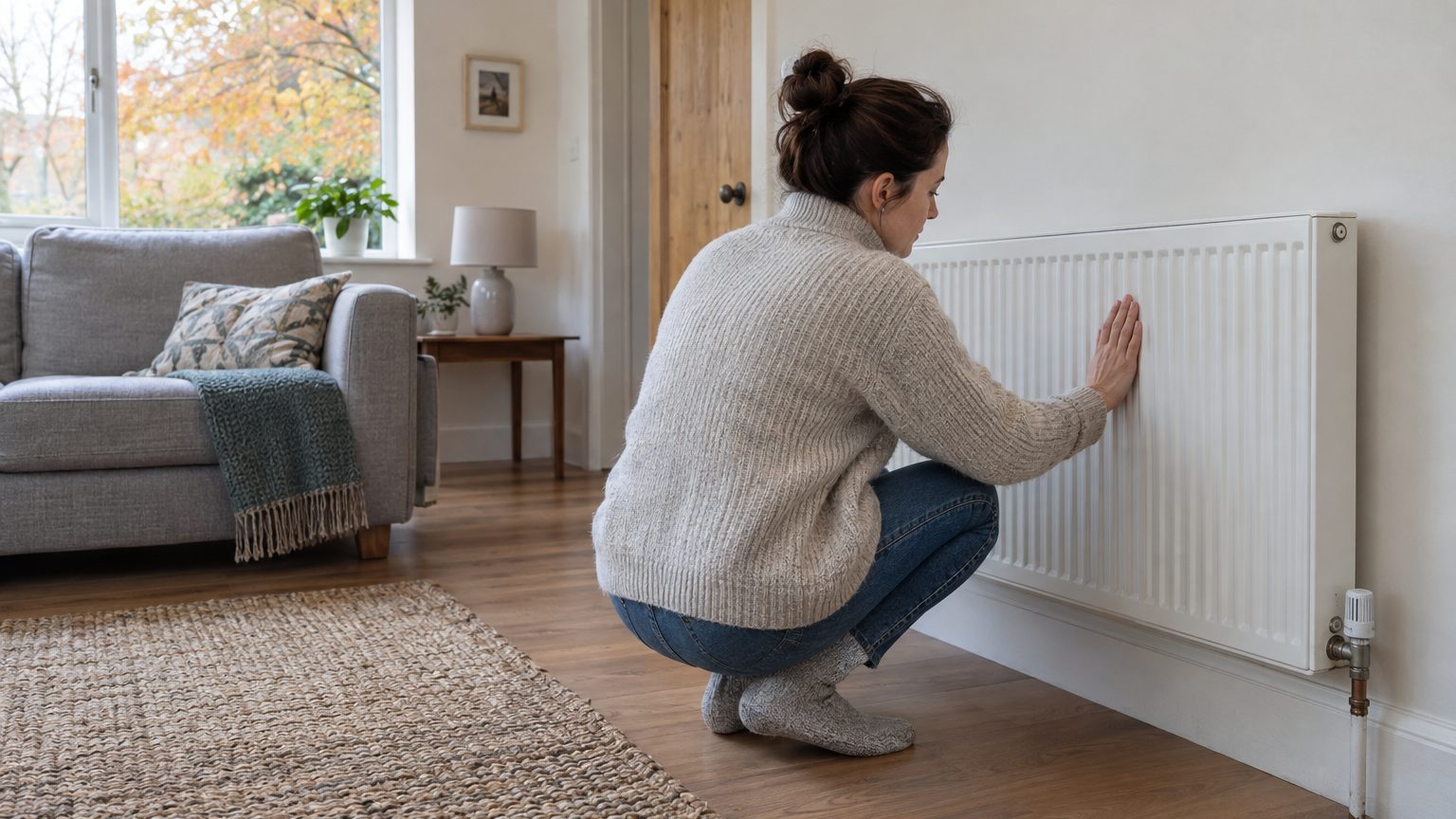
A radiator that stays stubbornly cold after bleeding almost always has one of five problems: sludge, a stuck valve, an unbalanced system, a circulation fault, or air that has simply moved elsewhere. Each has its own telltale signs, and most can be checked in an afternoon with nothing fancier than a towel, a spanner and a bit of patience.
Start by working out where the cold is. That single observation narrows the field considerably.
- Trapped air or gas makes the top of a radiator cold while the bottom stays hot.
- Sludge collects at the base or centre of a steel radiator and blocks the flow.
- A seized TRV pin keeps the valve shut even when the heating is running.
Read the pattern of cold before touching anything
Switch the heating on, give it twenty minutes, and feel along the radiator with the flat of your hand (not the fingertips, which are less sensitive). If the top is cold and the bottom is hot, you have trapped air or a gas build-up. If the bottom is cold and the top is hot, that points to sludge settling at the base. A radiator cold in the middle but warm at the edges is the classic sign of a sludge blockage in the centre.
Entirely cold? Then the water isn’t getting in at all.
Check the other radiators too. If every one is lukewarm, look at the boiler, pump and thermostat rather than the individual radiator. If only one or two are cold, the fault is local, and that is far better news for your wallet.
Causes one to three: the valve, the sludge and the balance
The humble valve is the cheapest culprit and the one people overlook. Take off the plastic cap on the thermostatic radiator valve (TRV) and look at the metal pin underneath. Pins can seize after a summer of sitting idle, leaving the valve shut even when it ought to be open. Try gently tapping the pin with a small hammer or wiggling it with pliers; if it springs back, the valve is freed. If it stays down, the pin or the whole valve head needs replacing, which is a modest cost compared with a callout.
Sludge is the second suspect, and it is common in systems more than ten or fifteen years old. Inside a steel radiator, iron oxide forms as a black, gritty deposit that collects at the bottom and builds up until it blocks the flow. A telltale sign is black, murky water when you bleed or drain the radiator. For a single stubborn radiator you can remove it, take it outside, flush it through with a garden hose until the water runs clear, and refit it. Expect the job to be messy, so lay down old towels and have buckets ready.
Before removing anything, switch off the heating and let the system cool completely. Close both valves, and place a bowl under the lower union nut to catch the first rush of dirty water. Have someone steady the radiator, because a full one is heavy, and tip it carefully so the contents run into a bucket rather than your carpet.
For whole-system sludge, a chemical cleanser added to the feed and expansion tank (or via the radiator) and then a power flush are the usual routes. A power flush is a professional job, and prices vary a good deal between firms, so get at least three quotes.
Balancing is the third cause, and it explains why radiators furthest from the boiler so often stay cold. Water takes the easiest route, so the nearest radiators hog the flow while the distant ones starve. The lockshield valve (the one at the other end from the TRV, usually under a cap) controls how much each radiator receives.
To balance the system, open every lockshield valve fully, then close them one at a time, starting with the radiator nearest the boiler. The aim is a temperature drop of about 20°C between the flow and return pipes on each radiator, which you can measure with a pair of cheap pipe thermometers. It is fiddly, and you may need an hour or two, but it costs next to nothing.
Causes four and five: circulation and stubborn air
If several radiators upstairs are cold while those downstairs work well, suspect the pump. Listen near the boiler or airing cupboard with the heating on. A pump that hums but does not turn, or one that is silent, may be seized or failing. Many pumps have a small central screw you can undo to release the shaft and give it a nudge with a screwdriver, but check your manual first, and if the water is hot, leave well alone. A failed pump is a job for a Gas Safe registered engineer if it sits within the boiler itself.
Pressure matters here as well. On a sealed system, the boiler gauge should usually sit between 1 and 1.5 bar when cold. Bleeding lets air out and pressure drops with it, so many people forget to top it up afterwards, and the boiler then refuses to circulate properly. Topping up through the filling loop, slowly, until the needle sits back in the green zone often cures the lot.
The fifth cause is the sneakiest, because it looks like the problem you have just tried to fix. Air can keep re-entering the system through a tiny leak, a faulty automatic air vent or a failing pump seal. If you bleed a radiator and it needs doing again within a week or two, something is letting air in. Look for damp patches or rusty stains around joints and valves, and check the feed and expansion tank in older open-vented systems.
Bleed in the right order, too. Begin with the radiator closest to the boiler on the ground floor, work outwards, and finish upstairs. Keep the pump off while you do it, otherwise you may simply pull more air in.
When to stop and call someone
Some jobs sit well outside the home handyperson’s remit. Anything involving the boiler’s internals, gas supply, or a persistent pressure loss needs a Gas Safe registered engineer, and you can verify one on the official Gas Safe Register at gassaferegister.co.uk. Radiator valves, bleeding and balancing are generally fair game for a confident DIYer.
One small trick from my own kitchen drawer: keep a notebook beside the boiler and jot down the date, the pressure reading and which radiators you bled. After a winter or two, the pattern shows you exactly which radiator is the troublemaker, and an engineer will thank you for it.
A magnetic filter fitted on the return pipe catches iron oxide before it gathers, and it is one of the better bits of prevention available for older systems.