
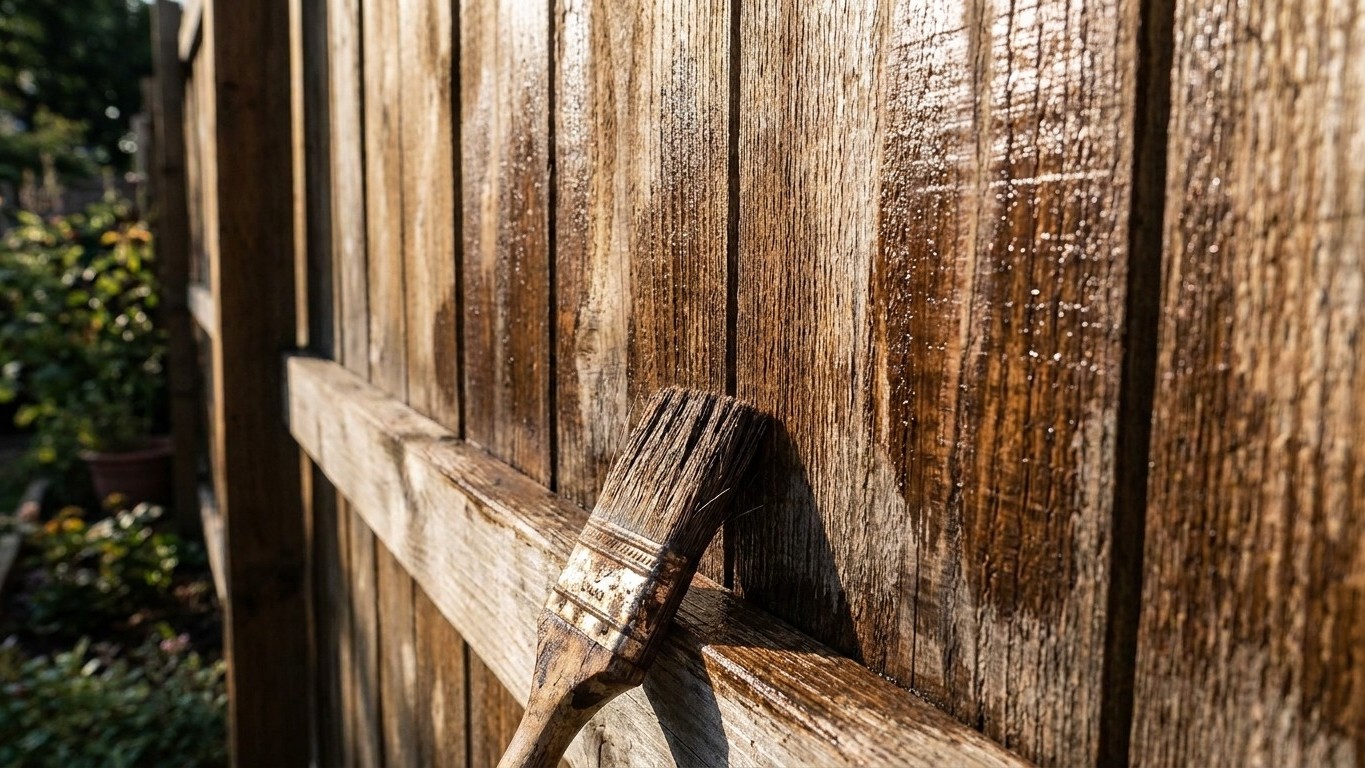
Fence stain applied in direct midday sun almost always dries too fast, and the result is not a rich, even colour but a blotchy, streaky surface that no amount of extra coats will fully rescue. Those patchy reflections you notice on the timber as you step back to admire your work? That is the stain skinning over before it has had a chance to properly penetrate the wood grain. By the time you see the problem, the damage is done.
Key takeaways
- Midday sun heats timber to 40-50°C, making stain skin over in seconds before it soaks in
- Wood changes colour as it heats up, making it impossible to see where you’ve already brushed
- There’s a narrow window to fix patchy stain—but sometimes stripping back is the only real solution
Why sunlight turns a simple job into a patchwork disaster
Wood is porous, and the whole point of a penetrating fence stain is to sink into those pores rather than sit on top of the surface. When the sun heats timber to temperatures well above the air temperature, the wood fibres expand and the surface moisture evaporates rapidly. A thin coat of stain applied in these conditions can dry in under a minute on the outer face, sealing the surface before the product has soaked in. The result is an uneven film, part dried and part still liquid, which cures into those tell-tale patches that catch the light at odd angles.
There is also a compounding factor that many people overlook: the timber itself changes colour as it heats up, making it very difficult to judge where you have already applied the stain. You brush on what looks like an even coat, only to find once the section cools that some areas have barely taken any colour at all. This happened to me one June afternoon when I was convinced I was doing Everything/”>Everything/”>Everything right, same tin, same brush, same fence I had stained several times before. The only difference was that the sun had moved round and was now hitting the boards full-on by noon.
The right conditions are more specific than you might think
The guidance printed on most fence treatment tins recommends applying in temperatures between roughly 10°C and 25°C, avoiding direct sunlight and strong wind. That 25°C ceiling is not arbitrary. Beyond that point, the solvent or water carrier in the stain evaporates too quickly regardless of whether the timber is in sun or shade. On a typical British summer afternoon where the fence has been baking since mid-morning, the surface temperature of the wood can easily reach 40°C to 50°C even if the air temperature reads only 22°C. Dark-stained or painted fences absorb even more heat and can get hotter still.
Wind is the other underestimated culprit. A fresh breeze that feels pleasant while you work is actually stripping moisture from the stain at nearly the same rate as full sun. If you have ever stained a fence on a breezy spring day and wondered why one section looks duller than the rest, that gust that came through while you were loading your brush was probably the cause. The sweet spot for fence staining is a still, overcast day, or early morning and early evening on a sunny one, working in the shadow of the fence wherever possible.
Can patchy stain be fixed, or must you start again?
The honest answer is: it depends on how badly the stain has cured. If you catch it within an hour or two and the surface is still slightly tacky in the worst patches, a careful second coat applied with a long-bristled brush, working with the grain, can sometimes blend the edges of the dried areas back into the wetter ones. This is painstaking work and requires you to keep a wet edge moving steadily, never going back to touch an area that has already started to set.
If the stain has fully dried and the patchiness is obvious, you have two realistic options. The first is to apply a further full coat in better conditions, accepting that this will deepen the overall colour and may even things out somewhat, though it rarely eliminates the variation completely. The second is to strip the fence back, which on rough-sawn timber means a pressure washer and a wood brightener or dilute oxalic acid solution, followed by a full drying period of at least 48 dry hours before you begin again. Not ideal, but sometimes the only way to achieve the result you were after.
For a badly patched fence that you simply cannot face stripping, a solid opaque wood paint or a very dark stain applied as evenly as possible can camouflage the variation. It is a bit like covering a kitchen wall with a deep colour when you have run out of patience with patchy emulsion, not the original plan, but perfectly respectable.
Making the job go right the first time
The single most reliable habit is to work in the shade of the fence itself. On a south-facing fence in summer, that means working on the shaded (north) side in the morning, then returning to the sunny face in the late afternoon once the direct light has moved off. This sounds obvious stated plainly, but plenty of us have spent years doing it the other way round simply because we went outside when we had the time, rather than when the conditions were right.
Preparing the timber properly beforehand also makes a surprising difference. Clean, dry wood that has been lightly sanded or pressure-washed and allowed to dry completely is far more forgiving of slightly imperfect conditions than dirty, grey, weathered timber. Old wood with a closed surface sheds stain rather than absorbing it, which makes uneven drying even worse. A wood cleaner applied the day before, rinsed off and left overnight, opens up the grain so the stain has somewhere to go even when conditions are less than perfect.
One last thing worth knowing: oil-based fence stains are generally more forgiving in warm conditions than water-based ones, because the slower drying time gives you more of a working window. Water-based products have improved enormously in recent years and are easier to clean up, but they remain more sensitive to heat and sun. If you live somewhere with a genuinely warm summer, that trade-off is worth factoring in before you buy.