
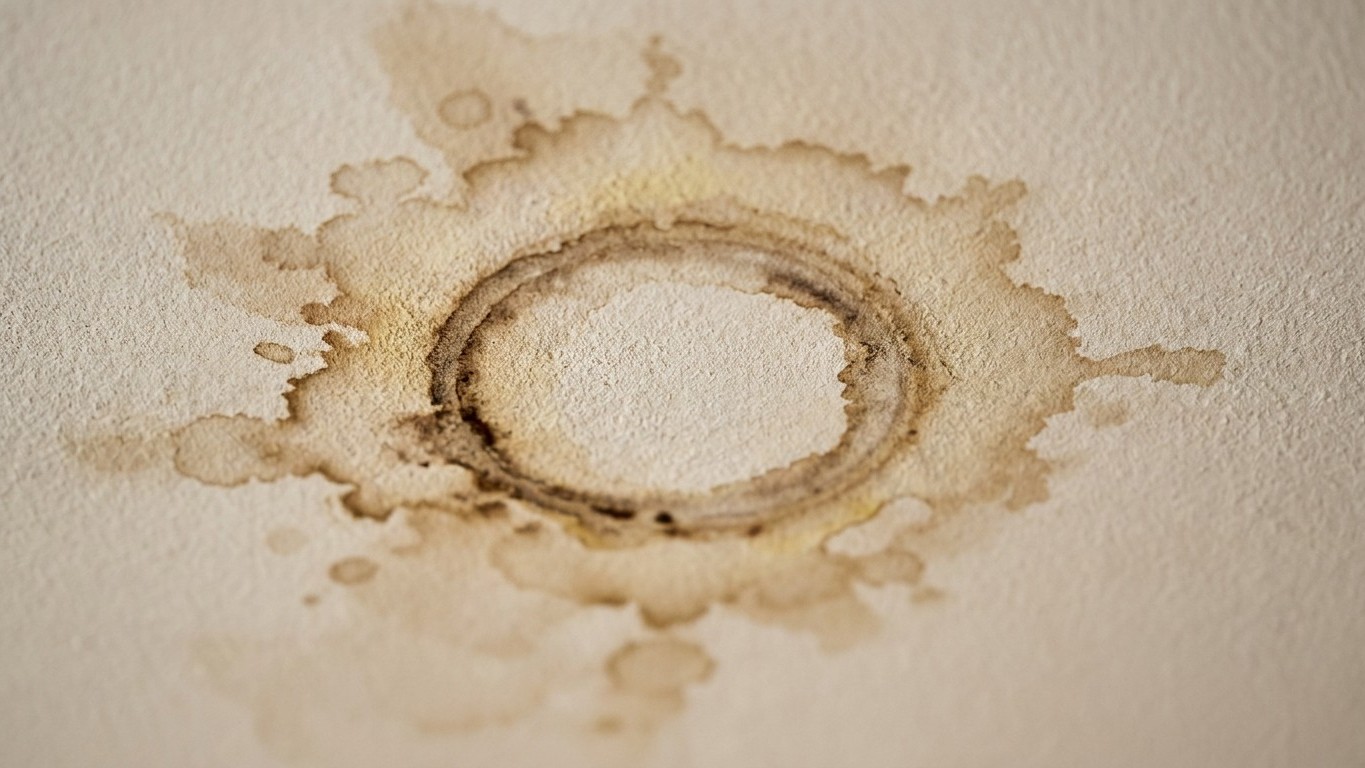
That brown ring didn’t appear overnight. It crept across the landing ceiling slowly, through one particularly cold January, until the day I finally climbed into the loft with a torch and found the truth: my bathroom extractor pipe wasn’t going outside at all. It simply ended in mid-air above the insulation, pumping every shower’s worth of steam straight into the coldest part of the house. Years of hot, moist air had been condensing on the underside of the roof felt and running back down through the ceiling plasterboard, one dark ring at a time.
It’s a mistake made in an awful lot of British homes, and usually for the same reason mine happened: cutting through an external wall looked like more work, more mess, more money. Running the duct a few feet into the loft space seemed the tidy option. What nobody tells you at the time is that a loft is not a magical void where damp air simply disappears. It’s an unheated space, often only a few degrees above outside temperature, and when warm bathroom air hits it, the moisture has nowhere to go but back onto the nearest cold surface.
Key takeaways
- A single shortcut during installation can pump litres of moisture into your loft space every month
- The damage spreads invisibly for years before a telltale brown ring finally appears on your ceiling
- Roof timbers and structural beams don’t rot overnight, but by the time you notice staining, they’ve been saturating in damp for far longer than you’d think
Why the Loft Was Never a Real Destination
Extractor fans exist to solve a genuinely serious problem. A single hot shower can release the better part of a litre of water into the air, and if that vapour isn’t carried right out of the building, it has to land somewhere. The simple answer is no if you are simply installing an extractor fan that vents directly into the loft space, because the air in your loft will be colder than the air being vented in, and that temperature difference causes condensation. The water droplets don’t politely evaporate again once the fan switches off. They sit on cold timber and cold felt, and they stay there.
This isn’t a grey area in the rulebook, either. The duct from a bathroom fan must terminate outside the building, not into the loft, not into the ceiling void, not into a soffit, and terminating into the loft is the most widespread installation error and one of the most damaging. Building Regulations Part F sets this out plainly for ventilation in homes, and while older installations like mine aren’t retrospectively illegal, any bathroom refit or new fan fitted now needs to comply properly.
The Damage Hides Longer Than You’d Think
What makes this particular fault so sneaky is that the fan itself keeps working perfectly well the whole time. You hear it whir into life, the mirror clears a bit faster, and you assume the job’s done. Meanwhile the real damage happens somewhere you never look. When a fan terminates inside a ceiling void or loft space instead of reaching the exterior, every shower pumps humid air into a space never designed to handle it, and the moisture condenses on cold surfaces such as roof timbers, insulation and plasterboard, creating the perfect breeding ground for mould and rot.
One case that stuck with me involved a Victorian property where a bathroom fan had simply been venting into the loft for roughly eight years before anyone noticed. A friend had to have extensive repairs done to the roof timbers of his Victorian villa because a ceiling fan in the bathroom just vented into the loft, and it had been there about eight years. Rafters don’t rot overnight, but by the time you spot a stained ceiling, the structural timber has often been sitting damp for years already. I count myself lucky my own problem showed up as a cosmetic stain rather than a rotten joist.
Even when people do try to fix things by running proper ducting up to a roof tile vent or soffit, a second, quieter problem often lurks: condensation forming inside the pipe itself. Poor ducting creates hidden moisture inside the system itself, as warm humid air travelling through a cold loft cools quickly inside an uninsulated duct, forming droplets that accumulate until they cause blockages or drip along the duct route. Flexible concertina hose is the worst offender here, since it is very prone to trapping condensation and fluff between the ridges, and tends to hang in loops with a pool at the bottom of each loop.
Doing It Properly, Without Breaking the Bank
Fixing this doesn’t have to mean an expensive re-plumb of the entire bathroom. The principle is simple: the pipe needs to reach fresh air outside, by the shortest and most direct route you can manage, and it needs to stay warm enough along the way that moisture doesn’t turn to water before it gets there. In practice that usually means one of three routes: out through the soffit board under the eaves, out through a dedicated vent tile in the roof, or straight through an external wall with a wall grille, which building professionals generally consider the simplest and most reliable option.
Whichever route you choose, a few details make all the difference. Use insulated ducting for runs through cold loft spaces, ensure the duct slopes towards the external terminal to drain condensation, and avoid excessive length or bends that reduce airflow and increase condensation risk. Rigid ducting outperforms flexible hose for exactly this reason, since a smooth, gently sloping pipe gives water nowhere to pool. If your run genuinely has to go some distance across a loft, a small condensation trap fitted at the lowest point isn’t a luxury, it’s cheap insurance against the fan itself eventually filling with water and failing.
My own fix, in the end, cost rather less than I’d feared: a length of rigid pipe, a soffit vent kit, and an afternoon with a good friend who actually knew what he was doing with a hole saw. The brown ring on the landing has long since been painted over, though I left the loft hatch propped open for a good fortnight afterwards just to let everything dry out properly. Worth remembering, too, that even a correctly vented fan needs that overrun timer running for ten or fifteen minutes after you switch the light off, because the steam keeps rising long after you’ve stepped out of the shower and reached for a towel.
Sources : community.screwfix.com | mybuilder.com