
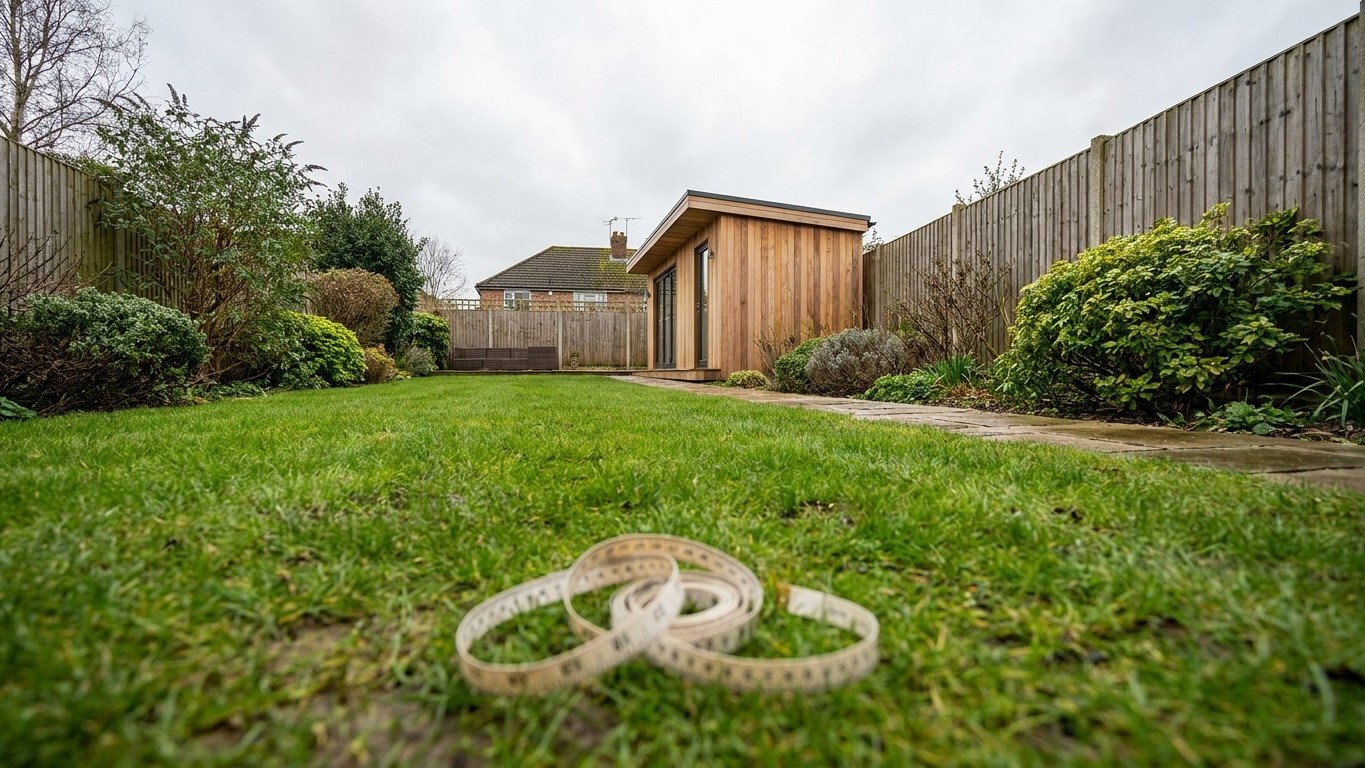
A letter from the council dropping through your letterbox is, frankly, one of the more unwelcome surprises a homeowner can face. The studio was built, the desk was arranged just so, the kettle was in the corner, and then an envelope arrived. For thousands of British homeowners who have built garden offices and studios in recent years, this scenario is far more common than the companies who sell these structures tend to advertise. The culprit is almost always one of a handful of planning rules that look simple on paper but hide real complexity in practice.
Key takeaways
- A seemingly innocent garden studio can breach planning control in ways most homeowners never suspect
- One measurement mistake—your roof pitch exceeding 2.5 metres near a boundary—triggers council enforcement letters
- The rule people genuinely don’t know about could already be in force on your property, lurking in your local council’s files
The Permitted Development trap that catches people out
Most garden rooms do not require a planning application, as they fall within permitted development rules under Class E, a pre-approved form of planning permission, provided the room is built subject to a number of limits and conditions. The trouble is that “provided” is doing an awful lot of work in that sentence. Your project has to play by a very specific set of rules covering its size, height, and where you place it. Most people absorb the broad strokes, rear garden, single storey, no sleeping, and assume they are covered. Many are. But the rules have sharp edges.
The height restriction is the one that trips up the greatest number of builds. If your garden room sits within 2 metres of any boundary, the entire structure, from ground to the highest point of the roof, must not exceed 2.5 metres. This is the rule that catches most people. A standard kitchen ceiling is about 2.4 metres. Squeeze a roof pitch on top of that, and you can creep past the limit without ever realising. The problem is compounded if the studio sits at the bottom of a sloping garden, where the ground level at the back of the building is higher than at the front. Measurements must be taken from the highest natural ground level, not from raised decking, patios, or any artificial ground build-up.
Then there is the 50% rule. The total area of ground covered by all outbuildings, extensions, sheds, and other additions must not exceed 50% of the total land area around the original house, meaning either as built, or as it stood on 1 July 1948, whichever is later. So if you already have a large extension and a shed, a garden room might tip you over the limit. Most homeowners never tot this up before they build.
The rule people genuinely do not know exists
Here is where it gets interesting, and where that council letter most likely originates. Your local council has the power to make what is called an Article 4 Direction, which removes some or all of your permitted development rights. These are most commonly applied within conservation areas, though they can be used anywhere. If an Article 4 Direction is in force on your property and it covers Class E outbuildings, you will need to apply for planning permission for any garden room, regardless of its size or position.
There are roughly 10,000 conservation areas across England, and Article 4 Directions within conservation areas often restrict permitted development further, some councils require planning permission for any outbuilding above a tiny size. The catch? Many homeowners do not realise they live in a conservation area, or know about it vaguely but assume it only affects what they do to the front of the house. Some newer housing estates also have conditions attached to the original planning permission that remove permitted development rights — common where the council felt plots were already built out to capacity. Checking your property’s planning history or title deeds would reveal this. Few people do.
Permitted development rights may not apply if you live in a conservation area, own a listed building, live on a new-build estate, or your area has an Article 4 Direction. There is no automatic notification when you buy a house in such an area. You have to look. The council’s interactive planning map is the place to start, and a five-minute search before building could save a very great deal of trouble afterwards.
What actually happens when the letter arrives
The envelope itself can feel like a verdict, but it usually is not. Where the development causes little or no harm, the council may take no further action. Many unauthorised developments can be resolved by negotiation, often the quickest and most effective method. In the most common cases involving garden studios, the council is not seeking demolition. It wants you to submit a retrospective planning application, which is essentially asking for permission after the fact. If you have received a letter from planning enforcement giving you the option to submit a retrospective planning application, you will need to submit the relevant forms — often either a householder or full application.
It is worth knowing that enforcement notices are legal documents informing the recipient that their building development is in breach of planning control, either where development requiring permission has been carried out without it, or where conditions have not been met. The notice orders actions that must be taken to remedy the breach. That sounds severe, but there is a right of appeal against the notice, and when an appeal is made, the effect of the notice is suspended until the appeal has been determined. You are not without recourse.
It is, however, a criminal offence to ignore an enforcement notice. That is the line you must not cross. If you receive one, take it seriously, respond promptly, and get advice. The garden studio is almost certainly saveable.
The document that costs very little and prevents all of this
There is a straightforward way to avoid the council letter entirely, and it costs considerably less than a planning application. A Lawful Development Certificate (LDC) is a formal document from your local authority confirming that your build is lawful. If you build your garden room under permitted development rules, it is worthwhile applying to your local authority for one. It provides confirmation that your construction is legally compliant, can reassure concerned neighbours, and helps streamline the conveyancing process when you sell your house.
If you have an LDC stating your proposed garden building is permitted development, the council cannot later insist you needed planning permission (as long as you build exactly per the LDC). It effectively “freezes” the lawfulness on the date of application, meaning even if rules change later, your certificate remains valid for what was described. That last point matters more than most people appreciate, since permitted development rules are periodically updated by government.
The council usually takes between 6 and 10 weeks to decide on applications for Lawful Development Certificates. Solicitors representing purchasers will require documentary evidence that your garden room is lawful when you come to sell. It also provides necessary evidence that any works are lawful if, for example, a neighbour were to make a complaint about the work. One more thing worth knowing: while garden offices for personal use typically fall under permitted development, if clients will visit your garden office regularly, this may be considered “non-incidental” to residential use and could require planning permission. Each local authority may interpret this differently, so consultation is advisable for business use. The studio-as-home-office is usually fine. The studio-as-client-meeting-venue is a different matter entirely, and one the council letter writers do occasionally notice.
Sources : rosebrick.co.uk | plansmadeeasy.org