
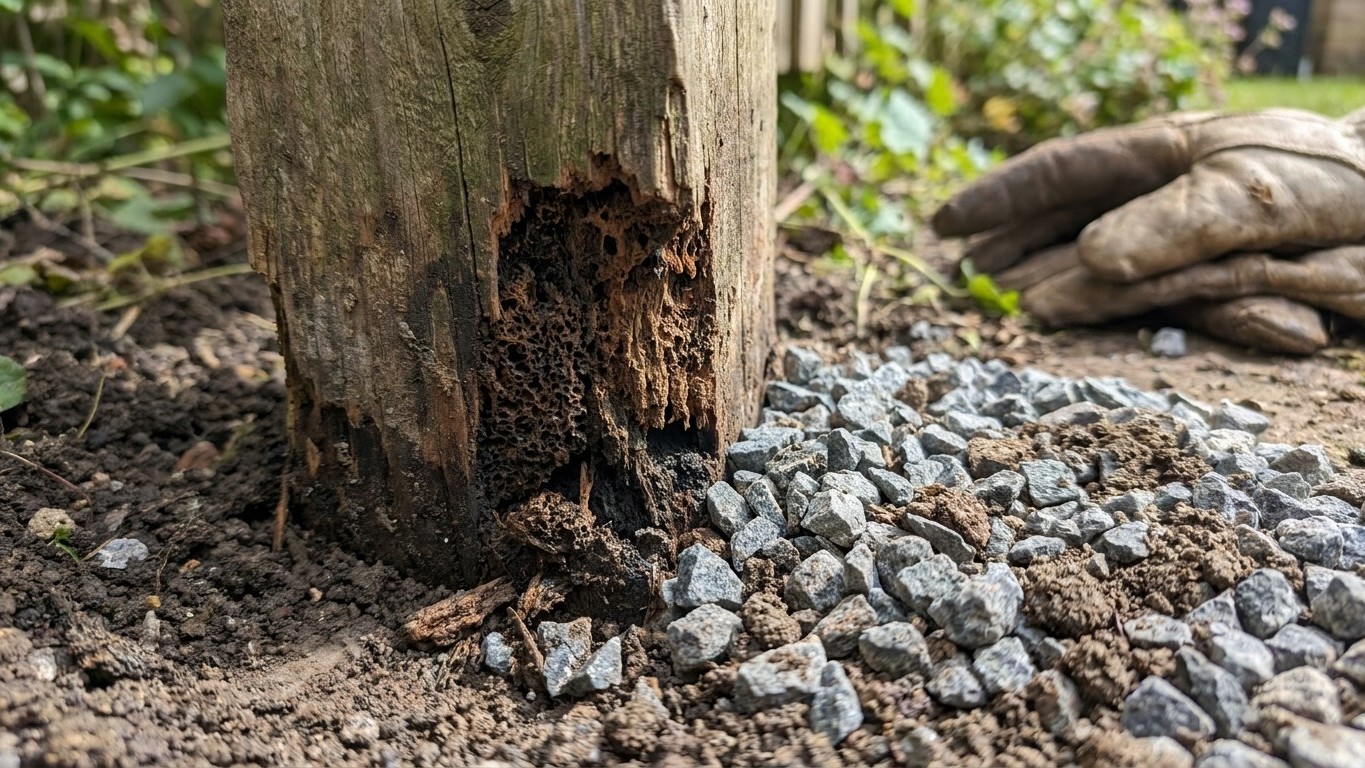
Concrete around a fence post seems like the sensible choice. It feels solid, looks professional, and virtually every DIY guide from the last forty years has recommended it. The trouble is, concrete and timber are quietly working against each other from the moment you fill that hole, and the rot that follows isn’t bad luck, it’s chemistry.
A builder friend of mine (thirty years in the trade, the sort who still uses a spirit level out of habit rather than necessity) watched me sink six posts one summer and said nothing until I’d finished tamping down the last bag. Then he told me I’d just given every one of them a death sentence. Not immediately, mind you. But within two or three seasons, he said, I’d be digging them all out again. He was right on five of the six.
Key takeaways
- Concrete forms a moisture trap that keeps fence post bases permanently damp, accelerating fungal decay
- The rot starts invisibly below the concrete line and only becomes visible when structural damage is already severe
- A compacted gravel alternative outperforms concrete and costs less, while allowing posts to dry out naturally
Why concrete actually speeds up the rot
The problem isn’t the concrete itself, exactly. It’s what concrete does to water. When rain falls on a fence panel, it runs down the post and pools right at ground level. In bare soil, that water disperses fairly quickly in all directions. But concrete forms a collar around the post that holds moisture against the wood in a tight, airless channel. The base of the post sits in a permanently damp microenvironment, and that’s where fungal decay takes hold fastest.
There’s a second issue that most people don’t consider: concrete is slightly alkaline when it cures, and that alkalinity draws moisture toward it over time. The result is that even in a dry summer, the junction between the post and the concrete collar stays wetter than the surrounding soil. Timber treatment helps, but pressure-treated wood certified to UC4 standard (the rating for ground contact in the UK) is designed to resist decay in normal soil conditions, not in the artificially wet conditions that concrete creates.
The rot tends to start just below the concrete surface, which makes it invisible until it’s already structurally serious. You won’t see it from above. The post looks fine, the panel looks fine, and then one February storm knocks the whole thing sideways and you discover the base has gone completely soft.
What actually works better
The alternative my builder friend showed me is almost embarrassingly simple: compacted hardcore, usually crushed stone or angular gravel, packed tightly around the post in layers. No cement, no mixing, no waiting for it to cure. The method is sometimes called a “dry-set” or “gravel-pack” installation, and while it sounds less impressive than concrete, it genuinely Outperforms it for timber posts in residential garden fencing.
The mechanics are straightforward. Angular gravel (not rounded pea shingle, which shifts too easily) locks together under compaction and provides excellent lateral stability. Water drains freely through the voids rather than pooling, so the base of the post stays closer to ambient moisture levels. Crucially, the post can also dry out between wet periods, which is the single most important factor in preventing fungal decay. Wood rots when it stays wet. It lasts for decades when it can cycle between wet and dry.
The installation process is a little more involved than pouring concrete, but not much. Dig your hole to the standard depth (roughly a third of the post length, so about 60cm for a standard 1.8m post), drop in about 10cm of gravel as a drainage layer at the base, position your post, then fill in around it with angular gravel in 10-15cm lifts, tamping each layer firmly with a piece of offcut timber or a purpose-made tamping bar. Check your vertical with a spirit level as you go. By the time you’ve reached ground level, the post is genuinely solid.
Some builders use a hybrid approach for heavier loads: a thin concrete base pad at the very bottom of the hole, with gravel-packed sides. This gives a stable footing without trapping water against the wood. For standard garden fencing, though, the pure gravel method is perfectly adequate.
Choosing the right post in the first place
All of this is somewhat academic if you start with the wrong timber. The posts sold cheaply at some garden centres and DIY sheds are often only treated to UC3 standard, which is meant for above-ground exposed use like cladding or decking rails. For anything going into the ground, you want UC4-rated pressure-treated timber, which has a deeper preservative penetration and is specifically tested for soil contact.
Hardwood posts, particularly oak, larch, and sweet chestnut, have naturally higher tannin and resin content that provides genuine resistance to decay. Green oak fence posts, for instance, are commonly found in hedgerows and rural boundaries in Britain that have stood for generations. They cost more than softwood, but the longevity calculation often favours them over time.
Post caps deserve a mention too. An open-grained post top absorbs rainfall directly into the end grain, which is where water penetrates timber most readily. A simple bevelled cap, either cut at an angle or fitted as a separate plastic or metal cover, sheds water away from the most vulnerable surface. It’s a small thing, but end grain exposure can reduce post life by years in a wet climate like ours.
One last detail worth knowing: the depth of rot that concrete causes tends to concentrate at exactly the point where the concrete meets the air, rather than deeper underground. In truly anaerobic conditions (completely oxygen-free, like deep in waterlogged clay), timber actually preserves remarkably well, which is why ancient wooden piles and medieval bridge timbers survive intact in river mud. The rot happens in that transitional zone where there’s enough moisture to feed fungi but enough oxygen to let them breathe. Concrete, by holding water at precisely that level, creates the worst possible conditions right where the post is most vulnerable.