
A loose screw that won’t tighten is one of those small domestic frustrations that quietly gnaws away at you. You try a larger screw, it holds for a week, then wobbles again. You try yet another, even chunkier one, and the whole sorry cycle repeats. What you don’t realise, until someone who actually works with wood every day shows you otherwise, is that the hole itself is the problem, and no screw on earth can fix a hole that’s lost its grip.
Key takeaways
- Why driving larger screws into the same hole makes things progressively worse
- The physics of wood grip: what happens to fibres when you keep enlarging the hole
- A ten-minute repair method carpenters have relied on for decades
Why bigger screws are almost never the answer
Wood is not a passive material. Drive a screw into it repeatedly, swap it out for a larger one, and the fibres around that hole become progressively more compressed and torn. The wood loses its ability to grip anything at all. A carpenter friend of mine once described it rather vividly as “trying to shake hands through a fraying glove”, the wider your hand gets, the worse the grip becomes.
The physics here are worth understanding, because they explain why so many well-meaning DIY attempts fail. A screw holds by threading itself into intact wood fibres. Those fibres press against the thread from all sides, creating friction and resistance. Once the fibres are crushed or stripped, there’s nothing left to press. A larger screw simply carves through what little remains, buying you perhaps a few weeks before the same problem returns, usually at the most inconvenient moment possible, like when a door hinge gives way mid-winter.
The matchstick method: what it is and how to do it properly
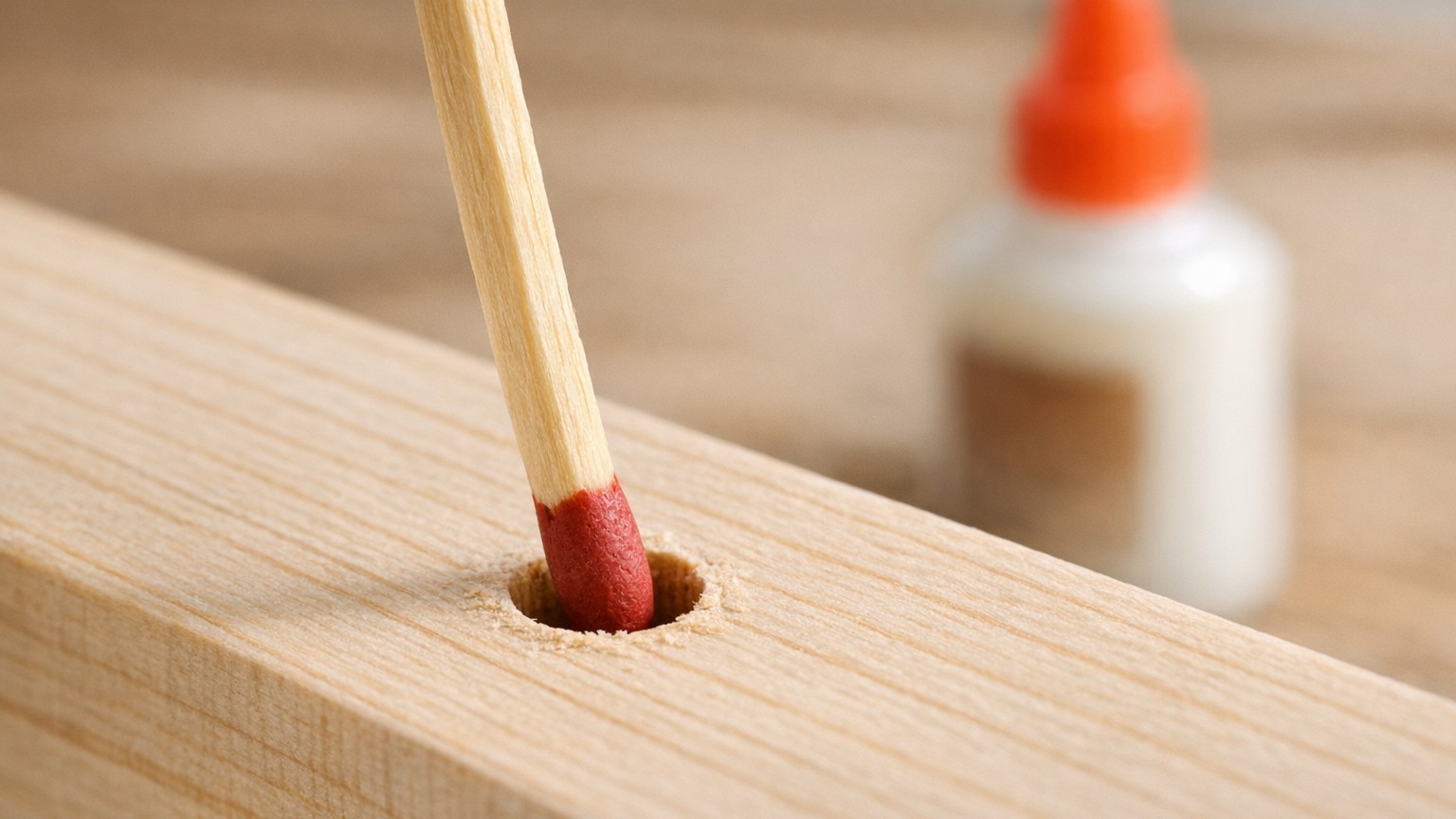
The fix a skilled carpenter will reach for costs virtually nothing and takes about ten minutes. You fill the damaged hole with wooden matchsticks (or wooden toothpicks for smaller holes), pack them tight with a dab of wood glue, snap them off flush with the surface, let it cure, and then drive your original screw back in. The wood fibres in those matchsticks give the screw something real to grip again.
The method works because matchstick wood is soft enough to compress slightly as the screw enters, yet firm enough to hold the thread. It’s not a temporary bodge, done properly, this repair can last decades. I’ve seen door hinges fixed this way that are still solid fifteen years on.
The steps, done carefully, go like this. First, remove the loose screw entirely and clean any dust or debris from the hole. Apply a small amount of wood glue (PVA works perfectly well) to three or four matchsticks, or as many as will fit snugly without forcing. Push them into the hole, wooden end first, the sulphur heads snap off first if that’s easier. Pack them as tightly as you can manage. Snap or score them flush with the surface once the glue has set, usually after an hour or two, though leaving it overnight is better if you can. Then simply drive your original screw back in at a slow, steady pace. You’ll feel it bite almost immediately.
One small but important note: use standard wooden matchsticks, not the extra-long cook’s matches, which can be too thick for smaller screw holes. And always let the glue fully cure before re-driving the screw, rushing this step is the only way the repair can let you down.
When matchsticks aren’t quite enough
For larger holes, or situations where the wood around the hole has splintered significantly, a slightly more robust version of the same principle applies. Wooden toothpicks work brilliantly for fine joinery. For something more substantial, a fence post bracket, a heavy cabinet hinge, some carpenters use thin wooden dowel offcuts instead, glued in and trimmed flush, then pre-drilled carefully before the screw goes back in.
There’s also the question of the surrounding wood. If the timber itself is rotten or the surface has delaminated (common with older MDF or low-quality flat-pack furniture), then no amount of clever filling will provide a lasting fix. In those cases, the honest answer is to reposition the fitting entirely, moving it a few centimetres to find fresh, solid material. It feels like admitting defeat, but it’s actually the more competent choice, and the repair will hold.
A word about those proprietary screw repair kits you sometimes see in hardware shops: some are perfectly decent, using nylon inserts or resin compounds to rebuild the hole. They tend to cost more than a box of matches and aren’t necessarily more effective for standard timber. Save them for situations where wood-based repairs genuinely won’t do, such as fixing screws into crumbling plaster or very soft chipboard.
The wider lesson from a box of matches
There’s a reason experienced carpenters keep matchsticks in their tool bags alongside things that cost considerably more. It’s not sentimentality. It’s that understanding why something fails changes how you approach fixing it. The instinct to reach for a bigger, longer, more powerful version of whatever you’re using is deeply human, but in woodworking, as in quite a few other areas of life, the problem is rarely about size.
Hardwood screws tend to strip holes less quickly than softwood ones, incidentally, because they cut cleaner threads rather than simply forcing their way through. If you’re doing any repair work near windows or exterior doors where screws take regular stress, this is worth bearing in mind when you next visit a hardware shop. The original screw was almost certainly a soft zinc-plated type, swapping it for a hardened steel equivalent, while you have Everything apart, adds very little cost and quite a lot of longevity.