
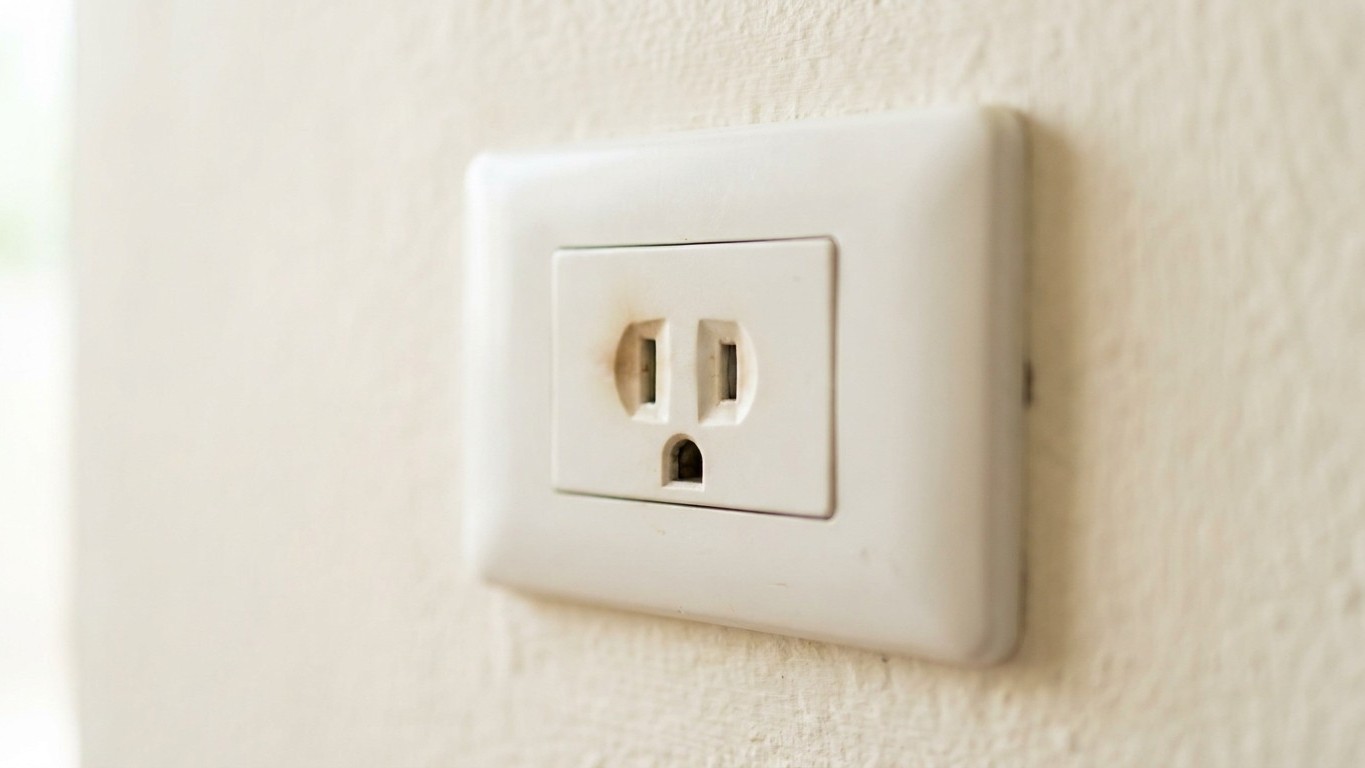
That little twist of the screwdriver on the socket faceplate makes us feel better, but it does absolutely nothing to the fault sparking away behind the plaster. Tightening a cover plate only secures a decorative bit of plastic or metal to the wall. The wiring, the terminals, and the actual point where electricity is jumping a gap sit inches behind that plate, completely untouched by your fiddling.
I understand the instinct. A crackle from a socket is unsettling, and reaching for a screwdriver feels like doing something useful. But the noise you hear is electrical current struggling to flow and intermittently making contact, jumping tiny air gaps causing arcing, where great heat is created as the resistance of the air is broken down. That process is happening at the terminal screws inside the box, or where a wire meets the socket’s metal contacts, not at the plate you can see and touch. No amount of tightening a visible screw reaches those hidden connections.
Key takeaways
- That one-second faceplate tightening myth—and why it persists despite doing zero harm prevention
- How electrical arcing generates thousands of degrees of heat without tripping your breaker
- The five warning signs actually worth calling an electrician for (and why warm sockets matter more than you think)
What’s actually arcing, and why your breaker won’t always save you
Arcing is electricity behaving badly. Rather than flowing smoothly along a copper conductor, it leaps across a gap it shouldn’t be crossing, and that leap generates ferocious heat. An arc fault occurs when electrical current jumps across a damaged or loose connection instead of flowing smoothly through a conductor, creating intense heat, sometimes exceeding several thousand degrees Celsius, without drawing enough current to trip a standard circuit breaker. That last part is the bit that catches people out. We assume a tripped breaker or blown fuse means we’re safe, and that a working breaker means Everything behind the wall is fine. It doesn’t work that way with arc faults.
Loose connections create electrical arcs, and an arc produces high-temperature plasma without drawing enough current to trip standard breakers. Arc faults spark behind walls and differ from short circuits because current flows intermittently, creating repeated ignition points. So the fault can smoulder, cool, spark again, and smoulder some more, all while your consumer unit sits there quite unbothered. I find that rather sobering, honestly. It’s a bit like a chimney fire that never quite catches properly but keeps charring the same spot for months.
The most common culprits behind this kind of arcing are mundane, which is almost worse than if they were exotic. The two most common areas for an arc fault to occur are firstly at cable terminations, where the termination is loose, and secondly within the cable itself where the insulation has been damaged, with causes including rodent damage, cables being crushed, or trapped during building work years earlier. Add to that ordinary ageing: the electro motive force generated by the flow of electricity through conductors will gradually cause connections to loosen over time, even in a socket nobody has ever tampered with.
Why this matters more than we think in British homes
The scale of this problem in the UK isn’t trivial. Electrical faults are behind approximately 14,186 accidental dwelling fires in England each year, over half of all accidental home fires. And faulty electrical equipment and sockets cause around 70 deaths and 350,000 injuries annually in UK homes. Sockets, plugs and wiring aren’t some rare, dramatic cause of house fires, they’re the leading one.
Regulators have clocked this too. Standard circuit breakers and RCDs are brilliant at catching overloads and earth faults, but there’s one type of fault that none of the usual protective measures guard against, which is electrical arcing within a cable or connection, created when current jumps the gap between two conductive materials, and if the current is high enough a continuous electrical arc is generated where the air changes from a gas to a plasma capable of supporting the arc. That’s exactly why Arc Fault Detection Devices, or AFDDs, have started appearing in new consumer units. These devices detect intense heat, sometimes exceeding several thousand degrees Celsius, without the current being high enough to trip a standard circuit breaker, catching precisely the fault that a tightened faceplate screw never could.
The signs that actually deserve your attention
Forget the screwdriver. What you should be watching and listening for is rather different, and thankfully quite easy to remember:
- A socket or switch that feels warm, or a faceplate that has yellowed or bears faint scorch marks around the pin holes
- A persistent crackling, popping or buzzing that comes and goes as you move a plug or as an appliance draws power
- A burning or “hot plastic” smell with no obvious source, especially near a socket bank
- Lights that flicker when an appliance switches on elsewhere in the house
Some 7,000 house fires are caused by faulty electrics, appliances, wiring and overloaded sockets every year in the UK, and hot plugs or sockets, scorch marks, fuses that often blow, or flickering lights are all signs of loose wiring or other electrical problems. None of these are fixed by a screwdriver. If you spot any of them, the sensible move is to stop using that socket, switch off the circuit at the consumer unit if you can identify it safely, and get a registered electrician out. Don’t remove the faceplate yourself to peer inside, and definitely don’t poke at live terminals with a screwdriver hoping to nudge something back into place.
What actually helps, beyond calling someone out
If your home is more than a decade or so old and hasn’t had a proper check, an Electrical Installation Condition Report from a qualified Electrician is money well spent, usually somewhere in the low hundreds of pounds depending on property size, far cheaper than a fire. It tests every circuit, terminal and connection that a visual glance, let alone a faceplate wiggle, could never reveal. For anyone rewiring or fitting a new consumer unit, it’s also worth asking your electrician about AFDD protection, which is becoming increasingly common in updated UK wiring regulations for higher risk rooms such as bedrooms and lounges.
My grandmother always said a house tells you when something’s wrong, you just have to know which noises to trust. A crackling socket is one of those noises. The tightened screw might quiet your nerves for an evening, but the wiring behind it doesn’t care one bit, and it will carry on arcing quietly until someone with the right tools actually opens the circuit and finds the real fault.
Sources : meekselectrical.com | horizonelectricmi.com