
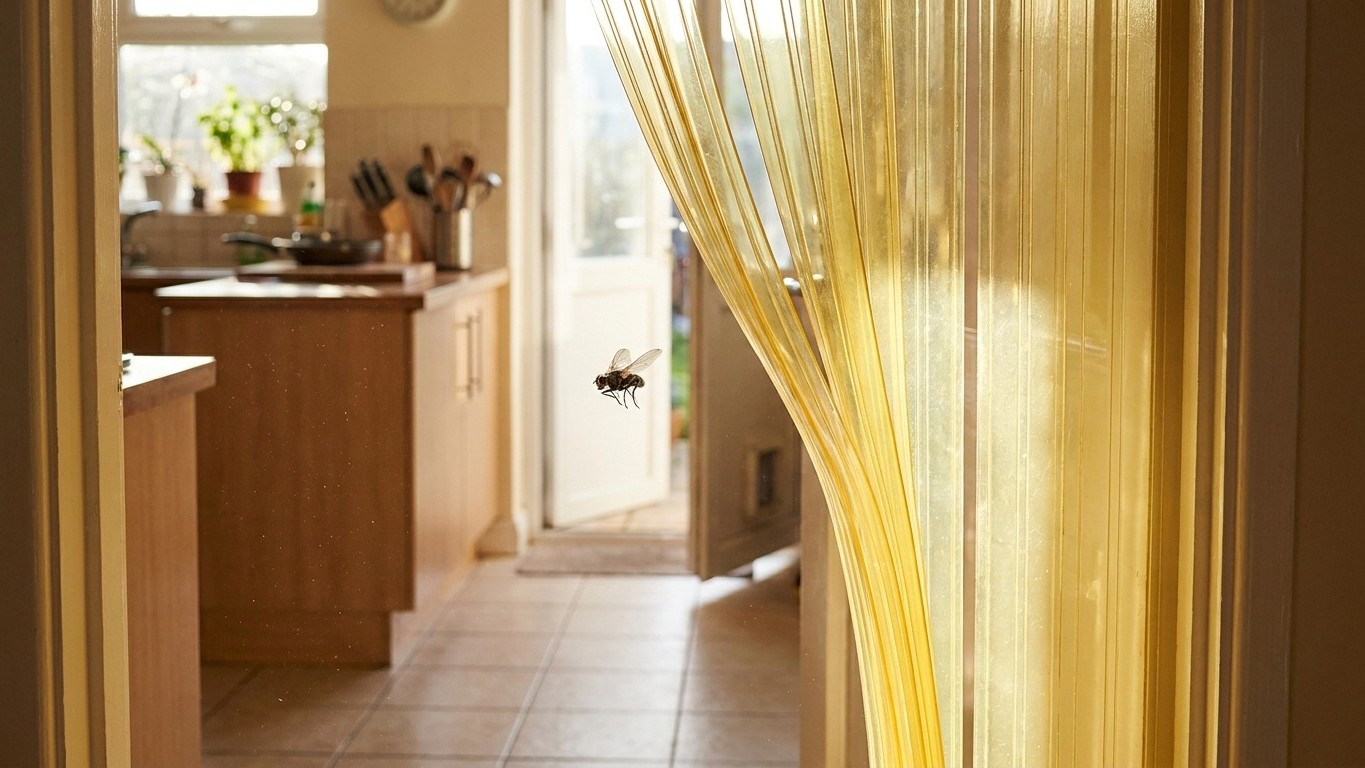
Grandmother wasn’t being eccentric with her rattling curtain of yellow plastic strips. She was applying pest control that Scientists had already tested on dairy cows a decade before I was born, and it turns out cattle farmers and grandmothers were onto exactly the same trick.
Back in 1972, researchers publishing in the Journal of Economic Entomology hung curtains across barn doorways to see what would happen to the flies plaguing dairy herds. The results were unambiguous: walk-through curtains hung in doorways so they presented solid barriers to flying insects greatly reduced the number of house flies entering screened dairy barns while permitting free passage of cattle and people. Cows walked through without a second thought. Flies, on the whole, didn’t follow. That’s the entire principle behind Grandmother’s doorway curtain, just scaled down from a milking parlour to a kitchen door.
Key takeaways
- A 1972 dairy farm study confirmed what grandmothers already knew about plastic strip curtains
- Flies perceive overlapping strips as a solid surface, not an opening—so they simply don’t enter
- The yellowish colour isn’t accidental: it repels insects and blocks their light detection
Why a few strips of plastic actually fool a fly’s brain
Flies aren’t clever, but they are remarkably good at reading their environment through movement and contrast. Hang enough strips close together and something odd happens to how an insect perceives the doorway: it stops looking like an opening and starts looking like a wall. As one description of these curtains puts it, the strands placed very close together mean flies perceive it as a surface rather than an aperture. The fly doesn’t calculate anything, it simply doesn’t register the doorway as somewhere to fly into, so it veers off.
Commercial pest control companies rely on precisely this effect today, decades after Grandmother figured it out with off-cuts from the ironmonger’s. Modern strip curtains work because overlapping PVC strips create both a physical and visual barrier that insects are reluctant to pass through, significantly reducing fly movement without restricting airflow or staff movement. The overlap Matters More Than most people assume. Industry guidance is blunt about it: correct overlap means a better seal, and a curtain with gaps between strips is really just decoration.
There’s a second, sneakier trick Grandmother’s curtain happened to use, and I doubt she knew the biology behind it, though she’d have appreciated it. Her strips were that distinctive yellowish, slightly translucent plastic, not clear. That wasn’t only because clear PVC was pricier back then. Manufacturers now sell insect-specific strips in that exact colour because the material is translucent yellow, a colour known to repel flies and insects, and because yellow colour inhibits an insect’s ability to detect light behind the curtain. A fly navigating largely by contrast and brightness struggles to see daylight through a yellow-tinted barrier the way it can through a clear one. Whether Grandmother chose that colour deliberately or simply because it was what the shop had in, I can’t say. I suspect a bit of both, knowing her.
Fitting one properly, without overspending
If you fancy trying this yourself this summer, the measurements matter more than the material cost, which is refreshingly low either way. Strips typically come in widths from around 75mm for a modest back door up to much wider for barn-sized openings, and thickness ranging from a flexible 1.5mm for light domestic use to heavier grades for constant traffic. For an ordinary kitchen or garden door, a slim, lightweight strip is plenty, no need to buy the freezer-grade material sold for industrial cold stores. The strips should overlap by a good third of their width, hung so each one covers the join between its neighbours, because wall mounting gets the hardware out of the doorway and allows the strips to overlap the door jambs for maximum seal and air lock. Measure your doorway generously, add a touch of extra width so the outer strips can wrap onto the frame rather than stopping dead at the edges, and trim with a sharp utility knife against a straight edge rather than scissors, which tend to leave a ragged cut that catches on itself.
Don’t expect miracles against every airborne visitor, mind. Anyone who’s watched a wasp determinedly nose its way between two strips knows these curtains aren’t infallible, and lighter insects can sometimes find a gap a heavier fly wouldn’t risk. But for the ordinary house fly and bluebottle, which make up the bulk of summer’s uninvited guests, a well-hung curtain does a genuinely useful job while leaving the door open for the breeze, the cat, and anyone carrying a tray of sandwiches through with both hands full.
The bit Grandmother never mentioned: it saves you money too
What she probably didn’t clock, because nobody talked about energy bills quite the way we do now, is that the same curtain doing fly duty in July does double duty come winter. A hung curtain across a doorway lowers heating and cooling costs by allowing easy pedestrian access while restricting air fluctuations and draughts. That back door left ajar all August for ventilation is also the back door letting your central heating escape every time you nip out in October, unless there’s something hanging across it moderating the airflow both ways.
For those wanting a slightly more refined look than trade-style PVC strips, magnetic mesh curtains have become popular in recent years, using strips of fine netting joined with magnetic seams that snap shut behind whoever’s just walked through. They’re worth a look if you want something less industrial-looking for a front door, though a length of good yellow-tinted strip curtain across the utility room or kitchen door remains the cheaper, harder-wearing option, and frankly the one with the better pedigree. After all, it’s been keeping flies out of dairy barns since before colour television was common in British sitting rooms, and there’s something rather satisfying about a fix that’s been quietly proven for over fifty years while everyone else was reaching for the fly spray.
Sources : academic.oup.com | plasticstripcurtain.com