
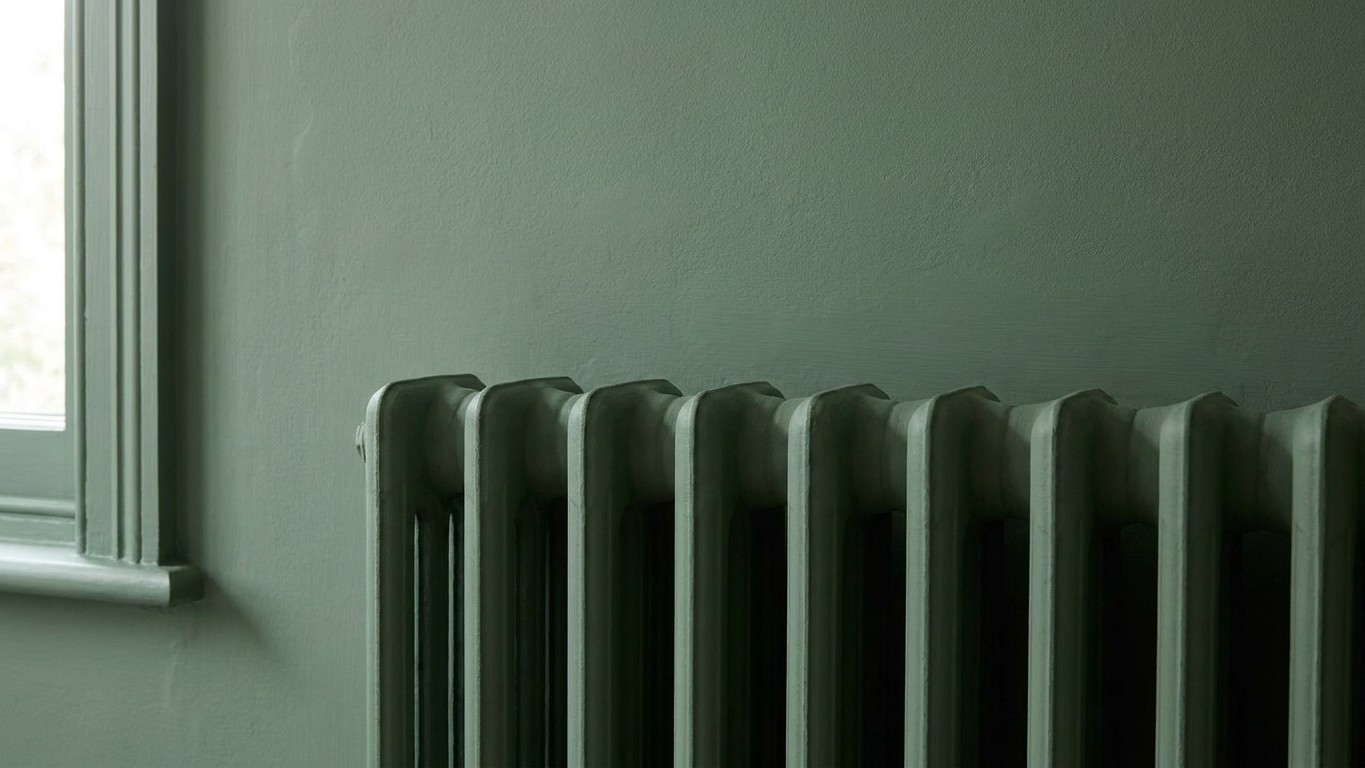
That old rule about slapping on a fresh coat of brilliant white whenever your radiator looks tired? It’s quietly doing your walls a disservice. The real decision that determines whether a room feels tall and airy, or oddly chopped in two, is whether you match that radiator to your wall colour or leave it standing out in stark white contrast. Get this one choice right and your paintwork works with the architecture of the room, not against it.
Key takeaways
- A white radiator under a coloured wall creates a visual line that makes rooms feel shorter and more cramped
- Matching your radiator paint to your walls can make ceilings feel higher and spaces feel more generous
- The right paint and technique matter more than you’d think—and it’s not always about white or matching
Why a white radiator cuts your wall in half
Think about what happens visually when you paint a wall a lovely deep sage or dusky blue, then leave the radiator beneath it gleaming white. You’ve created a hard, pale rectangle sitting halfway up the wall, and the eye reads that as a break, a line where the colour simply stops. It’s the same effect as putting a white skirting board against dark walls without a picture rail to soften the transition: the room ends up looking shorter and more broken up than it actually is.
Paint and radiator specialists have been talking about this for a while now, and the advice is consistent. Painting your radiators to match the walls preserves a room’s harmony and flow, especially now that wall and radiator paint ranges are often available in the same colour libraries. The blending trick isn’t just a fad either, it’s rooted in basic optical logic: painting radiators to match the wall colour can blend them into the background and create a more cohesive and polished look in a room, giving the illusion of space. Take away the visual full stop halfway up the wall, and your eye simply travels upward, uninterrupted, which makes the ceiling feel higher and the whole room feel more generous than it is.
It works especially well the darker your walls go. This technique works exceptionally well with darker colours like navy or charcoal, as the harsh outline of a fixture becomes harder to spot. I’ve seen this in older terraced houses with box-shaped cast iron radiators under the window; against a pale wall the white radiator looks perfectly normal, but the moment the owner goes for a moody teal or charcoal wall and keeps the radiator white, that poor radiator suddenly looks like it’s wearing the wrong coat. Match it to the wall, though, and it practically disappears.
When white (or bold colour) still wins
Now, matching isn’t the only sensible option, and I wouldn’t want you thinking your radiator has to vanish into the wallpaper. There’s a whole opposite school of thought that says make a feature of it. Painting your radiator a bold, vibrant colour that contrasts a light or neutral backdrop is great for transforming an otherwise faceless feature into a striking accent. If you’ve got a plain magnolia hallway that needs a bit of personality without a full redecoration, a deep burnt orange or forest green radiator can do the job of an art piece, cheaply.
The trick with going bold is coordination rather than randomness. Choosing two colours that complement each other, like blue and orange or purple and yellow, creates a bold and dynamic contrast that’s pleasing to the eye, rather than one that simply looks like a mistake. And if your walls are already neutral, pairing that with a splash of colour on the radiator gives you a low-commitment way to test a shade before you paint an entire room in it. Should you tire of burnt orange, repainting one radiator is an afternoon’s job, not a weekend lost to rollers and dust sheets.
Getting the paint job right without ruining your radiator
Here’s where the budget-conscious grandmother in me insists on a word of caution: not every tin of paint in your cupboard is fit for the job. Radiators heat up and cool down constantly, and that stress will crack, bubble or yellow an unsuitable finish within a season. The paint needs to adhere properly to metal radiator surfaces while withstanding temperatures that may exceed 200 degrees Fahrenheit over years of use, and it should not crack, peel, or discolour from the constant heating and cooling.
The good news for anyone wanting a seamless colour match is that you don’t necessarily need to hunt down a separate radiator-specific tin in the exact shade. Most premium quality interior paint will withstand a temperature up to 180°F, so you can use the same paint that you used on the walls or trim, which is precisely how so many people achieve that flawless blend-into-the-wall effect. A good quality satin or eggshell finish tends to cope best, being neither as prone to yellowing as high gloss nor as easily marked as flat matt. Dedicated radiator paints exist too, and some are genuinely excellent for older cast iron models that see heavier use, with proper heat-resistant formulas rated to withstand temperatures around 60°C without discolouring.
Whichever route you choose, the preparation matters more than the paint itself. Turn the heating off and let the radiator go completely cold before you start; painting while it’s even slightly warm causes the paint to set unevenly and leaves drip marks you’ll be looking at for years. Give it a proper wipe down to remove dust and any greasy residue, apply thin, even coats rather than one thick layer, and allow a full 24 hours drying time before the heating goes back on. Rush that last step and you risk a tacky finish that picks up fingerprints every time someone brushes past.
My own view, for what it’s worth, is that most terraced and Victorian houses with high ceilings can get away with either approach happily, but newer builds with lower ceiling heights genuinely benefit from the blending trick. If your lounge already feels a touch boxy, that white radiator sitting under a coloured wall is doing you no favours at all, and an hour with a paintbrush costs rather less than moving house for more headroom.
Sources : tiktok.com | tiktok.com