
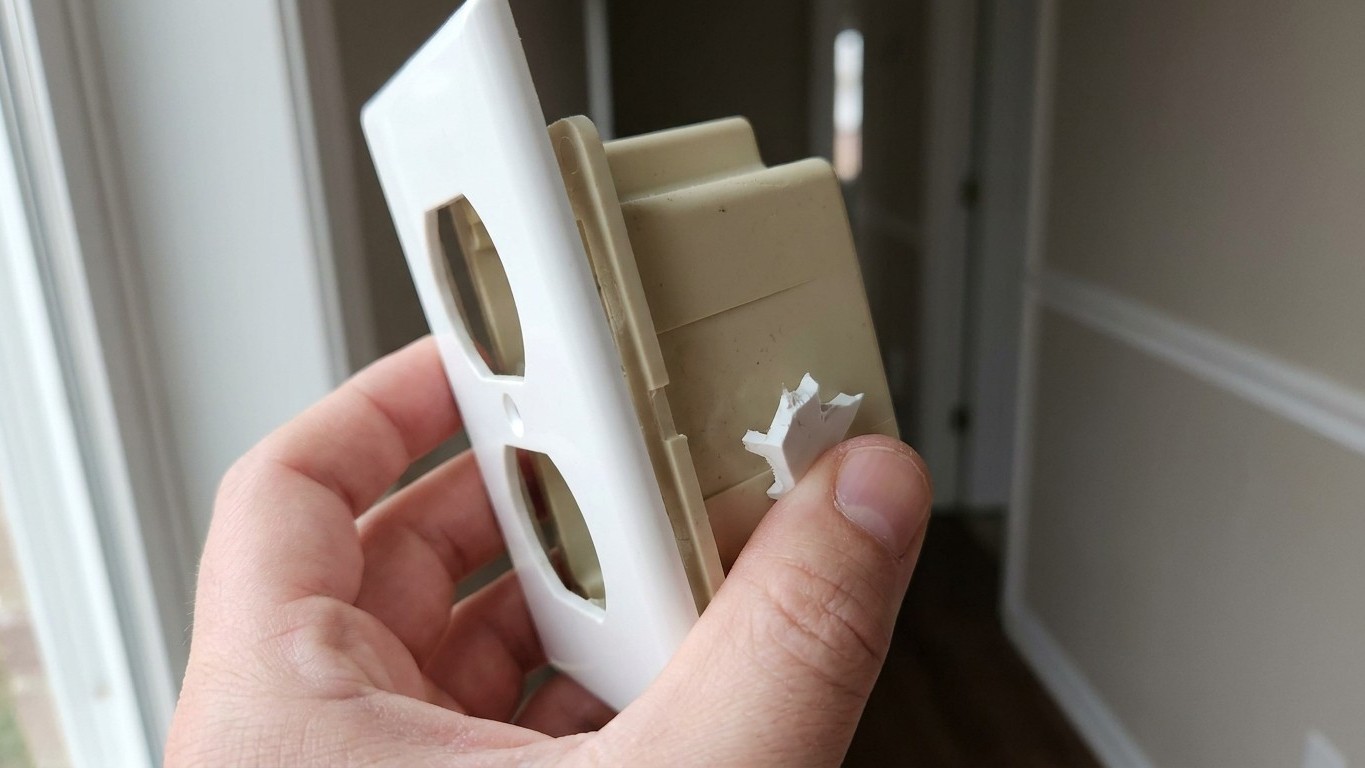
A socket that rocks and wiggles every time you push a plug in usually means one thing: something behind that faceplate has given up the ghost. Take the cover off, as I did in my own hallway last month, and you’ll likely find one of those little plastic “lugs” (the small tabs that the mounting screws bite into) has sheared clean off. It’s a small piece of plastic, but its failure explains why the whole socket has been jiggling about like a loose tooth.
Before you touch anything else, switch off the power at your consumer unit. Not just the socket, the whole circuit, because you cannot always be sure which switch does what. If you are not sure which switch turns the sockets off then it is best to turn off all the switches, as not all consumer units are labelled correctly. My late husband used to say electricity doesn’t care how experienced you feel, and he was right.
Key takeaways
- That tiny plastic lug holding your socket in place has a weakness nobody talks about
- Years of yanking plugs out at odd angles puts hidden stress on components you can’t see
- What looks like a simple fix could actually hide a serious electrical hazard lurking behind your walls
Why that little plastic lug snaps in the first place
Sockets fitted into plasterboard walls rely on a plastic back box with adjustable lugs behind the board. These boxes are made of plastic and have special mounting lugs to hold them in position. When you screw the faceplate down, the boxes are held securely in place when the face plate retaining screws are tightened, done after the socket has been connected up, and the action of tightening sandwiches the plasterboard between the lugs and the rim of the box. That’s a clever bit of engineering when it’s done properly, but it has a weakness: those lugs are plastic, and plastic fatigues.
Years of plugs being yanked out at an angle, or a previous handyman overtightening the screws, puts repeated strain on that little tab until it cracks. I’ve seen it in homes barely five years old, not just in Victorian terraces with crumbling plaster.
There are other culprits behind a wobbly socket too, and it’s worth knowing the difference because the fix varies. Screws can become damaged and not hold the socket anymore, the receiving lugs can become damaged and not accept the screws anymore, the back box or surface mounted box can become loose, the socket itself can get cracked or damaged, or the wall plaster can fail to hold the box, causing the whole assembly to come loose. In older solid-wall houses you might instead have a metal box set into the masonry, where the problem is more often crumbling plaster around the fixing than a snapped lug. Either way, the socket moving about isn’t just annoying. Loose connections in outlets can cause electrical arcing, the jumping of electricity between gaps, and the extreme heat produced can burn nearby objects like insulation or wood. That’s not scaremongering, that’s just physics, and it’s precisely why nan’s old advice to “just tighten the screw and leave it” doesn’t quite cut it anymore.
What you can safely do yourself
If it really is a snapped lug and the back box itself is sound, there are a few sensible options before you resort to ripping plaster out. Electricians and keen DIYers on forums such as DIYnot regularly suggest three approaches for a stubborn broken lug:
- Squeezing the remaining lug gently with pliers around the screw to tighten its grip, since you can normally squeeze the lug with pliers to shrink the hole or bend it to reduce the size, then rethread with a new screw so it holds.
- Drilling and tapping a fresh hole where the lug used to be, as if it’s the fixed lug that’s gone, you can drill and tap a 3.5mm hole and either use long screws or screw an extension post into it.
- Simply swapping the broken lug for a spare one, because it can be worth trying to lift the bits which hold the lug in place and replace it with one from another box.
None of these need a qualified electrician’s toolbox, just patience, a small drill bit, and the power off at the mains. What you should never do is push a wood screw straight into softened plaster and hope for the best, a bodge that one contributor on the DIYnot forums admitted to fixing “a couple of times” after previous owners tried exactly that shortcut.
When the wall itself is the real problem
Sometimes the lug is fine but the plasterboard around it has simply crumbled to dust, especially if the box was never fitted with proper support behind it. This is more of a structural issue than an electrical one, and it needs a different sort of patience. Fitting what’s called a dry-lining or “fast-fix” box, designed specifically to grip crumbling plasterboard from behind, is usually the tidiest permanent fix. Grab adhesive behind a surface box can also work well, spreading the load evenly across the board rather than relying on a few screw points, though it does make any future replacement considerably messier, since with a good grab adhesive behind the box it’s almost impossible to replace it without serious damage to the plasterboard. I’d rather deal with a slightly awkward repair now than a demolition job in five years.
Do bear in mind that if your repair involves rewiring the socket itself, rather than just re-securing the box, you’re straying into territory covered by Part P of the Building Regulations and BS 7671 wiring rules, and the UK’s IET Wiring Regulations establish standards for electrical installations and maintenance that guarantee efficiency and safety. A straightforward mechanical fix (tightening a screw, replacing a lug, swapping a cracked faceplate) is well within most confident homeowners’ abilities. But if you’re touching the actual wiring behind the socket, or you’re at all unsure what you’re looking at, that’s the moment to ring a qualified electrician rather than carry on regardless. It’s cheaper to pay for twenty minutes of someone’s expertise than to explain to your insurer why the hall carpet caught fire.
One thing that genuinely surprised me when I looked into this: those cheap, bargain-bin plug tops sold with some imported gadgets are partly to blame for accelerating this wear. Some manufacturers produce very cheap inferior plug tops where the plastic earth pin commonly snaps off, and the pin often remains lodged in the socket, which is both inconvenient and a danger. A broken pin left rattling around inside the shutter mechanism puts extra strain on the whole socket every time you try to use it, quietly hastening the very failure I found behind my own wobbly faceplate. Worth checking your plug tops as closely as your sockets, really.
Sources : quora.com | diynot.com