
For years, pallet furniture was the pride of the thrifty and the creative in equal measure. Coffee tables, bed frames, garden sofas, planter boxes, if it could be built from reclaimed wood, someone somewhere was doing it with pallets. Then a friend glanced at the stamp on one of those planks and pointed out two letters: MB. Two tiny letters. The furniture came apart that same evening.
The story is not unusual. Thousands of people across the UK have built beautiful pieces from pallet wood without ever stopping to examine what those stamped codes actually mean. The good news is that the system is logical once you know it. The not-so-good news is that getting it wrong has real consequences.
Key takeaways
- A simple stamp on pallet wood reveals whether it’s safe or toxic—but most people never look
- MB-treated pallets contain methyl bromide, a neurotoxic chemical banned in Europe since 2005 that still circulates
- Thousands of people are currently living with furniture made from chemically treated wood without realizing it
The stamp that tells the whole story
International Standards for Phytosanitary Measures No. 15 (ISPM 15) is an international regulation developed by the International Plant Protection Convention (IPPC) that directly addresses the treatment of wood materials used to ship products between countries, with the main purpose of preventing the international transport and spread of disease and insects that could harm plants or ecosystems. In plain English: every pallet that crosses a border must be treated to kill off any creepy-crawlies hiding in the grain, and it must carry a stamp proving that treatment was done.
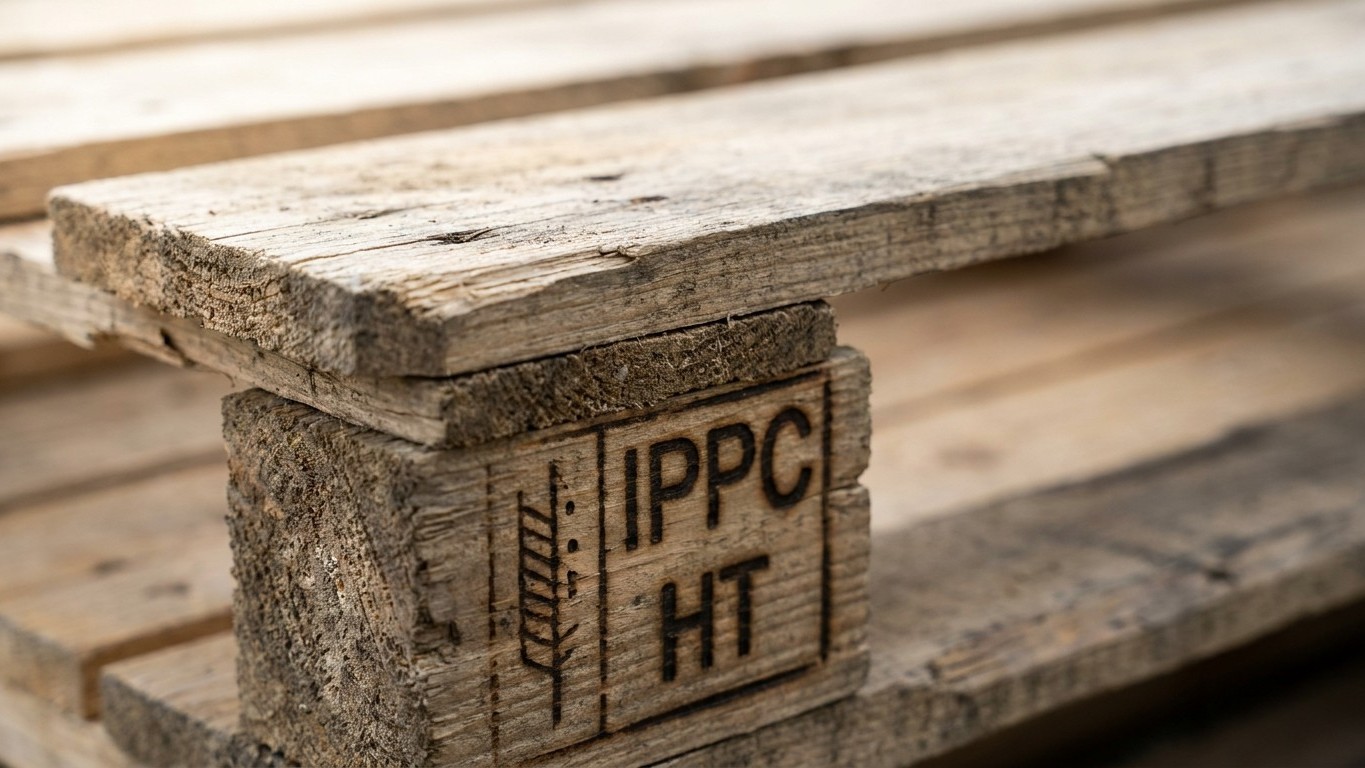
If a pallet is going to travel outside the UK it must bear an IPPC stamp showing a few key details. That stamp contains, among other things, a two-letter treatment code. Perhaps the most vital part of the ISPM 15 stamp is the treatment code, a two-letter abbreviation that specifies the phytosanitary treatment method used. There are two codes you must know before you touch a pallet with a saw: HT and MB.
“HT” means the pallet was heat-treated, heated to a minimum core temperature of 56°C for at least 30 minutes, a Chemical-Free process that eradicates pests and is widely accepted internationally. No chemicals, no residue, perfectly safe for building furniture your family will sit on, sleep near, or rest their cups of tea upon. Heat-treated pallets are generally safe for indoor projects, including retail display, furniture construction, and other DIY projects.
Now for the one to avoid. “MB” stands for methyl bromide, a chemical used to fumigate pallets that can be hazardous if inhaled or ingested. Methyl bromide is a highly toxic colourless gas that used to be widely used as a fumigant and pesticide for timber, soil and agriculture. The reason you may still encounter MB-stamped pallets despite the bans is straightforward: although methyl bromide fumigation was banned in Europe in 2005, there are still some regions that use it to tackle pests that can’t be eliminated by heat treatments, and there are still some MB-stamped pallets in circulation from before the ban.
What methyl bromide actually does to a person
This is where the story stops being about furniture and starts being about health. Studies in humans indicate that the lung may be severely injured by the acute (short-term) inhalation of methyl bromide, and both acute and chronic long-term inhalation can lead to neurological effects in humans. It is neurotoxic and negatively affects the respiratory system, eyes, and nervous system.
The particular concern with MB-treated furniture is not just accidental inhalation during sanding or cutting, alarming as that is. Fumigation residues can linger deep within the wood. A coffee table made from MB pallets sits in your living room, potentially off-gassing over months and years. A bed headboard made from the same wood is even closer to where you breathe for eight hours a night. Coating them would have to be perfectly sealed in several layers with no gaps or air bubbles, and there are no studies that verify encapsulating an MB pallet would guarantee safety and eliminate outgassing of toxins. So sealing it and hoping for the best is not, unfortunately, the answer.
MB-marked pallets should never be used for indoor heating, such as by burning, as methyl bromide releases toxic fumes that can be hazardous to both human and animal health. That means they should not end up in the log burner either. If you have them, your local council’s waste management team can usually advise on proper disposal of chemically treated wood.
Reading the stamp: a practical guide
Locating the stamp on a pallet takes about thirty seconds. Look on the side rail, the long outer board, and you will usually find a burned or inked mark. The IPPC logo should always be present; the IPPC exists to prevent and control the spread or introduction of pests of plants and plant products around the world. Near that logo you will see a country code (GB for Great Britain, CN for China, and so on), a supplier number, and then the treatment letters.
The codes worth knowing, beyond HT and MB, are:
- KD — Kiln Dried, a type of heat treatment to minimise moisture content in the wood. Safe to use.
- DB — Debarking removes the bark using a cutting tool or planer, and the pallet wood remains untreated. This is done to allow for a more thorough treatment of wood before being approved for transport. Pallets marked with DB only are chemical-free and safe to use.
- EPAL — Euro pallets marked EPAL are not chemically treated; they undergo heat treatment, aligning with European regulations that prioritise safety and environmental considerations. These are among the safest pallets to work with.
If a pallet is missing the IPPC mark entirely, it is best to avoid using it for projects, especially those that involve food or human contact. Sometimes a wood pallet will simply have no stamps at all; if there are no markings or codes, it is considered a national pallet and has not been treated, used exclusively for domestic transport. These are generally lower-risk, but without a stamp you simply cannot be certain, and certainty is rather the point.
Starting again, the right way
If you have existing pallet furniture at home and you are now squinting at the wood wondering what stamps it carries, do not panic. Find the marks, check the letters. HT heat-treated pallets, which have been treated without chemicals, are safe for most applications including gardening or furniture projects. The code “MB” indicates chemical treatment, while “HT” or “KD” means the pallet is safe.
For anyone starting a new project, the simplest approach is to source pallets directly. Builders’ merchants, garden centres, supermarket loading bays, and electrical retailers are all worthwhile places to ask. Pallets that are unmarked, heavily soiled, painted with unknown substances, or have a strong chemical odour are not suitable for furniture making. Ideally, a pallet should be clean, dry, unpainted, and marked “HT.” A greenish or glossy surface may indicate chemical treatment, and a strong chemical smell is also a red flag.
One last thing worth knowing: you will sometimes see “MB” paired with other treatment codes, such as “DB-MB” meaning debarked and treated with methyl bromide, or “KD-MB” for kiln-dried and treated with methyl bromide. The presence of MB anywhere in that string, whatever company it keeps, means the same thing, set it aside. Two letters really do carry that much weight.
Sources : quicargo.com | rnmark.com