
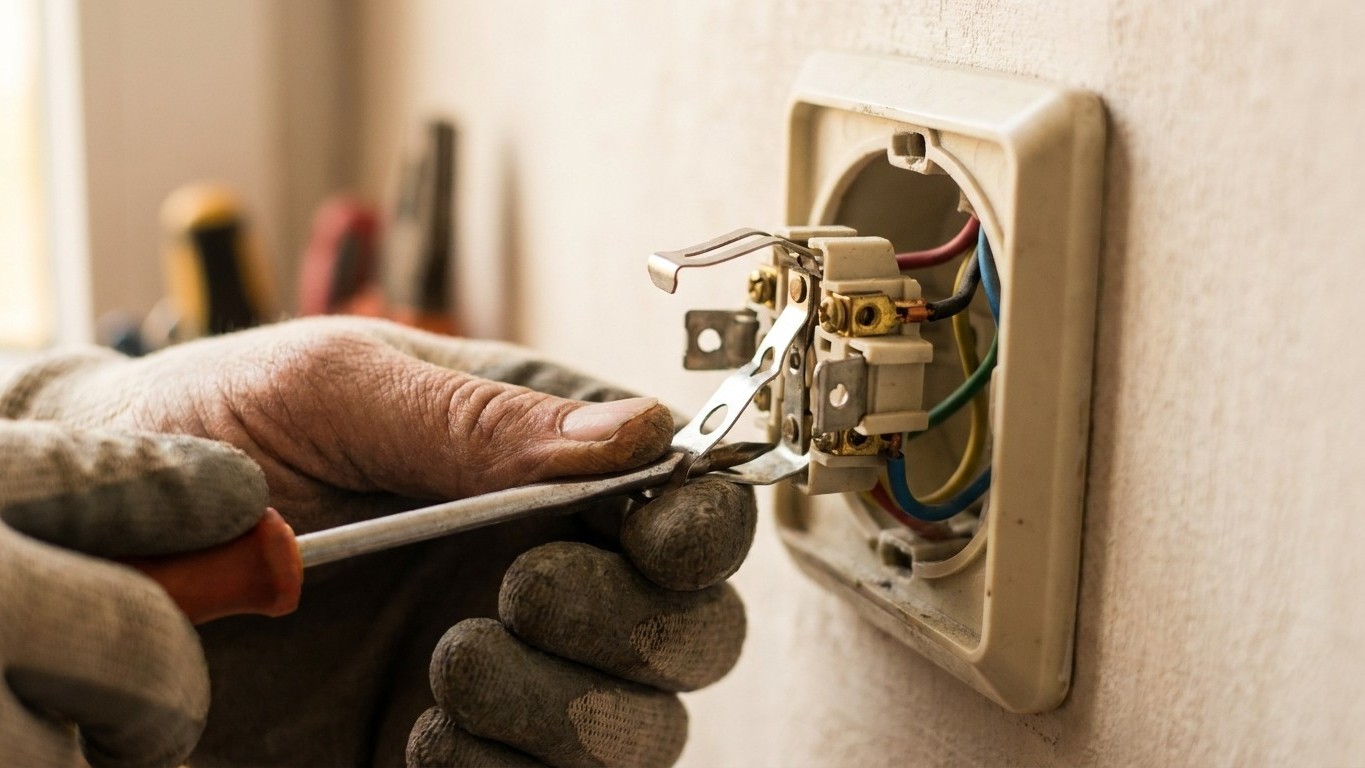
A wobbly mains socket is one of those household irritations that starts out minor and slowly nags at you until you decide to fix it yourself. The first instinct is always the same: unscrew the faceplate, tighten whatever looks loose, and shove it back into the wall. Perfectly reasonable. The problem is that what most of us don’t realise, and what most of us have to be told by a professional, is that there is often a tiny spring-loaded metal tab hidden on the back of the socket that we have been crushing, weakening, or simply ignoring every single time we’ve gone in there. That tab is the heart of the wiring method the Electrician originally used, and it is far more significant than it looks.
Key takeaways
- A tiny spring-loaded metal tab hidden behind your socket has been gradually weakening every time you’ve tried to fix it yourself
- This ‘backstab’ wiring method was installed in millions of homes to save time during construction, but it’s far less reliable than proper terminal connections
- The warning signs are subtle—warm faceplates, flickering lights, and buzzing sounds—but the failure mode can lead to electrical fires
The hidden shortcut that wired millions of homes
Pull any socket off the wall in a house built between the 1970s and early 2000s, and there is a decent chance you will find wires pushed straight into small holes on the back of the unit rather than wrapped around the screw terminals on the side. This approach, known informally as “backstabbing,” is a shortcut for securing wires to a receptacle: instead of wrapping the conductor under the terminal screws, the stripped wire is pushed into a small spring-clamp style hole in the back of the device. The internal spring is the only thing applying pressure to maintain contact.
This spring-loaded design became popular in the 1970s and 1980s for saving time on large construction projects. It saves two to three minutes per device installation. Multiply that by every socket and light switch in an entire housing estate, and the maths become attractive very quickly. The result is that millions of homes across the country have wiring connections that rely entirely on a small metal spring to remain secure, a spring that was never designed for a lifetime of use.
Backstabbing involves pushing a wire into a small hole in the back of the outlet and relying on a metal spring clip to hold it in place, whereas the superior “back-wire clamp” technique involves pushing a wire into a hole and then screwing a metal clamp over the wire to tighten its position. The two look almost identical from the outside, which is precisely why so many homeowners, and some electricians, conflate them.
Why tightening the faceplate screws doesn’t actually fix anything
Here is the thing most of us do when a socket feels loose: we tighten the two screws that hold the faceplate to the back box. Sometimes that does help, and the socket stops wobbling. But if the real problem is a failing backstab connection inside the unit, those faceplate screws are completely irrelevant. Over time, thermal cycling, vibration, and the mechanical stress of plugging and unplugging devices can loosen a backstabbed connection.
The backstab method is dependent on a small, spring-loaded contact point for both mechanical and electrical connection. This thin spring clip provides very little surface area for current transfer. Over time, the constant flow of electricity generates heat, causing the wire and the metal spring clip to undergo thermal expansion and contraction. Each time that cycle repeats, every time you boil the kettle or plug in a charger, the connection degrades a little further. And if you then pry the socket out from the wall and go prodding around with a screwdriver, you can accidentally compress or deform that spring tab still further, making the situation worse without ever realising it.
The small physical gap created by a loose connection can allow electricity to jump across it, a phenomenon known as arcing. Arcing generates intense, localised heat and sparks that can reach temperatures high enough to ignite nearby flammable materials, such as wood framing or insulation. This process is a leading cause of electrical fires originating within the walls of a home. That is not scaremongering; it is the mundane physics of a failed joint. One family had just sat down to dinner when the outlet behind their wall table started to smoke and spark, and the breaker for that area had tripped when an electrician arrived to investigate a failed backstab connection.
Recognising the warning signs before things get serious
A backstab connection rarely fails dramatically all at once. It usually gives you plenty of warning first, if you know what to look for. Warning signs include a warm outlet faceplate (a loose connection between the wire and the metal spring clip creates electrical resistance, which generates heat), flickering lights (voltage fluctuations caused by an unstable connection), intermittent power (the copper spring clip vibrates and thermally expands or contracts, causing it to lose and regain contact with the wire), a buzzing sound from the outlet (electricity may arc across the gap), and a burning smell or discolouration turning the faceplate slightly yellow or brownish.
In older homes, loose plug socket outlets are more common, and terminal screws can work loose at the back of plug sockets resulting in loose wires. Loose outlets can be dangerous as there is the risk that live parts are exposed or the outlet may come away from the wall when a plug is inserted or removed. A single loose connection can also affect multiple outlets downstream on the same circuit, so a problem in the sitting room can manifest as dead sockets in the hallway, leaving you baffled.
One measure worth knowing: contact resistance measured for outlet screw terminals was four times lower than for backstab connections, and backstabs have almost no mating surface area, a quantity that depends on both pressure and the physical contact area between conductor and terminal. Lower resistance means less heat generated during normal use. That difference is not academic.
The right fix, and what it actually involves
The safest long-term fix is removing backstab connections and re-terminating wires under screw terminals or using approved lever connectors. This creates a solid mechanical connection that resists vibration and heat cycling. Before touching anything, turn off the circuit at the consumer unit and confirm the power is off using a socket tester or a non-contact voltage tester. Never rely solely on switching the socket off at the wall, the wiring is still live behind the faceplate.
Screw terminal wiring requires stripping the wire and forming its end into a small, clockwise “J-hook” shape, which is then placed under a screw on the side of the receptacle and tightly secured. The screw-and-plate design physically compresses the wire against a metal terminal, creating a large contact surface area and a mechanically robust connection that is reliable over the lifespan of the device. When you do wrap that wire, always go clockwise so that tightening the screw pulls the loop closed rather than pushing it open.
Even when wire comes out of a backstab connection easily, the wire end is often nicked badly and really needs to be cut off at the nick and the wire re-stripped. This is worth bearing in mind: do not assume the wire is in good condition simply because it looks intact. A small nick on copper is enough to create a hot spot.
When the wiring job is done, there is a broader consideration. If you find one backstabbed socket in your home, there is a good chance that there are more. Having your electrical outlets and wiring system checked every ten years or so by an electrician, with a condition report obtained, remains the best form of home electrical maintenance. Any electrical work involving rewiring or replacing sockets in the UK should comply with Part P of the Building Regulations, which for most fixed wiring work means either notifying your local building control authority or using a registered electrician who can self-certify. When in doubt, call a professional, the cost of a visit is negligible compared to the cost of a house fire.
One small detail that does not get mentioned often enough: the flat spring in a backstab connection only makes contact with the wire at the edge and allows the wire to rotate and wiggle. That movement builds up over time as plugs are inserted and removed from the socket, weakening the connection until it eventually comes loose. Loose connections can cause arcing, excessive heating, and power interruption to the socket. Each time you plug in your hoover or your phone charger, you are, imperceptibly, incrementally, contributing to that loosening process. It is a slow drama, but it has been playing out behind the walls of British homes for the better part of fifty years.
Sources : inspectapedia.com | diychatroom.com