
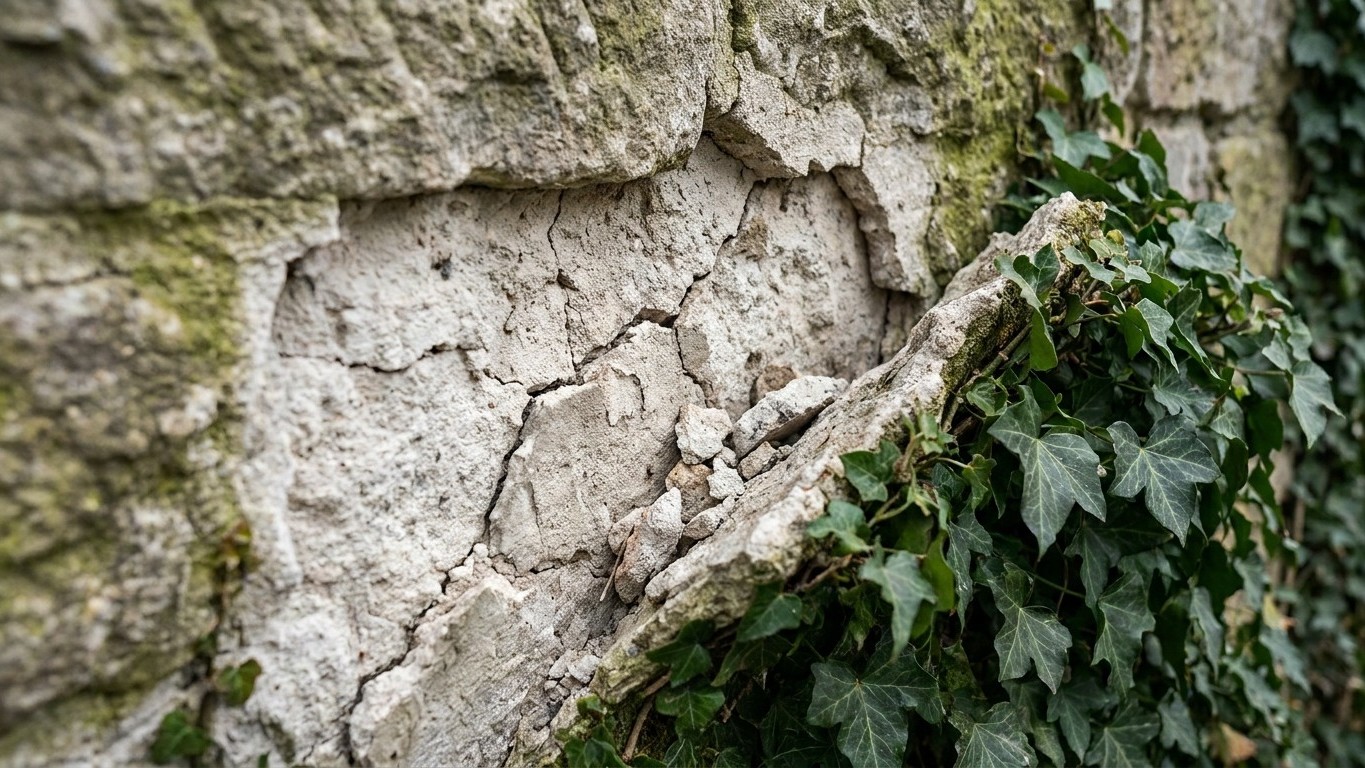
Ivy-covered walls are one of Britain’s most cherished domestic sights. That dense, glossy curtain of green climbing up a Victorian terrace or a Cotswolds cottage gives a house an air of permanence, even nobility. The trouble is, the mortar holding those walls together may be quietly losing the battle, entirely out of sight, for years at a time.
Key takeaways
- Ivy develops two types of roots: harmless aerial grippers and aggressive ‘proper’ roots that penetrate mortar and cause structural damage
- Older lime-based mortar is especially vulnerable to ivy invasion, and trapped moisture undergoes freeze-thaw cycles that silently crumble walls from within
- Removing ivy the wrong way can cause as much damage as the plant itself—patience and methodical techniques are crucial
How ivy actually attaches itself to a wall
Research published by the Royal Society shows that the attachment process is genuinely complex. As ivy begins to climb, it adapts its aerial roots to fit the surface and increase contact with the wall. Tiny hairs grow on these roots, secreting a chemical to help them stick, and hook-like growths further strengthen the bond. Those root hairs then dry out into spiral shapes, effectively locking the ivy onto the wall. It is, if you think about it, rather clever engineering on the plant’s part.
Although the attachment is remarkably strong, it is entirely superficial. The attachment roots do not penetrate the masonry material or extract moisture or nutrients from it. This is the crucial distinction that most people miss entirely: the small, hair-like aerial roots that you see clinging to a wall are not the problem. The problem comes later, in certain conditions, when something far more aggressive develops.
In some circumstances, “proper” roots are produced, usually at leaf nodes. This may occur if the base of the plant is cut, if a wall is very damp, or if there is organic matter like leaf litter from which the ivy can extract nutrients. These roots can then penetrate the structure via any small crack or hole, and under suitable conditions grow in size and number, disrupting the masonry and spreading deep within the structure, causing physical and mechanical damage over time.
The wall that suffers in silence
Ivy roots can invade crumbling mortar and loose bricks, potentially widening existing cracks. Homes built before 1930 are particularly vulnerable, as older lime-based mortar is softer than modern cement-based mortar. If you live in a Victorian or Edwardian house, that is most of Britain’s older housing stock, and it is worth paying close attention.
Water can also penetrate into the tiny cracks formed by these roots, causing even further damage, especially in areas that experience a freeze-thaw cycle. In the British climate, with its wet winters and fluctuating temperatures, this is almost guaranteed to happen season after season. Each freeze expands any moisture trapped inside those hairline fractures, widening them a little more each year. The mortar crumbles from the inside out, invisibly, behind a lush green screen.
There is another hazard that accumulates purely through sheer bulk. If ivy reaches the top of a structure and starts to produce arboreal or flowering growth, it will become increasingly large and heavy, especially when wet. It can act as a sail in windy conditions and destabilise sections of masonry. A mature ivy plant after a night of rain can weigh a surprising amount, and that weight is distributed across the very joints you most want to protect.
Perhaps an even bigger concern than ivy exploiting a home’s exterior flaws is the plant’s ability to disguise them. Dense greenery hinders a thorough inspection; it can be easy to overlook damaged window sills, foundations, gutters, blocked vents, and chimneys. An ivy-covered home that looks charming and perfect from the street may mask significant problems. Surveyors know this well, and many will flag heavy ivy growth as a concern precisely because they cannot properly assess what lies beneath.
The unexpected case in ivy’s favour
Before you reach for the secateurs in a panic, the science here is genuinely more nuanced than the doom-and-gloom might suggest. Ivy is regularly reported to damage the walls it grows on, but in most cases ivy does not cause these structural issues. Its aerial roots are unable to bore into sound masonry, and they often only cause damage when they are removed with force.
On limestone masonry test walls in central Southern England, ivy foliage had a significant influence on stone-surface freezing regimes. Over two successive winters the frequency of freezing events under ivy was reduced on average by 26%, their duration by 34%, and their severity by 32%. A subsequent laboratory simulation showed that stone mass loss, surface softening, and textural development were all significantly reduced under an ivy-covered thermal regime. That is not a trivial benefit for a historic building facing our unpredictable winters.
From field monitoring at a range of sites in England, it was found that ivy provides a thermal blanket for walls, protecting them from extremes of heat and cold and fluctuations in relative humidity. Similarly, studies in and around Oxford show that ivy can minimise particulate pollution reaching walls. So the plant that people assume is always destroying their home may, on a sound wall, actually be extending its life.
Managing ivy without making things worse
The single most important rule, and the one most people get wrong, is how to remove ivy once it has taken hold. The process of removing ivy can itself cause damage, pulling away paint and loose mortar, and you may need to carry out costly repair work, such as filling cracks and joints, re-rendering or repainting walls, after removal. Yanking at a thick old vine is one of the quickest ways to take half the face of your brickwork with it.
The correct approach is methodical and patient. Cut ivy stems at the base and allow the upper portions to die. This process may take several weeks but will help to loosen the plant’s grip. Then gently pull away the dead vines, being careful not to damage the surface. The dried-out root hairs that remain can usually be scrubbed away with a stiff bristle brush once they have fully desiccated.
Trim ivy regularly to keep it away from windows, gutters, and rooflines, and inspect the underlying surface periodically for signs of damage. Remove any ivy growth that begins to encroach on vulnerable areas. An annual check in late summer, when the foliage is still dense enough to assess but dry enough to work with, is a sensible habit.
Installing trellises or wire supports for the ivy to climb can be a good compromise between having vining plants and keeping your structures safe from damage. Keep these supports a few inches away from the wall surface. This approach allows for easier removal and wall inspection, reducing the risk of damage and making maintenance more straightforward. It is the kind of solution that lets you keep the look without gambling on the structure.
One last thing worth knowing: check for nesting birds before you do any work to control or remove ivy. It is an offence under the Wildlife & Countryside Act 1981 to damage or destroy the nest of any wild bird while it is in use or being built. Nesting season generally lasts from March to August, but may last longer for certain birds or those with multiple broods. Autumn, then, is your practical window for serious ivy management. And given that some insurance companies may view extensive ivy growth as a risk factor and raise your premiums accordingly, as the potential for structural damage and increased risk of water ingress can make your home seem riskier to insure, keeping a clear photographic record of annual inspections is a small habit that could prove very useful .
Sources : nature.com | epicgardening.com