
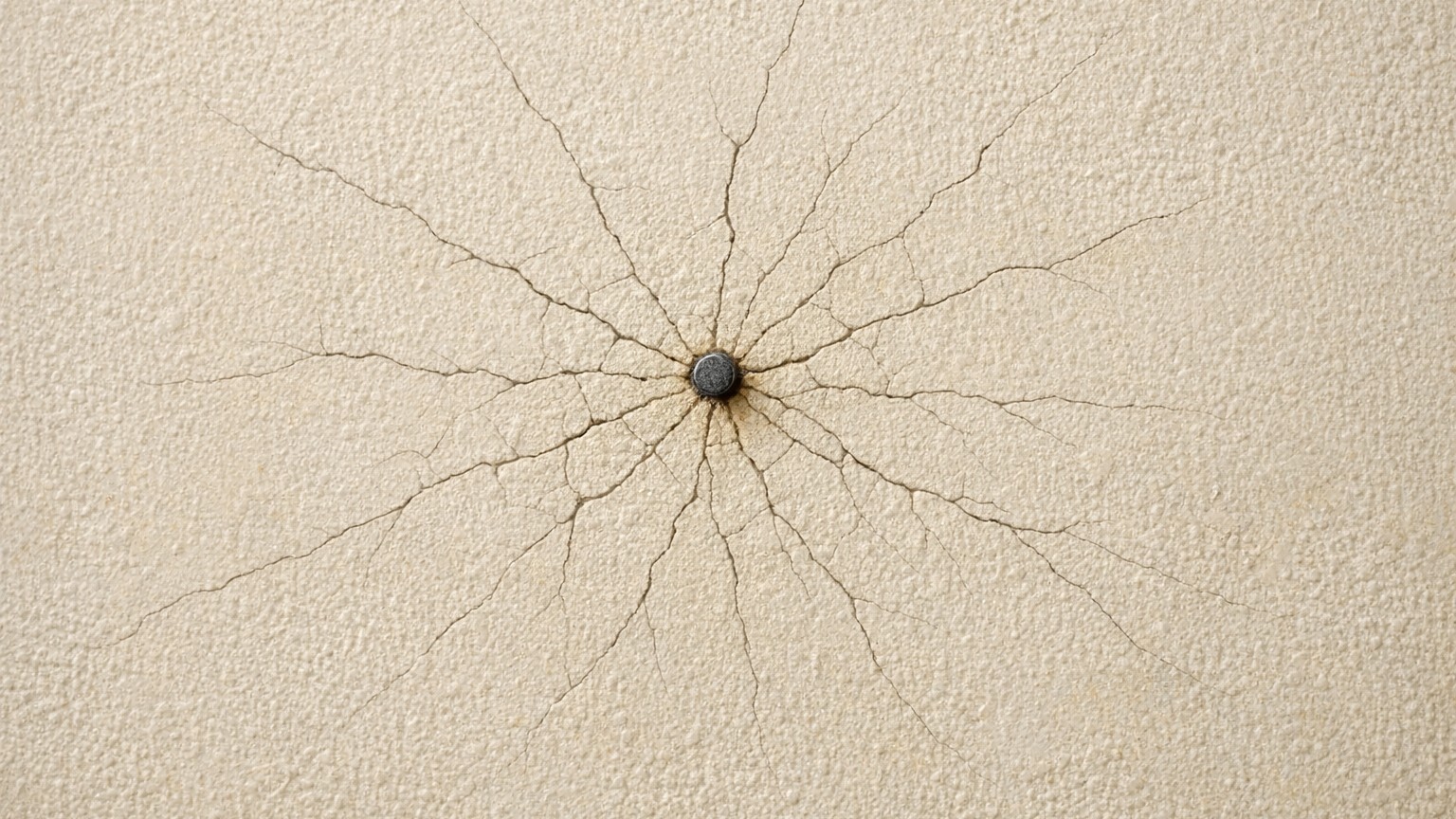
A heavy mirror fixed with masonry nails into a chimney breast is one of those jobs that feels solid at the time. The nail goes in with a satisfying thud, the mirror hangs straight, and you step back feeling rather pleased with yourself. Then, a few weeks later, you spot something unsettling: fine lines creeping through the plaster around the fixings, sometimes radiating outward like a spider’s web, sometimes running in longer cracks along the surface. Those lines are your chimney breast telling you something important.
Key takeaways
- Chimney breasts contain hollow flues that respond differently to weight than solid walls
- Masonry nails provide inadequate grip for heavy mirrors and cause plaster to separate
- Three-week timeline for visible cracks is typical—but the danger starts immediately
Why a chimney breast behaves differently from an ordinary wall
Chimney breasts are not just thick walls. They house a flue, which means there is often a hollow core running vertically through the structure, surrounded by relatively thin masonry. That internal void changes everything/”>Everything about how the wall responds to localised stress. When you drive a masonry nail into the plasterwork and hang a significant weight from it, the load concentrates at a single point rather than spreading gradually through solid brick or block. The result is that the masonry around the nail can shift ever so slightly under the sustained weight, and the plaster, which is far less flexible, cracks to accommodate that movement.
There is also the question of what lies beneath the plaster itself. Older chimney breasts are frequently finished with a lime-based render over rough brickwork, and that render can be in various states of adhesion. Some patches will be firmly bonded; others may have lost contact with the brick behind them over decades of heating and cooling. Hanging weight from a nail that happens to sit over a poorly bonded patch accelerates the separation, and the cracks you see are the visible sign of that delamination beginning to spread.
The specific problem with masonry nails on a chimney breast
Masonry nails are designed for light-duty fixing of timber battens, cable clips, and similar lightweight items. They grip by friction alone and rely on compression from the surrounding material to stay put. A heavy mirror, anything above roughly four or five kilograms, exerts a constant downward and slightly outward force that a masonry nail resists poorly over time. On a standard solid internal wall this might cause nothing more dramatic than a gradually enlarging hole. On a chimney breast, where the brickwork has been subject to years of thermal cycling from fires below, the mortar joints can already be slightly friable, and the nail essentially levers against weakened material every time the mirror moves.
Three weeks is a fairly typical timeframe for these cracks to become visible. The initial fixing holds well enough, but slow creep under sustained load, combined with any vibration from foot traffic or closing doors, gradually works the nail loose at a microscopic level. By the time you notice the lines, the fixing has likely already moved a fraction of a millimetre, which is all it takes to crack set plaster.
What to do now, and how to rehang safely
The first thing is to take the mirror down immediately. A heavy mirror that is already working loose is a genuine safety hazard, and the longer it stays up, the wider those cracks will grow. Once it is safely off the wall, resist the urge to simply fill the cracks and try a different nail. The plaster around the damaged area needs to be assessed properly before anything else goes back up.
Press gently on the plaster around the cracks with the flat of your hand. If it flexes at all, or if you hear a hollow sound when you tap it with your knuckle, a section of that render has detached from the brickwork behind it. Any new fixing you put nearby will have the same problem. In that case, a competent plasterer will need to cut out the loose section and patch it correctly before you proceed. This is not a job for filler alone, however much you might want it to be.
For the rehang, the right approach is to use proper wall plugs and screws driven into solid brick, not mortar joints. This means using a hammer drill set to rotary-hammer mode, not just rotation, with a masonry bit sized to match your wall plugs. Aim for plugs that sit at least 50mm into the brick itself, past any plaster and render. If your mirror weighs more than about six kilograms, two fixing points are far safer than one, as the load is shared and the risk of any single point failing is dramatically reduced. A mirror plate fixing, the type that screws to the back of the frame and hooks over a screw head, distributes the load more evenly than a single hanging wire pulling against one point.
Some people prefer to fix a wooden batten horizontally across the chimney breast using multiple screws into solid brick, then hang the mirror from the batten. This approach spreads the load across the entire width of the fixing rather than concentrating it at one or two points, and it is the method I would choose for anything heavier than about eight kilograms.
One thing worth knowing: if your chimney breast has an older lime plaster finish (common in houses built before around 1950), standard ready-mixed fillers can actually make cracking worse over time. Lime plaster remains slightly flexible throughout its life, and a rigid modern filler does not move with it. For repairs to lime plaster, a lime-based filler or a fine lime putty mix will bond and flex in the same way as the surrounding material, which is why older buildings stayed in better condition when their tradespeople understood this distinction.