
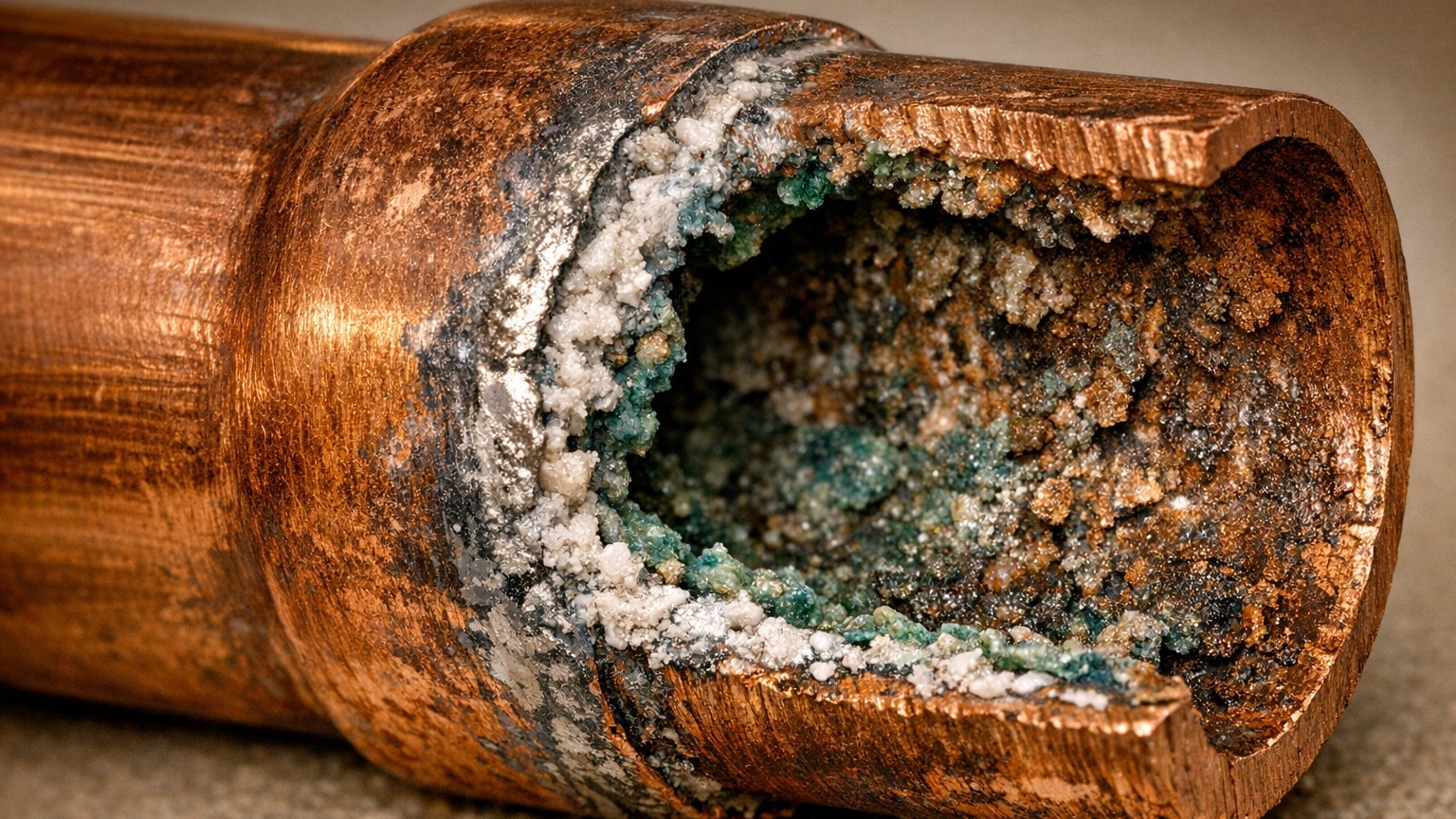
Flux left on copper pipe joints after soldering will corrode the metal from the inside out. This is not a scare story. The green, crusty residue you sometimes see weeping from an old soldered joint is cupric chloride, a corrosion byproduct that forms when acidic flux residue reacts with copper in the presence of moisture. Leave it long enough, and what began as a hairline attack on the inside of your joint can work its way through the pipe wall entirely.
I learnt this the hard way. Two years after replumbing a section of my kitchen, I cut out a joint that had been weeping a faint greenish stain for months. The inside told a sorry tale: a rough, pitted channel had eaten right through the solder at one side, the copper beneath it pocked and soft where it should have been smooth and sound. The flux I had used, an active paste type, had done its job beautifully during soldering, and then spent the next twenty-four months slowly dismantling what I had built.
Key takeaways
- Acidic flux residue doesn’t stop working when your torch does—it spends months chemically attacking the copper beneath
- A joint that looks perfect on the outside can be completely undermined within two years, creating invisible pinhole leaks
- The solution takes five minutes and costs almost nothing, but almost nobody does it because the instructions are in very small print
Why flux turns from helper to hazard
Flux serves a very specific purpose during the soldering process. It cleans the copper surface by dissolving the thin oxide layer that forms naturally on the metal, and it prevents new oxides from forming while the joint is hot. Without it, solder simply beads up and refuses to bond properly. The problem is that most plumbing flux is mildly to moderately acidic, and that acidity does not switch off once the torch goes cold.
Paste fluxes, which are the most widely sold type for copper plumbing in the UK, typically contain a blend of zinc chloride and ammonium chloride. Both are highly effective at cleaning copper, and both remain chemically active after soldering. Any residue left on or inside the joint will absorb atmospheric moisture and begin attacking the copper again, slowly, but persistently. Water flowing through the pipe accelerates this further, especially if that water is slightly acidic, as much UK tapwater is.
The British Standard for lead-free solder and flux, BS EN 29454, distinguishes between flux types by their corrosive residue activity. Category 1 fluxes leave residues that must be removed; category 2 are described as low-residue. Most DIY-sold paste fluxes fall into the more aggressive category, which is why the instructions on the tin, almost always in very small print, do actually tell you to clean the joint after soldering. We just rarely read that bit.
What the damage actually looks like
The external sign most people notice first is a faint green or turquoise staining spreading from a joint, sometimes accompanied by a white chalky crust. This is verdigris, essentially copper carbonate and copper chloride forming as the metal oxidises. On the outside, it looks cosmetic. Cut the pipe open and the picture changes. The interior of a flux-corroded joint tends to show uneven pitting along the solder line, where the flux pooled during assembly. In severe cases the solder itself is undermined, leaving a joint that looks intact from the outside but has almost no mechanical strength left at the interface.
This type of failure is sometimes called “flux-induced pitting corrosion”, and while it sounds technical, the mechanism is straightforward enough. The acidic residue creates micro-pockets of low pH on the copper surface. In those pockets, the metal dissolves preferentially, creating tiny craters that deepen over time. Once a pit reaches a critical depth relative to the pipe wall thickness, you get a pinhole leak, the kind that drips inside a wall cavity for months before anyone notices.
Cleaning up properly: the method that actually works
The good news is that this is entirely preventable, and cleaning soldered joints is neither difficult nor expensive. The key is timing. You want to clean the joint while it is still warm, but not so hot that you burn yourself or damage the joint. About thirty seconds to a minute after the flame comes off, when the solder has just set, is the right window.
A damp cloth is your primary tool. Wring it out well so it is moist rather than wet, and wipe firmly around the entire joint, paying particular attention to any flux that has run down the pipe below the fitting. The heat will have spread flux further than you think. Rinse the cloth and wipe again. For joints in awkward spots, an old toothbrush dampened with warm water gets into crevices far better than a cloth can.
Once the pipe is fully cold and the system is back in service, give every joint a final wipe with a cloth dampened with a very dilute solution of bicarbonate of soda in warm water, roughly a teaspoon to half a pint. Bicarbonate is mildly alkaline and will neutralise any residual acid traces. Wipe dry afterwards. This takes perhaps five minutes for an entire run of joints and costs almost nothing.
Some plumbers prefer to use a dedicated flux remover spray, which you can find in any plumbing merchant. These work well, but for domestic work, warm water and bicarbonate genuinely does the same job at a fraction of the price.
A note on no-clean flux
Marketed as a cleaner alternative, no-clean flux does exist for plumbing applications, though it is far more common in electronics. For copper water pipe in the UK, read the packaging carefully before trusting that claim. Some products labelled “low-residue” still leave enough active chemistry to cause problems over a decade or more, particularly in systems with soft or acidic water. The Water Regulations Advisory Scheme (WRAS) approves certain fluxes as suitable for potable water systems, checking that approval marking on the tin is a sensible habit before you buy.
One thing worth knowing: the corrosion risk is higher in hot water systems than cold. Elevated water temperatures speed up the electrochemical reactions involved, which is why flux residue that causes no visible problem in a cold feed pipe over five years might attack a hot water joint noticeably faster. If you are soldering near a boiler or on a central heating circuit, cleaning those joints afterwards is not optional, really.