
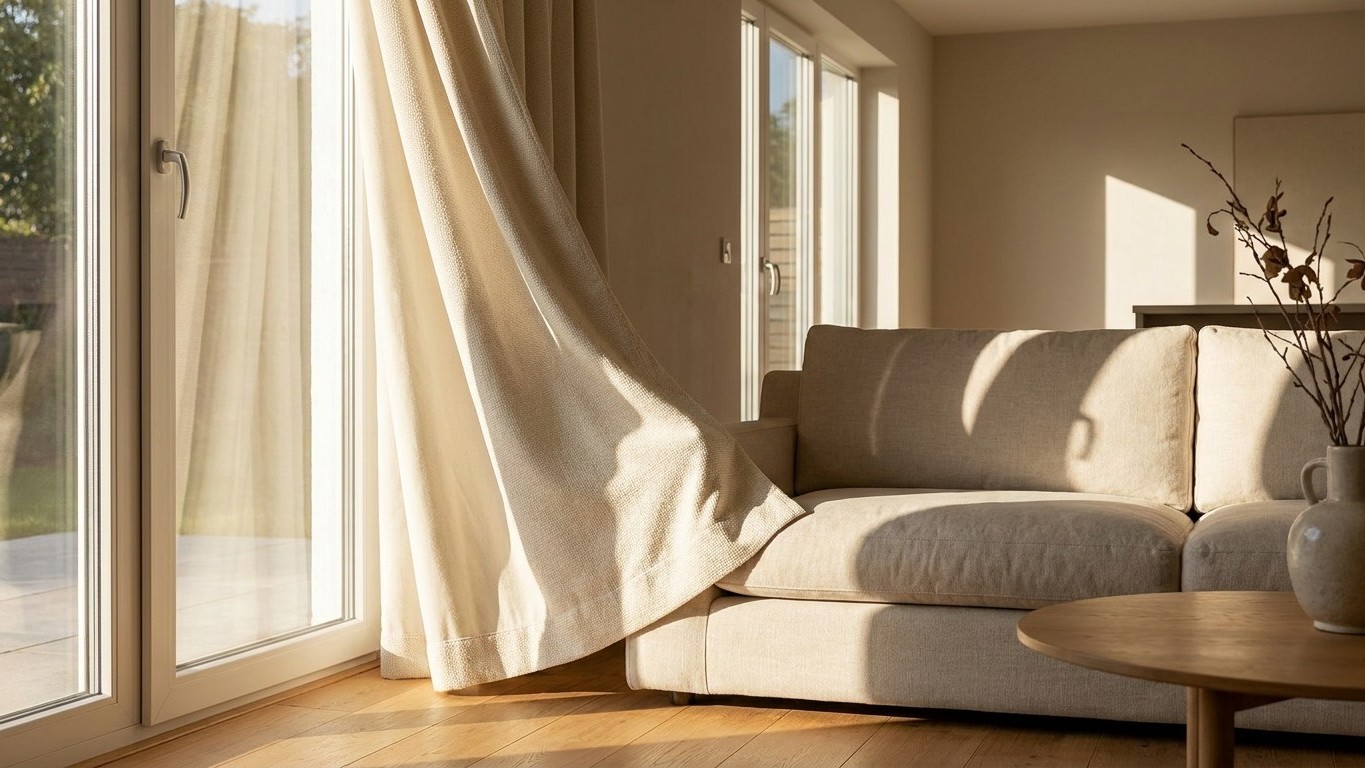
Patio doors are basically a floor-to-ceiling pane of glass, which makes them one of the biggest heat traps in any home. Hang even a thin, unlined curtain over one and close it during the hottest hours, and you create a barrier that keeps that solar warmth from ever reaching your sofa. It sounds almost too simple to be true, but the physics behind it has been measured properly, and the numbers are rather startling for something that cost about the same as a fish and chip supper.
Key takeaways
- A thin £12 curtain can reduce heat gain through patio doors by up to 33%, according to official energy research
- The timing of when you close the curtain matters just as much as the fabric itself—close too late and you trap heat inside
- Pale colors with reflective backings outperform dark fabrics by a significant margin when blocking solar radiation
The science behind a £12 miracle
Glass is a poor insulator and an excellent heat conductor, which is exactly why a west-facing patio door turns a living room into a greenhouse by mid-afternoon. The US Department of Energy, whose window-covering research is some of the most cited in the world, found that medium-colored draperies with white-plastic backings can reduce heat gains by 33%. That’s not a marketing claim from a curtain company, it’s a government energy body measuring actual heat transfer through glass.
The mechanism is straightforward once you picture it. Because the thermal fabric blocks hot air, if the hot air is outside the window, it will keep the room nice and cool in summer, then block the hot air from escaping during the winter. A pocket of air forms between the glass and the fabric, and that trapped layer acts like a buffer, so the heat radiating off the door has to fight its way through two barriers instead of one before it reaches you on the sofa. Some manufacturers even build curtains with several layers specifically for this purpose, and typically that construction includes a decorative outer layer, a moisture barrier, a thermal layer or layers, and a backing with UV protective properties. Even a plain, unlined curtain does some of this job simply by adding fabric between you and a hot surface, though a proper lined one does it far better.
Why it works even better on a patio door than a normal window
Patio doors take the brunt of it because of their sheer surface area. Homes with large windows or patio doors are at particular risk for significant heat gain in the summer and loss in the winter. A small bedroom window might let in a manageable trickle of afternoon sun, but a full-height sliding door is basically inviting the whole sky in for tea. Curtains there aren’t just decorative, they’re doing structural work against a much bigger thermal problem.
Timing matters just as much as the fabric itself, and this is where a lot of people undo their own good work. Once sunlight has already flooded the room and warmed the furniture and floor, drawing the curtain simply traps that heat inside like a lid on a saucepan. You need to make sure you close your thermal curtains before sunlight enters the room if you want them to keep a room cool effectively. Don’t wait until the sun streams into the room and heats it up. It won’t work. It will only trap the heat in the room if you close the curtains later in the day. For a south or west-facing patio door in the UK, that generally means drawing the curtain from late morning onward, well before the sun swings round to hit the glass directly.
There’s also a gap problem worth knowing about, because it’s the single most common reason people feel underwhelmed by curtains that should be working brilliantly. The ability of curtains and drapes to reduce heat gain depends on the fabric type and color. Hang the curtains as close to windows as possible. For maximum effect, install a cornice at the top of the draperies, seal the draperies at the sides, and overlap them in the middle. Any daylight sneaking round the edges of the fabric is warm air finding its way straight past your barrier, so a curtain pole that extends a good few inches beyond the door frame on each side, plus a curtain long enough to properly overlap in the middle, makes a genuine difference. I’ve seen plenty of otherwise lovely curtains left hanging loose and gappy at the sides, doing barely half the job they’re capable of.
Colour, fabric, and the bits nobody tells you
Colour isn’t just an aesthetic choice here, it’s doing thermal work too. Pale shades reflect far more solar radiation than dark ones, which absorb heat and can even re-radiate some of it back into the room once the fabric itself warms up. That’s precisely why the Department of Energy’s benchmark figure specifies medium to light colours with reflective backings rather than any old heavy curtain. A cream or off-white curtain over glass doing full sun duty will noticeably outperform a deep navy one of identical thickness.
Fabric weight and construction matter almost as much as colour. A proper thermal or blackout-lined curtain, even a budget one, tends to include multiple layers, and studies and product tests show that blackout curtains with thermal linings can reduce heat gain through windows by up to 30-45%, which is a significant amount, especially during hot summer days. You don’t need anything fancy or expensive to get this benefit, since a simple lined curtain from any high street shop or supermarket homeware aisle will usually do, provided it’s floor length and hung with enough width to overlap properly.
It’s also worth being honest about the limits, because I’d rather you went in with realistic expectations than felt let down. Think of them as insulation: thermal curtains reduce the rate of heat entry but don’t generate cool air. For best results, they should be part of a larger strategy that includes proper window sealing, shading from outside structures, and, of course, an efficient cooling system. Pair the curtain with an open window overnight and a strategically placed fan drawing through cooler air in the early morning, and you’ll get results that genuinely rival plugging in an air conditioning unit, minus the electricity bill and the noise.
A cheap trick with a long pedigree
None of this is new, incidentally. Grandmothers were closing heavy curtains against the midday sun long before anyone coined the phrase “solar heat gain,” relying on nothing more than observation and common sense passed down through generations. What’s changed is that we now have proper measurements behind the habit rather than just instinct, and the NHS itself weighs in on the same side, noting among its guidance for staying cool that to keep rooms cool during warm weather, shades and reflective materials outside windows are worth using alongside sensible ventilation. So that £12 curtain over the patio door isn’t a fluke or a happy accident, it’s a genuinely well-documented bit of household physics, dressed up as decoration.
Sources : blindsdirect.co.uk | idealhome.co.uk