
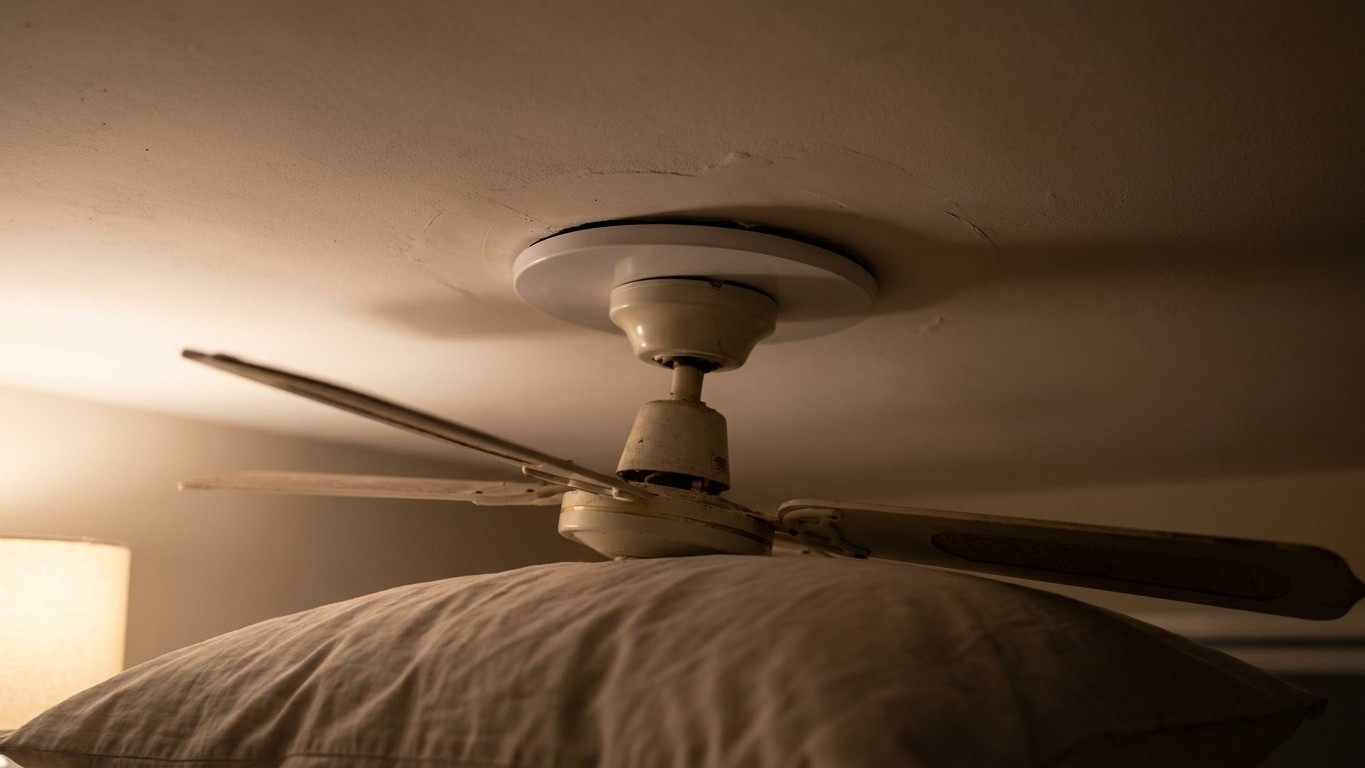
What was really holding that fan up was a few millimetres of pliable plastic and a couple of twisted copper strands, nothing more. Standard ceiling roses simply were never built to carry a moving load, and that swaying you felt over the bed was the first physical evidence that the fixing was slowly giving way. It’s a common shortcut, avoiding the mess of cutting into plasterboard and finding a joist, but it’s also exactly the kind of shortcut that turns a bedroom ceiling fan into a genuine hazard.
Key takeaways
- A standard ceiling rose supports only static weight, but a spinning fan creates dynamic loads and vibration it was never built to handle
- Visible gaps, spongy canopies, or angled screws are warning signs that fixings are failing—and the danger creeps up silently over weeks
- Proper installation requires anchoring into joists or installing timber nogging, plus a separate isolator switch—shortcuts can mean catastrophic failure
A ceiling rose was built for stillness, not spinning blades
Ceiling roses do a perfectly good job with the fitting they were designed for: a static pendant light hanging quietly in one spot. Under BS 7671, the UK wiring regulations, if the mass of the luminaire is greater than 5 kg, the installer must ensure the fixing means is capable of supporting the mass, installed according to the manufacturer’s instructions. That 5 kg figure crops up again and again in the regulations, with fixing points required to support a pendant luminaire with a mass of not less than 5 kg. Notice the word “pendant”. A fan is a different animal entirely.
A running fan doesn’t just hang there, it pulls, twists and vibrates thousands of times an hour. As one electrician put it plainly, a proper ceiling mount into a joist or purpose-built fan-rated mounting box will prevent vibration, and you should never mount a ceiling fan into a standard lighting rose as they are not rated for the load. Trade guidance for UK installers goes further, warning that standard lighting fixture boxes and fixings are not rated for ceiling fan installation, because fans generate dynamic loads and vibration that exceed static light fixture requirements. That’s the crux of it. Weight alone isn’t the danger, movement is.
Anyone who’s ever fitted a lampshade knows the flex itself was never meant to bear serious weight either. Forum advice from experienced installers is blunt on this point: the flex will not support that kind of weight, and heavy ceiling lampshades usually need a supporting metal chain or pole, absolutely not the flex. Some plastic roses are held together by little more than a screw thread formed in the pliable plastic that some roses are made from, which is perfectly fine for a lampshade nudged occasionally while dusting, and hopelessly inadequate for something that shudders every time the blades reach speed.
What should have gone up there instead
A proper installation starts above the ceiling, not below it. Fitters are told to locate the ceiling joists, the wooden beams that provide structural support, which become the anchor points for the fan mounting system. Where the ideal spot doesn’t line up with a joist, the standard solution isn’t to compromise, it’s to add one: the fan bracket has to be fixed into the joists or a noggin fitted between them specifically to take the load, and if your ceiling doesn’t have a joist in the right place, a noggin gets fitted first, because skipping this step leaves you one loose fixing away from a fan coming down. A noggin, for anyone unfamiliar with the term, is simply a short length of timber fixed crosswise between two joists to give a solid fixing point exactly where you need one.
There’s also a wiring detail that catches out a lot of enthusiastic DIYers. Under the regulations, a ceiling fan is a piece of fixed equipment with a motor which, under BS 7671, needs its own means of isolation, usually a fused connection unit or a double-pole switch, separate from the light switch. One tradesman noted that most DIY fan fittings called out to fix have skipped this entirely, wired straight off the lighting circuit with no way to isolate the fan on its own for maintenance. Handy to know before you next reach for a screwdriver at the fuse box rather than a proper isolator switch.
None of this necessarily means calling in a contractor for every fixture in the house. Replacing a like-for-like light fitting on an existing circuit is generally straightforward, but fan installation sits in different territory. Guidance on the Building Regulations is clear that ceiling fan installations must comply with Part P, requiring either a registered competent person to complete the work or notification to building control if doing it yourself, and all fixed electrical installations must adhere to BS 7671. If you’re not entirely confident locating a joist by ear or eye alone, that’s precisely the point where a NICEIC-registered electrician earns their fee.
The tell-tale signs worth checking tonight
Vibration is patient. It won’t announce itself with a bang, it creeps up over weeks of ordinary use, and a running fan that seemed perfectly steady in month one can start to wobble by month six as fixings work loose in plasterboard that was never designed to flex repeatedly. Worth checking:
- Any visible gap or movement between the ceiling rose and the plasterboard when the fan is switched on
- A soft, spongy feel when you gently press upward on the canopy while the fan is off
- Screws or fixings that look pulled or angled rather than sitting flush
If any of those ring a bell, switch the fan off at the isolator, not just the wall switch, until someone qualified has had a proper look underneath. A fan over a sofa is one thing. A fan over a bed, spinning through the night while you sleep beneath it, deserves rather more than a plastic rose and a bit of hope holding it there.
Sources : diynot.com | northwestelectricpros.com