
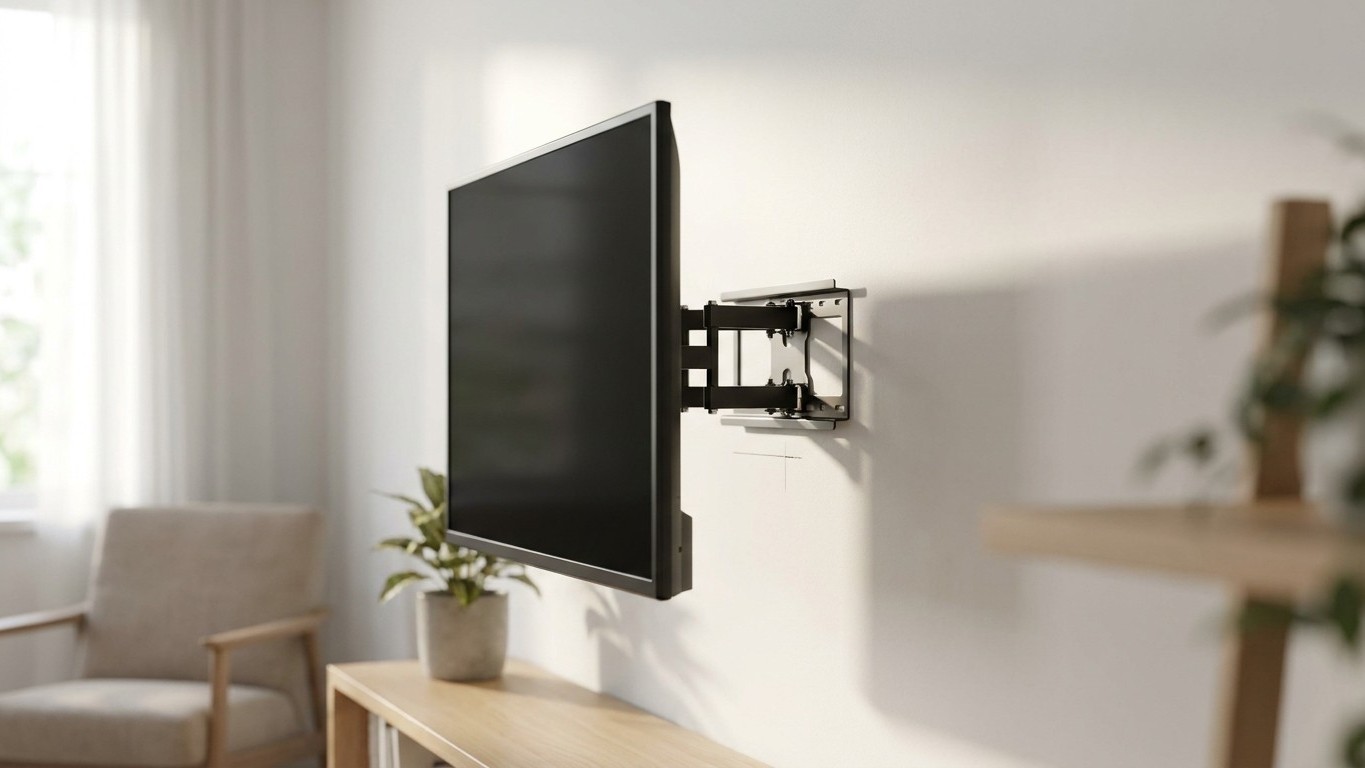
A 50-inch flat-screen television weighs somewhere between 15 and 25 kilograms depending on the model. Plasterboard, that pale, chalky sheet that lines most modern British homes, holds a wall anchor to roughly 10 kilograms under ideal conditions, and that is being generous. The maths, in hindsight, is brutally simple. But most of us only do that calculation after the crash.
My neighbour Derek found out the hard way one Sunday afternoon when his telly came away from the wall mid-match, taking a fist-sized chunk of plasterboard with it. The bracket twisted, the screen cracked, and a cable ripped the socket half out of the wall. Three hundred pounds of damage, all because he’d used the wrong fixings. That day he asked me to help him put it right, and what we found inside that wall taught me more about British home construction than any DIY manual ever had.
Key takeaways
- Plasterboard is essentially compressed chalk and cannot reliably support a TV’s cantilever load without special installation
- The difference between a secure mount and a wall-destroying failure often comes down to finding timber studs and using proper fixings
- Hidden dangers like live electrical cables and rented properties add layers of complexity most people never consider before drilling
Why plasterboard cannot hold a TV on its own
Plasterboard, sold under brand names but essentially the same product everywhere — is a sandwich of compressed gypsum chalk between two sheets of paper. It is brilliant for creating smooth walls quickly, but structurally it is closer to a thick biscuit than a load-bearing surface. The material itself will shear under sustained, uneven weight. A flat-screen television mounted on a wall bracket creates what engineers call a cantilever load: the weight pulls forward and downward simultaneously, putting enormous stress on the fixing point.
Standard plastic wall anchors, the ones that come in the box with almost every wall bracket sold in this country, are designed for light picture frames. When used in plasterboard alone, they grip the paper facing rather than anything solid. Over weeks, the slight vibration from the TV’s sound system, the micro-movement every time someone adjusts the angle, and simple gravity all conspire to loosen that grip. The failure is rarely sudden, it is slow, silent, and then catastrophic.
The only reliable fixing points inside a stud wall are the timber studs themselves. In most British homes built since the 1970s, these vertical timber uprights sit behind the plasterboard at intervals of 400mm or 600mm apart. A screw driven 40mm or more into solid timber holds many times more weight than any anchor ever will in the board alone. The entire job hinges on finding those studs before you drill a single hole.
Finding the studs, and getting the bracket right
A decent electronic stud finder costs less than a takeaway and is available in any hardware shop. Run it slowly across the wall in horizontal passes at about the height where your top bracket screws will go. It detects the density change where timber sits behind the plasterboard. Mark the centre of each stud with a pencil, then verify with a thin nail or a fine drill bit, if you meet resistance at 50mm or so, you’ve found your stud. If the drill sails through into hollow air, you’ve missed.
Once you’ve confirmed two stud positions that align with the holes on your bracket, use screws rated for the load, a 60mm timber screw with a load rating clearly marked on the packaging is your minimum. For a TV over 20kg, many professional fitters use 80mm screws into timber, and they use a minimum of four fixing points. Spacing matters too: wider fixing points on the wall distribute the cantilever load across a larger surface, which is why VESA-pattern brackets with wider spreads tend to perform better over time than narrow ones.
There is one situation where studs simply aren’t where you need them. Perhaps your ideal viewing position falls squarely between two studs, or you are mounting on a solid masonry wall. Masonry is actually easier: a masonry drill bit and appropriate masonry anchors (not the plastic hollow-wall type, proper masonry fixings) into a brick or block wall will hold your television reliably for years. The tricky scenario is a solid plasterboard wall with no accessible studs at the fixing points. In that case, a French cleat system or a timber batten fixed horizontally across multiple studs distributes the load across the whole width, and then the bracket attaches to the batten rather than to plasterboard directly.
The hidden cable problem nobody mentions
Cables routed inside walls before drilling is something worth addressing separately, because it catches people out just as often as poor fixings. Building regulations in the UK specify that mains electrical cables inside walls should run in vertical or horizontal zones, typically within 150mm of corners, ceilings, skirting boards, or directly above or below switches and sockets. Drilling randomly through a wall to route your HDMI or power cable risks hitting a live cable, and that risk is real rather than theoretical.
A cable detector, often combined with the stud finder in the same device, will scan for live wires and metal pipes before you drill. Using one takes less than two minutes and can save you from a very nasty experience, at worst a serious electrical shock, at best a rewiring bill that makes your television seem cheap by comparison.
There is also the question of what happens if you are renting. Many tenants assume they cannot wall-mount a television at all, but most standard tenancy agreements in England and Scotland permit small fixings. A wall-mounted television, properly done with stud fixings and good-quality wall plugs, leaves no worse a mark than a large picture frame when removed, and a landlord who finds two clean screw holes in plasterboard will rarely raise an objection. Where the real trouble begins, as Derek discovered, is with the ragged, plaster-deep craters that a failed mounting leaves behind.
One detail worth knowing before you start: some newer British homes built with lightweight steel-frame stud walls rather than timber require different fixings entirely, as standard timber screws have nothing to bite into. If your stud finder detects metal rather than wood, toggle bolts or specialist steel-stud anchors are the correct solution, and they are widely stocked in larger hardware retailers across the UK.