
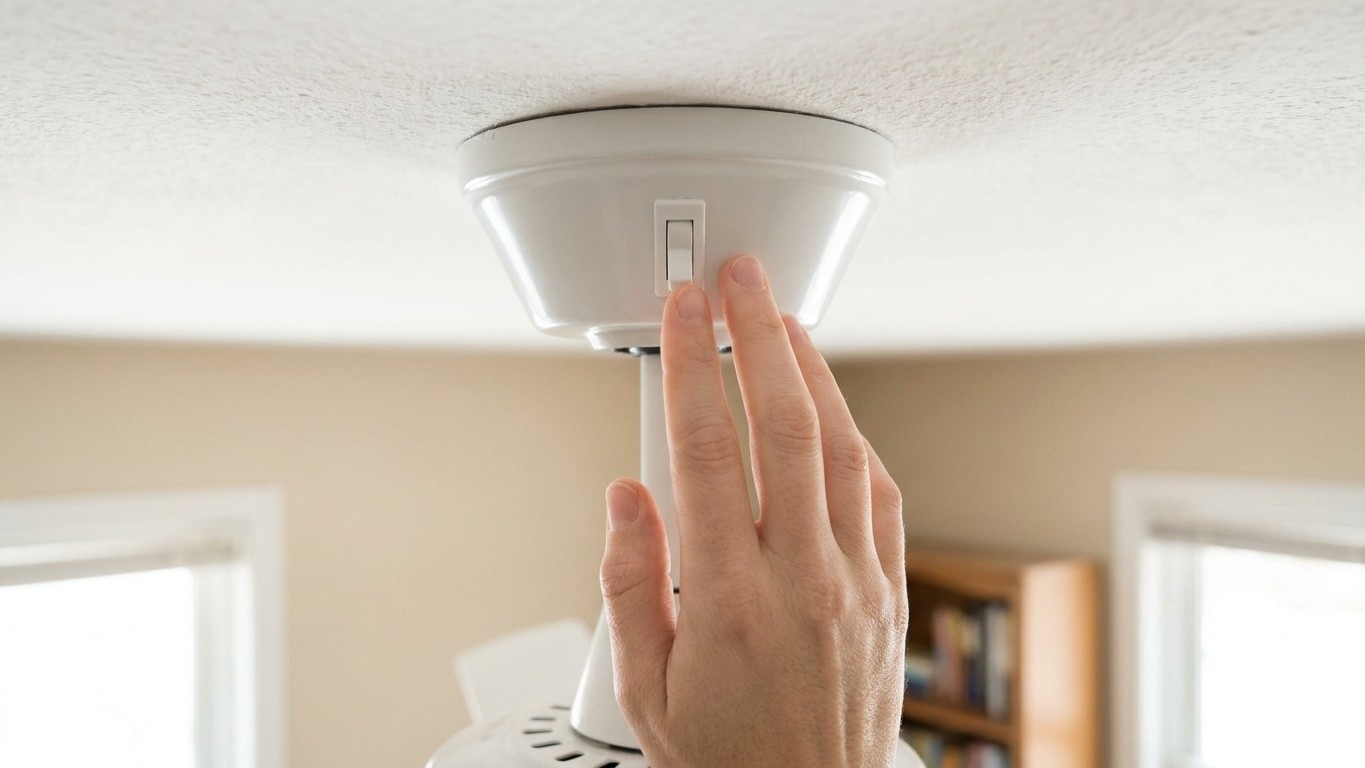
Most ceiling fans have been spinning the wrong way in British homes all summer. Not broken, not faulty, just set to the wrong direction because nobody mentioned there was a right one. That small plastic switch on the motor housing, the one easy to mistake for a pull-cord toggle or simply never to notice at all, is the difference between a fan that genuinely cools you down and one that merely hums reassuringly while you swelter.
Key takeaways
- A tiny overlooked switch determines whether your ceiling fan cools you or wastes electricity
- The direction change takes 30 seconds but could cut summer cooling costs by up to 30%
- Most people don’t realize fans cool people, not rooms—and leaving them on empty spaces is costing you money
Why direction is everything
Because the blades of a ceiling fan are slightly angled, changing the direction it spins will either funnel the air upward or push it downward. Pushing the air downward creates a cool breeze, while pulling the air upward helps redistribute warm air around the room. Those two movements feel completely different to anyone sitting underneath.
The ceiling fan direction in summer should be counterclockwise to help create a downdraft, which creates that direct, cooling breeze. Stand beneath it and you’ll feel it immediately, a steady column of moving air that brushes against your skin. The breeze makes perspiration on your skin evaporate, creating a wind chill effect. People under a ceiling fan can feel several degrees cooler than the room’s actual temperature. That’s not a mild improvement. During the summer months, ceiling fans should rotate counterclockwise, and this setting pushes air downwards, creating a cool breeze that can make you feel up to 4°F cooler.
Here is the thing that trips everyone up, though. One of the most persistent myths is that ceiling fans cool rooms. In reality, fans cool people, not spaces. They create a breeze that helps evaporate sweat, lowering body temperature. This matters enormously in practice. Leaving the fan on in empty rooms, fans cool people, not air. Turn it off when you leave, and save yourself the running cost.
The switch itself, and how to use it
Most ceiling fans come with a small direction switch located on the motor housing or can be adjusted via remote or smart control. On older models, the switch is a slim toggle, easy to overlook because it sits just above the blade assembly, usually on the side of the motor casing. The ceiling fan direction switch is often just an on/off toggle, with no real indication of which setting it activates. So you cannot simply glance at it and know which way round you’ve set it.
The foolproof check takes ten seconds. Stand directly under the fan while it is running. If you feel a strong breeze, it is rotating counterclockwise, which is exactly what you want in summer. No breeze felt from beneath means the fan is pulling air up, working in its winter configuration. The fix is simple: wait for the blades to completely stop moving. Safety first — the blades can injure you if they’re still moving. Make sure they come to a complete stop. Then flip the switch, and restart. If you change directions while the fan is still spinning, it could overload the motor and cause damage. Thirty seconds of patience, and it’s done.
If your ceiling fan is operated by a remote control, adjusting the blade direction can often be done with the press of a button. Many newer fans also respond to app controls or voice assistants, which makes the seasonal switch considerably less of an expedition up the stepladder.
What happens in winter, the overlooked bonus
Once you understand the summer logic, winter makes immediate sense. In the winter, ceiling fans need to spin clockwise on low speed. This creates an updraft that helps move warm air trapped near the ceiling back out and around the room, changing the average temperature in the living space. Warm air rises naturally, physics being stubbornly inconvenient, and without help it simply sits in a band near the ceiling, well above head height where it does nobody any good.
For rooms with high ceilings (ten feet or more), winter mode makes an even bigger difference, since warm air gets trapped higher, so redistributing it saves more on heating. Anyone with a Victorian house, a loft conversion with an apex ceiling, or even a generously proportioned sitting room will notice the difference most. You and your thermostat will feel the difference from recirculating the warm air, and this will help your heating unit run less often.
Speed matters here. In winter, set the fan to rotate clockwise at a low speed to recirculate warm air trapped near the ceiling without creating a draft. Run it too fast in clockwise mode and you will undo the benefit, the increased air movement will start creating that unwanted wind chill effect on anyone sat below, and a chilly draught in January is the last thing anyone wants.
The energy saving case, and one honest caveat
Using a ceiling fan allows you to raise the thermostat setting by about 4°F without reducing comfort, according to the US Department of Energy. That gap is meaningful when translated to a British summer: it means you can tolerate a warmer room without reaching for a portable air conditioning unit, which draws considerably more electricity than a ceiling fan ever will. The standard ceiling fan uses between 15 and 90 watts, depending on its size, motor type, and speed setting. Compare that to the energy appetite of a portable air conditioner and the arithmetic falls very clearly in the fan’s favour.
According to the Department of Energy, changing a fan’s direction can save up to 15% on winter energy bills and as much as 30% on summer cooling costs. Whether those figures translate precisely to British homes and our rather more modest summers is debatable, but the direction of travel (if you will forgive the pun) is clear. Less reliance on mechanical cooling or boosted central heating means lower bills and less wear on systems that cost considerably more to repair than a ceiling fan costs to run.
One thing worth knowing before you assume your fan is ready to reverse: not all ceiling fans have a reversible motor, so it is important to check the fan’s manual to determine if it can be used in both directions. If yours was bought primarily as a decorative fitting rather than a functional one, it may only spin one way. Most modern fans sold in the UK are reversible, but it is worth confirming before you spend an evening puzzled at a switch that does nothing at all. Also, while the fan is off, take a moment periodically to dust the blades. They collect dust and can send it spinning into the room the next time you start it, and a dusty fan in an old house is really rather impressive in its ability to deposit grey fluff on every available surface.
Sources : parrotuncle.com | constellation.com