
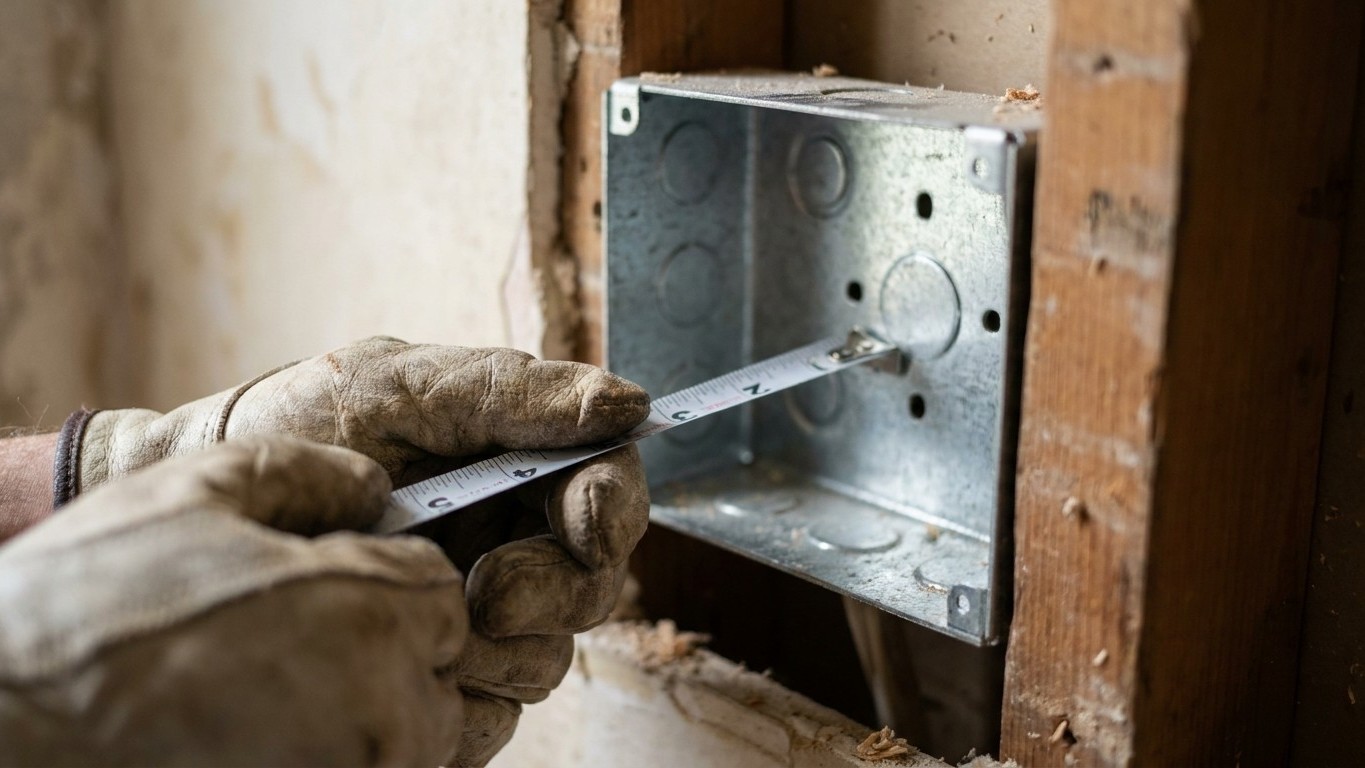
Fitting a USB wall socket feels like a perfectly sensible weekend job. You turn off the power at the consumer unit, swap out the old faceplate, reconnect three wires, screw Everything back flush, flip the breaker, and there it is, charging your phone without a bulky adapter in sight. A small, satisfying win. The problem is that the step most people skip happens before any wire is touched, and it has nothing to do with electricity at all. It has to do with the hole in the wall.
Key takeaways
- Most UK homes have 25mm back boxes, but USB sockets often require 35mm or deeper—a mismatch that can remain hidden for months
- Crammed wiring bent at harsh angles generates heat inside the wall, creating a fire risk that looks perfectly fine from the front
- A two-minute measurement check costs nothing and reveals whether you need a deeper box, a spacer frame, or a completely different approach
The box behind the socket is not a detail
Every socket in your home sits on a back box, the metal or plastic housing recessed into the wall that holds the wiring and provides the physical support for the faceplate. Standard sockets have been living happily in 25mm-deep back boxes for decades. The trouble is that USB sockets are considerably chunkier on the inside. Some USB outlets are deeper than standard receptacles, and if your back box is too shallow, you may need to install a deeper one. A depth of 35mm is required for flat-plate accessories and devices such as USB socket outlets where more depth is needed.
What happens when you ignore this? The electronics and wiring get crammed into a space they simply do not fit. If the instructions require one thing and you have something less, problems are inevitable. Some USB outlets will fit into 25mm boxes, but plenty will not, and even for those that do, 25mm is likely to be difficult and require very careful placement of the cables. The faceplate screws down, looks perfectly fine from the front, and the socket may even work. But inside the wall, wires are bent at harsh angles or pinched against the metal edges of the box. A loose or strained connection can generate heat and become a hazard. Not next week, perhaps. Maybe not for a year. But the risk is quietly sitting there in the plaster.
This is precisely the scene that greeted the electrician in the story above. He opened the box, took one look at the wiring crammed into an inadequate space, and rather diplomatically asked why no one had mentioned the back box first. The answer, of course, was that no one knew to check it.
How to measure before you buy anything
The good news is that this check takes about two minutes and costs nothing. Before purchasing a USB socket, turn off the relevant circuit at the consumer unit and use a voltage tester to confirm the power is dead. Then remove the existing faceplate screws, ease the old socket gently out of the wall, and look at the box behind it. Standard depths of metal back box are 16mm, 25mm, 35mm and 47mm. Most older UK homes have 25mm boxes. Use a ruler or tape measure to check the actual depth of the recess, bear in mind that the box may sit slightly deeper than its nominal measurement once plastering is accounted for.
Once you know your depth, check the installation instructions of whichever USB socket you plan to buy. They will state a minimum back box depth. Shallow boxes may not provide enough space for wiring, especially with modern accessories such as USB sockets or smart outlets. For most modern installations, a 35mm or 47mm back box is recommended to allow sufficient space for wiring and accessories. If your existing box is too shallow, you have two main options: replace the back box with a deeper one, or fit a socket spacer frame between the old box and the new faceplate, which adds a small amount of depth without requiring you to dig further into the wall.
While you have the old socket out, take a good look at the wiring too. Make sure any terminal clamps the copper wire itself, not the coloured insulation, as that will stop it working, or, in the case of the earth, make it unsafe. It is also worth taking a photograph of how the wires are connected before disconnecting anything. Take a photo before disconnecting them. You will thank yourself for it when you come to wire up the new socket.
What the law says about doing this yourself
Swapping a socket for a like-for-like USB replacement in an ordinary room (not a kitchen or bathroom) falls under the category of non-notifiable work in England and Wales. That means you can replace the socket yourself as it is a like-for-like change, which means you only need to be competent, not a qualified electrician, as per the Building Regulations, Electrical Safety: Approved Document P. Scotland operates under its own Building Standards system, but broadly permits the same scope of simple like-for-like DIY work.
Notifiable work includes installing a new circuit or extending an existing circuit, replacing or upgrading a consumer unit, any electrical work in bathrooms and shower rooms, and any electrical work in kitchens that involves new circuits rather than like-for-like replacement. Fitting a USB socket in a bedroom or living room? Entirely within your rights, provided the work is done safely. Fitting one next to the kitchen worktop on a new spur? That is a different conversation entirely.
The bigger legal concern for most homeowners comes later. If you break these rules and an electrical fault is responsible for damage in your home, you may find that your home insurance has been made invalid by the fact that you did the work yourself and cannot provide a minor certificate of works. When selling your home, the buyer’s solicitor may request electrical certificates for any work done during your ownership. Missing certificates for notifiable work can delay or complicate the sale. A USB socket swap in the bedroom will not trigger this, but it is worth knowing where the line sits.
One more thing worth knowing about USB sockets
Even a perfectly installed USB socket carries a safety consideration that most instruction leaflets gloss over. The primary safety concern with these products is that they could pose a risk of electric shock or fire if the extra-low-voltage parts of the USB power supply are not sufficiently segregated and separated from the low-voltage 240V parts of the product or from the fixed wiring installation. This is why product quality genuinely matters. If you buy any electrical equipment in the UK, always make sure it carries the British Standard Kitemark. Several safety risks are present in socket outlets incorporating USB power supplies, and based on testing, this is not limited to unbranded or lower-priced products.
There is also a quiet running cost to factor in. A USB socket with a built-in charging module draws a small amount of standby current around the clock, every day of the year. It is not enormous, but it is worth being aware of if you have several fitted throughout the house. On the whole, the upgrade remains a practical one, no more bulky charger blocks occupying the only socket by the bedside table, and no trailing cables across the floor. Just check the depth of that back box first, before you buy a thing.
Sources : homebuilding.co.uk | electricalsafetyfirst.org.uk