
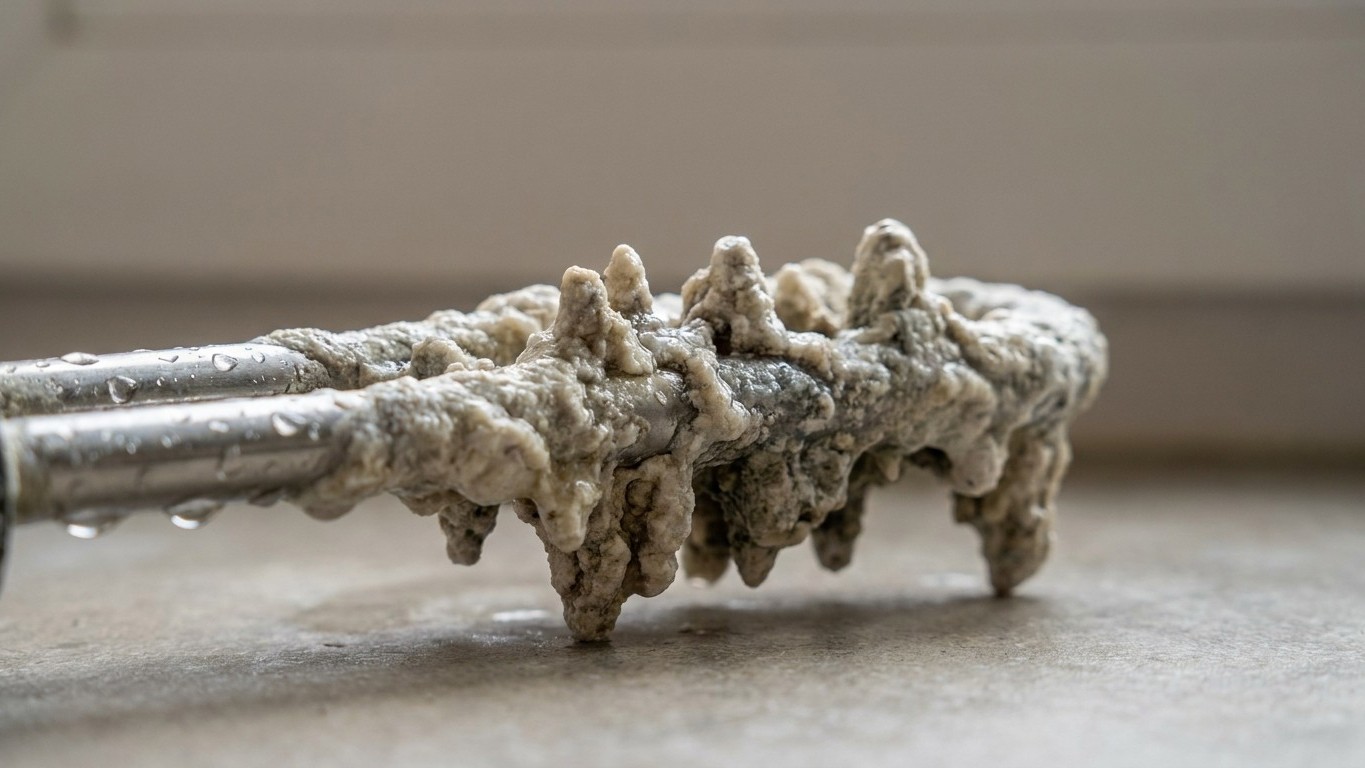
That thick, greyish-white crust clinging to the immersion element like a stalagmite in miniature is limescale, plain and simple. And the more you’d nudged that thermostat dial upward each month trying to coax the water hotter faster, the more you’d actually been feeding the problem. When water is heated, minerals collect and deposit on heating surfaces and in pipes, and the higher the temperature, the faster the precipitation process. You weren’t fixing a slow water heater. You were building a shell around the very thing meant to warm your water.
Key takeaways
- A simple decision to turn up the heat triggered an unintended chain reaction inside your tank
- The mineral crust you created actually prevents heat transfer—the opposite of what you were trying to achieve
- Where you live determines whether your water heater was doomed from the start
Why turning up the heat made everything worse
It feels logical enough, doesn’t it? Water not hot enough, quickly enough, so you crank the dial. But that instinct sets off a vicious cycle. Lowering the operating temperature of an immersion heater reduces limescale buildup because the calcium and magnesium in the hard water are less likely to form solid deposits when water is heated more gently. Flip that logic around and you can see exactly what happened in your tank: every degree you added sped up mineral separation, thickening the crust, which then insulated the element even further, which made the water take longer to heat, which presumably made you reach for the thermostat again.
The physics of it is almost cruelly simple. Limescale creates an insulating layer on the heating element inhibiting heat transfer and hence decreasing the efficiency of the unit, meaning you pay to heat the thick build-up of limescale before you start to heat your water. And this isn’t a trivial effect you can shrug off. Even a thin layer causes real losses, just a quarter inch of scale can cut heat transfer efficiency by up to 40 percent, and since water heating already accounts for roughly 17 percent of a home’s total energy use, scale makes that number climb higher still. One trade source puts a rough figure on what that means for a typical household: limescale in heating systems isn’t just a maintenance nuisance, it’s a slow-developing efficiency loss that costs UK households £200 to £500 a year in extra energy bills before any component even fails.
Is your postcode part of the problem?
Whether your immersion element was ever going to end up looking like a chalky reef depends heavily on where you live. In the UK, hard water is common in Southern and Eastern England where you’ll find chalk and limestone geology, while soft water tends to be found in Scotland, Wales, and parts of the North and South West with their granite and slate areas. If you’re in Kent, Essex, Hertfordshire or much of the Home Counties, your cylinder has been fighting a losing battle from day one. Nationally the picture is more widespread than most people assume: approximately 65% of the UK’s mains water is classed as hard due to the presence of calcium.
The maths on how quickly this builds up genuinely surprised me the first time I saw it written down. Limescale builds in hard water conditions at a rate of about 1mm a year, and according to British Water, the trade association for the UK water industry, hard water used by a family of four accumulates some 70kg of limescale in those 12 months. That’s not a light dusting. That’s the equivalent of a small sack of flour, mineralised and clinging to your pipework and tank every single year. And the damage from even a modest layer is disproportionate: just 1.6mm of limescale build-up can cause a 12% drop in heat transfer efficiency, meaning that equipment has to work harder to heat water. For an immersion element specifically, which sits directly in the water being heated at high intensity, the toll is worse than for a boiler’s heat exchanger. Boiler heat exchangers lose 5 to 15% efficiency at 1mm scale build-up, while immersion heaters lose 15 to 30%.
What the plumber found, and what happens next
Limescale doesn’t coat an element evenly, which is precisely why things can go from “a bit slow” to “properly broken” without much warning. Limescale does not form evenly, and thick patches create hot spots where, because steam expands up to 1,700 times the volume of water, sudden element rupture can occur. That’s the mechanism behind the pop, crackle or kettle-like rumble some water heaters develop, a sound caused by water trapped underneath layers of hardened sediment turning into steam bubbles that pop through the crust as it heats. If your tank has ever made a noise like gravel in a washing machine, that’s your answer.
The good news is that none of this requires anything drastic. Descaling the element and flushing the tank restores most of the lost efficiency at a stroke, and it’s exactly the kind of job a competent plumber will do as routine maintenance rather than an emergency callout. Beyond that, a water softener is the most effective long-term fix if you’re in a proper hard water postcode, since it can significantly reduce immersion heater element failure, especially in hard-water areas, by removing calcium and magnesium before scale can form. Failing that, simply resisting the urge to run the thermostat hotter than necessary makes a genuine difference, provided you don’t go too far the other way. Keeping water too cool for long periods can allow Legionella bacteria to grow, so most modern cylinders and thermostats are designed to run periodic higher-temperature cycles specifically to guard against that, rather than sitting permanently hot for your convenience.
One detail worth tucking away for next time your hot water seems sluggish: it’s rarely the thermostat that’s actually broken. Scale build-up on the sensor itself can fool the system into misreading the temperature entirely, so what looks like a faulty dial is often just a crusted probe reporting the wrong number altogether, and scale can coat the thermostat sensors, leading to inaccurate readings and showers that go from hot to cold without warning. Before you touch that dial again, it might be the sensor, not the setting, that needs attention.
Sources : cothermpil.co.uk | celticwatersolutions.ie