
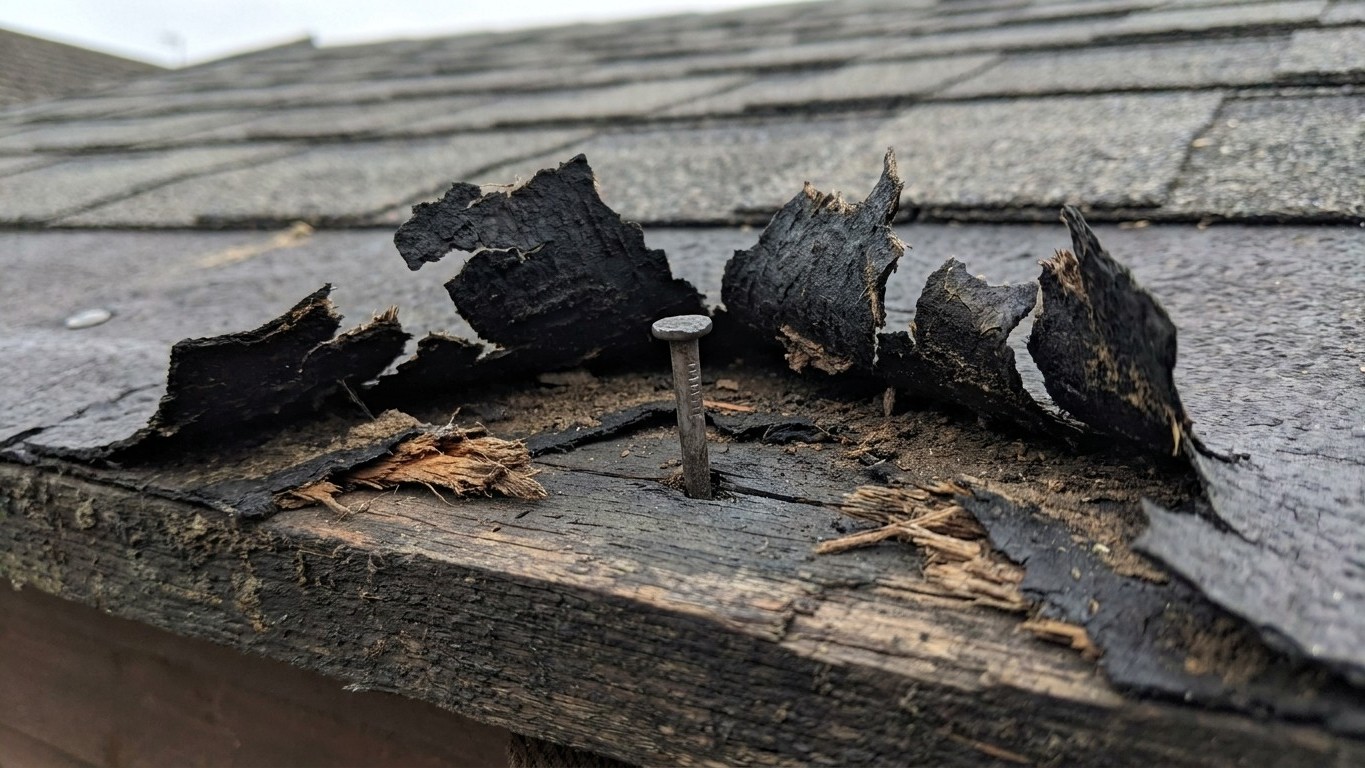
Roofing felt tears around nail heads for one reason above all others: it was laid under heat and expanded, then contracted overnight as temperatures dropped, pulling the material tight across every fixing point until something gave way. The nails didn’t fail. The felt moved, and the nails stayed put. That distinction matters enormously when you’re standing on a stepladder at seven in the morning, wondering where you went wrong.
Key takeaways
- Bitumen felt expands in heat and contracts overnight, creating tension that concentrates at nail holes
- A 15-20°C temperature swing between afternoon and morning can shift felt several millimetres per metre
- The solution involves timing, nail spacing, and a counterintuitive 20-minute waiting period before fixing
What heat actually does to shed felt
Roofing felt, the standard bitumen-based type sold in rolls at every builders’ merchant — expands when warm and contracts when cool. On a hot summer afternoon, the material you’re laying is already stretched slightly beyond its resting state. You nail it down flat, it looks perfect, and you feel rather pleased with yourself. But as the evening cools and the felt shrinks back, it has nowhere to go. The tension concentrates at the weakest points, which are precisely the small holes punched by your clout nails. By morning, those holes have become tears.
The thermal movement involved is more significant than most people expect. Bitumen felt can shift by several millimetres per metre of length across a reasonable temperature swing, and a British summer day can easily see a 15 to 20 degree difference between a sun-baked afternoon and a cool night. Over a two-metre shed roof, that movement adds up fast. Overlapping sheets compound the problem, because each sheet moves independently and can pull against its neighbour.
The right way to nail felt in warm weather
The golden rule, which most instruction leaflets bury in the small print, is to wait. If you’re working on a genuinely hot day, lay the felt out loosely on the roof and let it sit in the shade for twenty minutes before fixing it. This allows it to reach something closer to its ambient resting temperature rather than an artificially expanded state. It sounds almost too simple, and yet it makes a real difference.
Nail spacing matters just as much. The common mistake is to nail only the edges and overlaps, leaving large unsupported spans in the middle. On a cool day, this is fine. On a hot day, those unsupported spans are where the buckling and stress concentrate. Space your clout nails no more than 150mm apart along any edge exposed to tension, and use a generous overlap of at least 75mm between sheets, some roofers prefer 100mm in exposed positions.
The nails themselves deserve a mention. Standard galvanised clout nails with a large, flat head distribute the load across a wider area of felt than ordinary wire nails. Using the wrong type of nail, anything with a small head, dramatically increases the chance of pull-through, regardless of the weather. A 20mm clout nail is the standard choice for single-layer felt on timber boarding; go to 25mm if your decking boards have any roughness or unevenness.
Some experienced shed builders take a belt-and-braces approach in summer: they apply a thin bead of bitumen adhesive along the overlap before nailing, so the joint is bonded as well as mechanically fixed. The adhesive holds even if a nail tears slightly, and it stops wind from lifting the overlap and letting water in. A small tin of cold-applied bitumen mastic from any roofing supplies stockist costs very little and lasts for several repairs.
Repairing the damage without stripping everything off
If you’ve already had the overnight disaster and you’re facing a roof dotted with torn nail holes, the repair is straightforward as long as the tears haven’t let water in yet. Work on a dry, overcast day if you can, warm enough for the felt to be pliable, but not so hot that history repeats itself.
Cut small squares of spare felt, roughly 100mm by 100mm, and bed each one over a damaged area using cold bitumen adhesive. Press firmly, smooth out any air pockets, and nail the corners with fresh clout nails set at least 25mm in from the edge of the patch. The patch goes over the damage, not under it, so water running down the roof goes over the patch rather than under it. This is the point where a surprising number of well-meaning repairs go wrong.
For tears longer than about 50mm, or if the original felt has become brittle (a sign of age rather than just heat damage), you’re better off replacing the whole sheet rather than patching. Brittle felt won’t bond properly to adhesive and will simply crack again at the next temperature extreme. Fresh felt is inexpensive by any measure, and replacing one sheet takes under an hour.
A few things worth knowing before next summer
Mineral-surfaced felt, the heavier grade with a granular coating on the top surface, handles thermal movement better than the smooth, lighter grades. The mineral layer adds a degree of dimensional stability and also reflects more heat, which keeps the felt cooler in direct sun. It costs a little more per roll but tends to outlast the lighter grades by several years on a south-facing roof.
There’s also a class of self-adhesive torch-on membranes that bond directly to the deck and eliminate the nail-through problem almost entirely, but these require a degree of care to apply correctly and are overkill for most garden sheds. For straightforward shed roofing, standard felt applied with proper technique and the right nails in reasonable temperatures remains perfectly adequate.
One detail that catches people out: a shed roof laid in high summer will sit at its most contracted state on a cold January morning, and at its most expanded state on a July afternoon. If it’s going to fail, it tends to do so in the first autumn after laying, when the first significant cool spell arrives. A roof that survives its first winter has generally found its equilibrium and will behave well for years afterwards.