
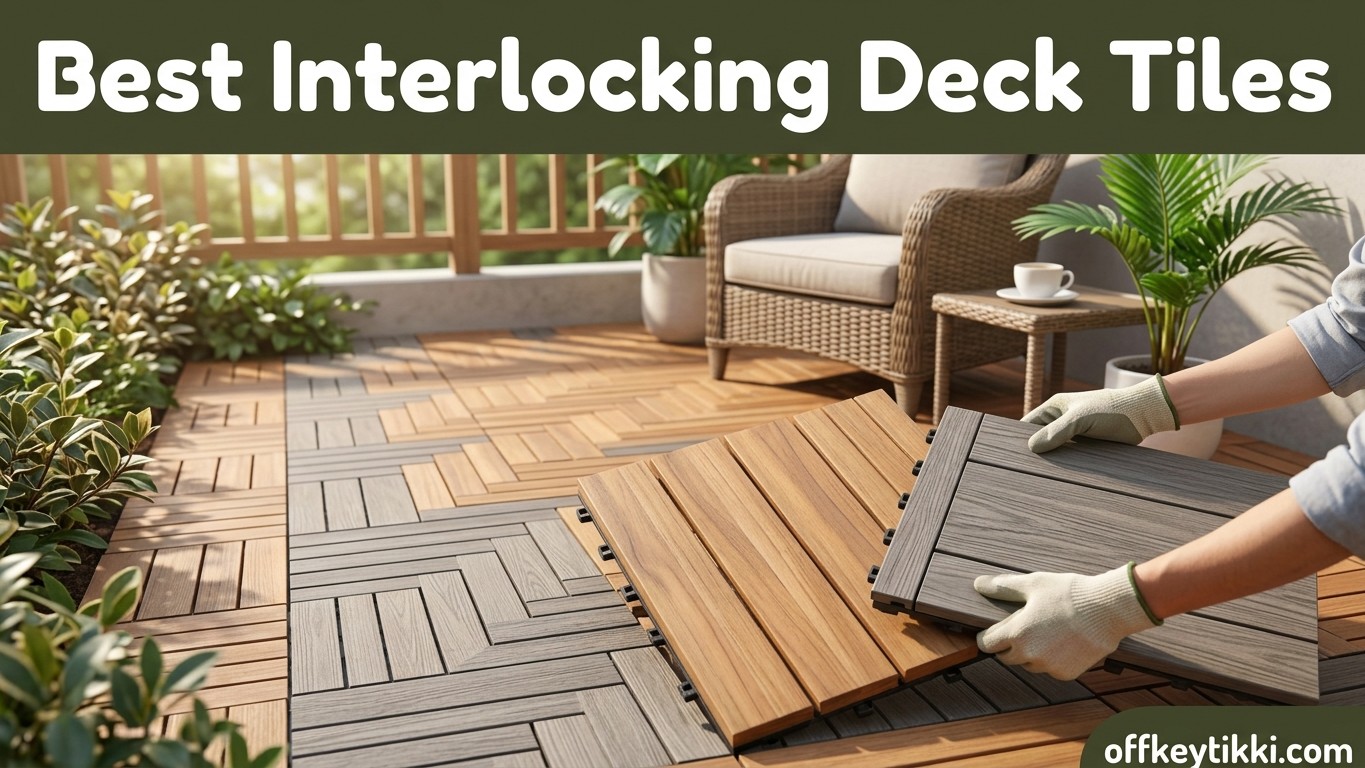
Click-together wood decking tiles look like a dream on the shelf: no tools, no nails, no contractor needed. You snap them together like a giant jigsaw puzzle, stand back, and feel rather pleased with yourself. The trouble is that a south-facing patio in July is nothing like the cool warehouse where those tiles were packaged, and the physics of heat expansion cares very little about your budget or your satisfaction.
Key takeaways
- Dark composite tiles can reach 70°C in full sun, expanding three to five times faster than natural wood
- Those tiny expansion gaps in the fine print? They’re the only thing standing between a flat deck and a buckled disaster
- Installing in spring with cool tiles means August heat will turn your invisible gaps into visible, trip-hazard ridges
Why the tiles seemed perfect at first
The appeal is completely understandable. Interlocking wood-plastic composite (WPC) deck tiles really do install remarkably fast. A 20-square-metre area that would take a professional crew two or three full days with traditional decking can be laid by one person in two to four hours, with zero construction experience required. No subframe, no joist system, no drilling through waterproof membranes. You lay them straight onto existing concrete or pavers, press the interlocking tabs together, and you are done by lunchtime.
The marketing images reinforce this confidence. Gleaming tiles in full sun, perfectly flat, not a ripple in sight. What those images do not show is the date they were taken, the temperature on the day, or whether the installer left the gaps that nobody tells you about on the front of the box.
What actually happens in full sun, and why contractors winced
Here is the problem that every experienced fitter knows instinctively. The coefficient of thermal expansion of WPC materials is approximately three to five times that of natural wood, and in hot weather the surface temperature of dark-coloured tiles can reach 60 to 70°C. That is the temperature of a very hot oven shelf. Your tiles are not just warm, they are actively growing.
If boards are butted tightly together to achieve a seamless look, the summer heat causes them to expand and push against each other. The boards will inevitably crack, or they will wave and warp entirely beyond repair. With interlocking tiles, the click-together system that felt so satisfying during installation becomes the very mechanism that concentrates the pressure. Each tile pushes against the next, and the next pushes back, and somewhere in the middle of that run the weakest connection pops upward in a ridge you could trip over.
If you install the tiles in midday heat, they are already in an expanded state. When they try to expand further, they buckle, pop and warp. This is what the contractors who laughed already understood: the installation conditions matter as much as the product itself. A professional would know to lay tiles in the cool of the morning and leave deliberate breathing room around every fixed edge.
The colour of your tiles makes things worse than you might expect. Dark colours undergo larger temperature swings upon installation, which is precisely why so many budget tiles sold online come in that attractive dark walnut or charcoal finish. They absorb more heat, they move more, and they fail sooner. Lighter, more reflective composite decking boards absorb less heat than darker options, reducing temperature-related movement.
The gap rule that the packaging buries in tiny print
Every reputable manufacturer does include installation guidance about expansion gaps. The difficulty is that it tends to appear in the small print of a leaflet tucked inside the box, after you have already bought the tiles, driven home, and mentally committed to finishing before tea. You should leave a 0.2 to 0.4 inch gap against all walls and posts for heat expansion. That sounds trivial. On a terrace five metres wide, however, those small gaps are the only thing standing between a flat surface and a buckled one.
All materials expand and contract according to temperature, so when installing tiles between two walls or a wall and a post, it is important to leave expansion gaps, best done in hot conditions when the tiles have already heated up to their most expanded size, so the gap will not get any smaller. Most DIY installers do the exact opposite: they lay on a pleasant spring morning when everything feels manageable, the tiles are cool and easy to handle, and the gaps seem enormous. Then August arrives.
There is also the question of the sub-surface. If the underside of the tile is damp for a prolonged period, the bottom side expands, while the dry top side, especially when in the sun, shrinks, causing warping. A terrace that looks perfectly drained can hold moisture underneath composite tiles for days after rain, creating a moisture and heat differential that cups even well-installed tiles.
How to do it properly if you still want the DIY route
None of this means click-together tiles are a bad product. Used correctly, quality co-extruded interlocking wood-plastic composite deck tiles will last ten to fifteen years with proper installation and basic maintenance. The word “proper” is doing a lot of work in that sentence.
The practical rules are straightforward once you know them. Install in the morning, never at midday. Allow your tiles to acclimatise for at least 72 hours outside in the garden before cutting and fitting, laid flat so they can adjust to your local climate and temperature. Leave those perimeter gaps without compromise, even when it means the edge tiles do not sit flush against the wall. Choose lighter colours for a south-facing spot. For large structural areas of 100 square metres or more, cumulative thermal expansion makes traditional fixed WPC decking preferable to the interlocking modular format.
One thing worth knowing before you buy: economical quick-fit tiles may show significant fading, swelling or delamination within two to five years, and longevity is highly dependent on climate, sunlight intensity, and base grid quality, with cheap polypropylene clips becoming brittle over time. The price difference between budget tiles and properly co-extruded ones is real, and in a full-sun situation it is not a place to economise.
The contractors were not laughing at your ambition. They were laughing because they had seen the same scenario dozens of times, the neat spring installation, the buckled August aftermath, the sheepish phone call. A terrace in permanent shadow is quite forgiving. A south-facing suntrap in a British summer, brief as it is, generates enough heat to expose every installation shortcut rather efficiently. The good news is that if your tiles have already lifted, if boards are buckling because they were installed without adequate gaps, the fix is simple: remove the end board or the board closest to the wall and trim five to ten millimetres off the board end with a fine-tooth blade, then reinstall it with the correct gap. You may salvage the whole lot for the cost of an afternoon and a bit of humble pie.
Sources : archatrak.com | compositewarehouse.co.uk