
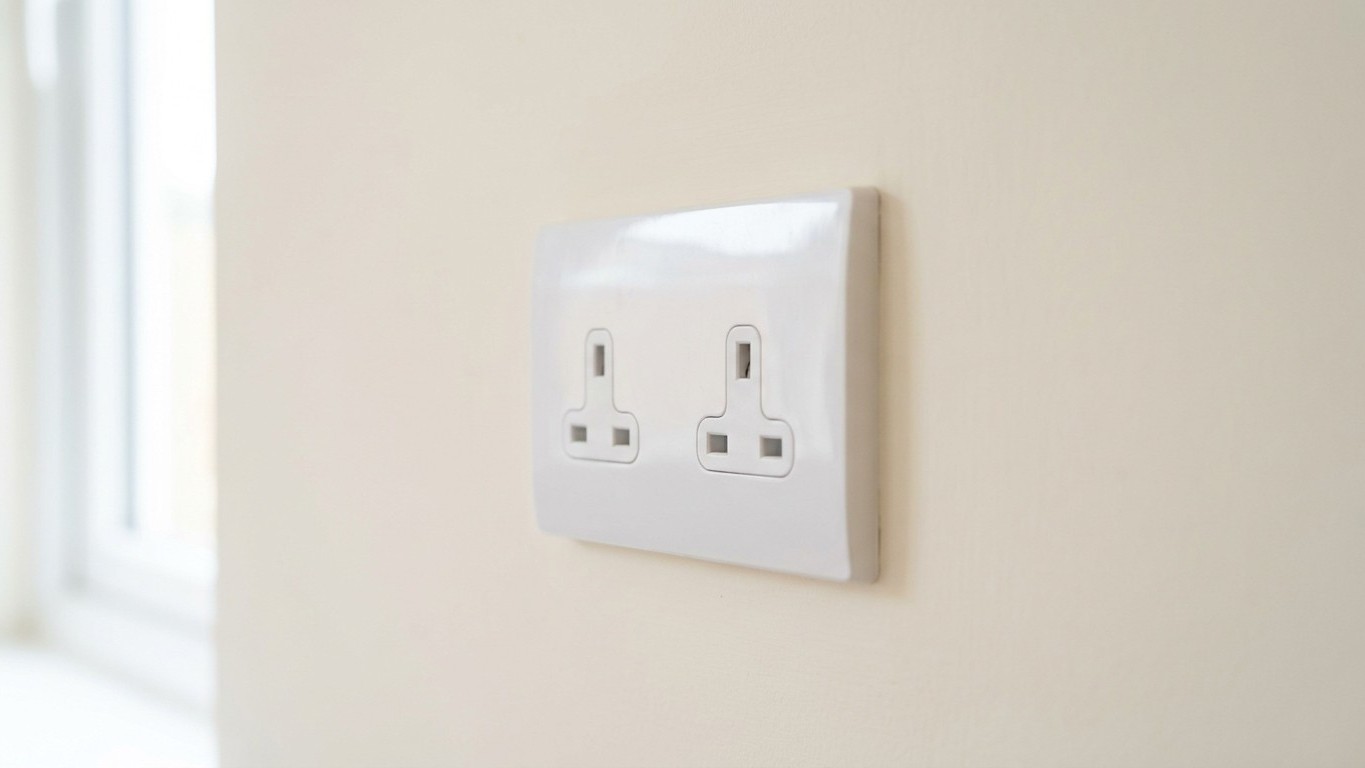
Adding a plug socket yourself is entirely possible in a UK home, and under Part P of the Building Regulations, adding a spur to an existing circuit in a standard room is one of the jobs that does not require notification to building control. The faceplate looked tidy, the socket clicked into the backbox perfectly, the power came back on without a hitch, and nothing tripped. Job done, or so it seemed. What an Electrician spotted weeks later, during a routine check on another piece of work, was something no visual inspection in the world would have caught.
Key takeaways
- A socket that looks and works perfectly can hide a loose wire terminal that causes dangerous arcing and fires inside walls
- Visual inspections catch nothing—only calibrated testing equipment can detect high-resistance connections that produce intense heat
- Two common DIY mistakes (under-stripping and over-stripping wire) create invisible poor connections that build inspectors and basic socket testers will miss
The invisible danger behind a perfectly fitted socket
The socket itself was fine. The screws were in. The cover plate sat flush. The problem was inside the terminal block: a wire that looked connected but wasn’t quite gripped by the screw. Loose connections are a leading cause of electrical fires. When a wire is not securely fastened in a terminal, it creates a high-resistance point, which leads to “arcing,” where electricity jumps across small gaps. That arcing is not a slow, lazy smoulder. It produces intense heat and can ignite surrounding materials. Inside a wall cavity, with timber noggins and plasterboard just centimetres away, the consequences are obvious.
The truly unsettling part is how completely undetectable this is to the eye. A high-resistance connection can occur in a circuit anywhere a cable or wire is joined, most commonly at an accessory such as a socket outlet or junction box. The most common cause is simply a loose screw terminal connection, it may not have been made sufficiently well in the first place, or dirt and debris could be present, or it might loosen over time. A trained Electrician does not rely on looking at it. They test it — with calibrated equipment, checking continuity and resistance values that no visual check can replicate.
There are two related errors that often appear together in DIY socket work. The first is under-stripping: the screw grips the plastic insulation rather than the copper conductor itself, so the terminal looks tight but has almost no real contact. This “screw-on-insulation” error means the terminal grips the plastic instead of the copper, creating a poor connection. The second mistake runs in the opposite direction: stripping too much wire back so that bare copper sits exposed outside the terminal. Bare wire can touch other wires or the metal back-box, causing a short circuit or making the metal box live. Aim for roughly 10–12mm of stripped conductor, seated fully into the terminal before the screw is tightened.
What actually needs testing, and why you probably can’t do it yourself
Here is where the DIY socket story becomes more complicated than most YouTube tutorials admit. The key is in the testing. The circuit needs testing before the job to make sure it is suitable to take the proposed changes, and afterwards to verify that the work done is safe and sound. That testing requires a proper multifunction installation tester, not a basic socket tester from a hardware shop, and certainly not a neon screwdriver. The lack of a proper, calibrated multimeter or voltage indicator is particularly dangerous, as cheap non-contact voltage testers can sometimes give false negatives or fail to detect certain types of faults.
Before adding a spur, an electrician will also verify that the socket you are spurring from is actually on the ring main, not already itself a spur. If you have only one cable coming into the existing socket, it is a spur already, which you cannot extend. There can only be one spur per socket or junction box, to ensure that the socket you are spurring from does not get overloaded, in the event there is too much draw on the spur, things can get very hot and eventually catch fire. Checking which type of circuit you have requires continuity testing of the ring, not just a peek behind the faceplate.
There is also the matter of RCD protection. Current regulations require RCD protection for almost all domestic circuits. If you are adding a new socket, it must be RCD protected. Since January 2025, all new installations must include RCDs under the updated BS 7671 18th Edition, Amendment 3 requirements. If your consumer unit is older and certain circuits lack RCD coverage, adding a socket without addressing that is a compliance issue, not a cosmetic one.
The legal and insurance reality no one mentions on forums
Adding a spur to an existing circuit in a standard room is classified as non-notifiable work under Part P, meaning you do not need to inform building control before starting. Some minor electrical work will not be notifiable. Examples include adding a power point to an existing circuit or adding a spur to an existing circuit. That sounds reassuring. But non-notifiable does not mean regulation-free. Any new work should still be carried out in accordance with BS 7671. The standard applies regardless of whether anyone comes to inspect it.
Where this becomes painfully consequential is insurance. If you break the rules and an electrical fault is responsible for damage in your home, you may find that your home insurance has been made invalid by the fact you did the work yourself and cannot provide a minor certificate of works for it. That is not a small-print technicality. It is the scenario where a fire starts inside the wall behind your new socket at three in the morning, and the loss adjuster asks for the paperwork you do not have. Insurance issues can arise when non-compliant work contributes to a fire or electrical fault, as your buildings or contents insurer may refuse to pay out.
There are warning signs worth knowing regardless of who did the installation. Flickering lights could indicate a loose connection in the circuit. Electricity should be silent, a buzzing sound coming from a switch or socket is often the sound of arcing. An unusual fishy smell is often the first sign that plastic components are burning or melting. Any of these should be treated as urgent. Turn off the circuit at the consumer unit and call a registered electrician — do not simply unplug things and hope for the best.
Getting the paperwork sorted after the fact
If you have already added a socket, the sensible move is to have it inspected and tested by an electrician registered with a Government-approved competent person scheme such as NICEIC or NAPIT. The NICEIC and NAPIT each maintain a list to help you find a suitable Part P electrician. Retrospective regularisation is possible, a registered electrician can inspect existing work and, if it is compliant with BS 7671, issue the appropriate certification. But it costs money and is not guaranteed if the original work was substandard.
A Minor Electrical Installation Works Certificate, issued after an inspection and test by a qualified electrician, gives you the documentation you need, for your insurer, for a future buyer, and simply for your own peace of mind. Over half of all accidental fires in Britain start from electrical faults. A socket that looks perfect and works perfectly can still contain a terminal connection that, over months of thermal cycling and expansion and contraction of the cable, is slowly working its way loose. That is not a reason to never pick up a screwdriver. It is a reason to pick up the phone to a qualified electrician once you have.
Sources : dorsetelectricalsolutions.com | diynot.com