
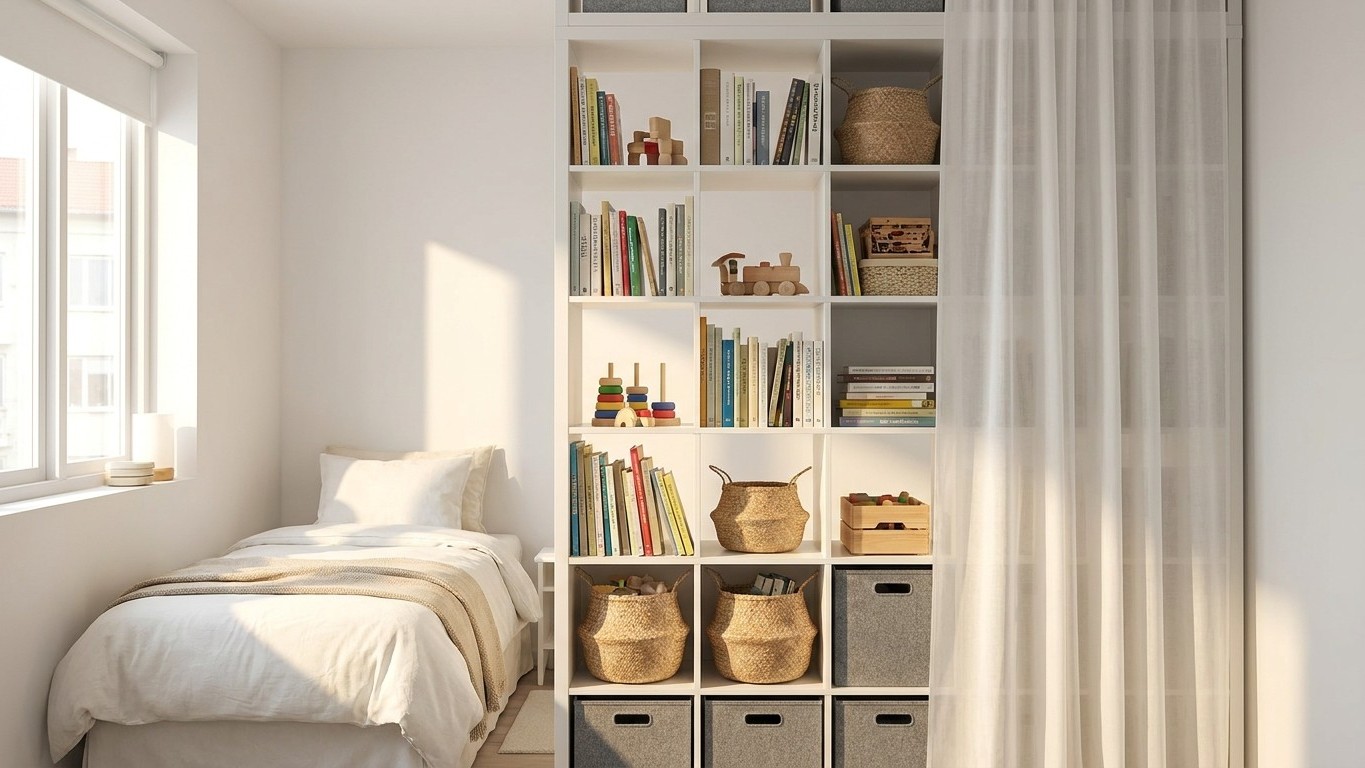
Moving house in Britain has never felt more punishing. The average cost of moving to a new home sits at around £13,018, and that’s before you’ve even started dreaming about the extra bedroom, the home office, or a sliver of genuine privacy. Almost three quarters of current homebuyers are looking to upsize, with the majority motivated by the need for more space due to growing families. But here’s the thing: a growing number of families across the UK have quietly stopped searching for bigger properties altogether. They’ve found something cheaper, faster, and frankly rather clever, a simple IKEA hack that turns one room into two.
Key takeaways
- One viral TikTok showed how stacked KALLAX shelves and MDF created a private bedroom from a shared space—attracting half a million views
- The hack works because filled cubbies act as sound barriers AND storage, while remaining accessible from both sides
- It’s completely reversible, costs a fraction of moving, and can be installed in an afternoon with basic DIY skills
The KALLAX That Changed Everything
The hero of this story is, without fanfare, a cube shelf. The IKEA KALLAX has become a staple in homes around the world. Known for its clean lines and cube-based design, it’s perfect for storage. Also, as a room divider in open-plan homes, studios, or compact apartments, whether you want to create zones, define areas, or simply add visual structure.
The hack that sent the internet into a mild frenzy involves stacking KALLAX units floor-to-ceiling and then adding an MDF panel on the back to mimic a proper wall. One TikToker, Danielle from @daniellejohnstonex, shared a video that attracted nearly 500,000 views in which she explained: “We split one room into two using IKEA KALLAX units, and I still get asked so many questions about how we’ve done it.” She had three daughters sharing a single bedroom. One shelf unit and a bit of MDF later, her eldest had her own private space. The result looked, by all accounts, as though it had always been there.
Danielle stacked several KALLAX units together in the centre of the room and then installed an MDF “fake wall” on the backside, painted to match the rest of the walls so it looks like it’s been there the whole time. The entrance to her daughter’s side? Just a curtain, though she noted “you could put a door.” Practical, reversible, and genuinely pretty. No planning permission, no builder’s dust, no remortgaging required.
Why It Actually Works (Not Just Looks Good)
A wall of KALLAX isn’t simply a visual barrier. The KALLAX units are firmly secured to the wall and ceiling using weight-bearing bolts, as is the MDF faux wall, so there’s no chance of the room divider tipping. Because the cubbies are filled with clothing, toys and crafts, it also works as a sound buffer between the two spaces. That’s something a simple curtain rail could never claim.
KALLAX shelving units are accessible from both sides, so you still get the feeling of two independent rooms. Use different inserts to organise belongings and free up desk space. On one side, books and bedtime reading; on the other, a tidy row of fabric storage boxes for the children’s toys. One side can store books, while the other might hold plants, photos, or even hooks for bags and accessories, making the unit useful for both zones it separates. That is a genuinely clever piece of design thinking, not just a viral gimmick.
The structural element matters too. Stability comes down to the framing: the PAX system (and by the same logic, KALLAX) doesn’t offer enough support if you screw MDF straight into it, so a proper timber frame behind is essential. Skip that step and you risk the back panel coming loose, or worse. Do it properly, though, and the finished result is solid, safe, and convincing enough to fool most visitors.
How to Build Your Own Room-Within-a-Room
The basic method is accessible to most confident weekend DIYers, though it does require a free afternoon and a second pair of hands. Here’s the practical sequence:
- Decide on the configuration, a 4×4 KALLAX gives a generous height, while two 2×4 units side by side cover more width.
- Assemble and position the units, then secure them together with bolts through the side panels.
- Build a slim timber frame (2×4 timber works well) to act as the structural support for the MDF back panel.
- Fix the MDF to the frame, fill the joints, sand, and paint to match your existing walls.
- Anchor the whole structure to the ceiling and at least one stud wall using appropriate fixings.
If needs change later down the line, the room divider can be easily dismantled, and the room will return to its original state. That reversibility is gold dust for renters, or anyone who isn’t quite ready to commit to a permanent building project.
For those who prefer not to build a faux wall at all, the open bookcase approach works beautifully in living spaces. KALLAX modules can build a room divider with an integrated desk, a 4×4 unit propped up by two 1×2 units works perfectly as a room divider with a built-in workspace. Open-plan kitchen-diners, studios, even a teenager’s homework corner carved out of a busy living room — all achievable without a single brick.
Beyond the KALLAX: Other IKEA Units Worth Knowing
The KALLAX gets the glory, but it isn’t alone. When one interior designer moved into a narrow townhouse where the shared living and dining areas felt dated and needed better separation, the floor plan made “floating” furniture feel wrong. The solution was IKEA’s ELVARLI shelving, which fitted perfectly between the sofa and dining set. Clever, yes, but also a reminder that the right unit depends on your space. ELVARLI’s open, airy structure suits larger rooms where you want a sense of separation without enclosure.
For a bedroom walk-in wardrobe effect, PAX wardrobes lined up and backed with MDF create a genuinely elegant dressing zone. If a space is too small to function as a full bedroom, it can become a dream dressing area instead. A wall-to-wall run of MALM chests, painted the same colour and topped with a bespoke-cut piece of wood, creates ideal all-round storage. Adding a ceiling-hung rail makes the most of the space, and shelves above work beautifully for perfumes and toiletries.
The IVAR system is another favourite among serious space-hackers. Replacing standard IVAR shelves with horizontal wooden slats spaced evenly apart creates partial privacy while allowing light and air circulation, a semi-transparent effect that defines zones without Completely blocking sight lines, which works particularly well in studios where you want to separate sleeping from living areas.
One detail that tends to surprise people: dense storage combinations filled with books and objects significantly reduce noise transmission even without sound-proofing panels. Fill those cubbies well, and you’ve accidentally improved the acoustics of your DIY room too. A satisfying, if unplanned, bonus.
Sources : livingetc.com | ikeahackers.net