
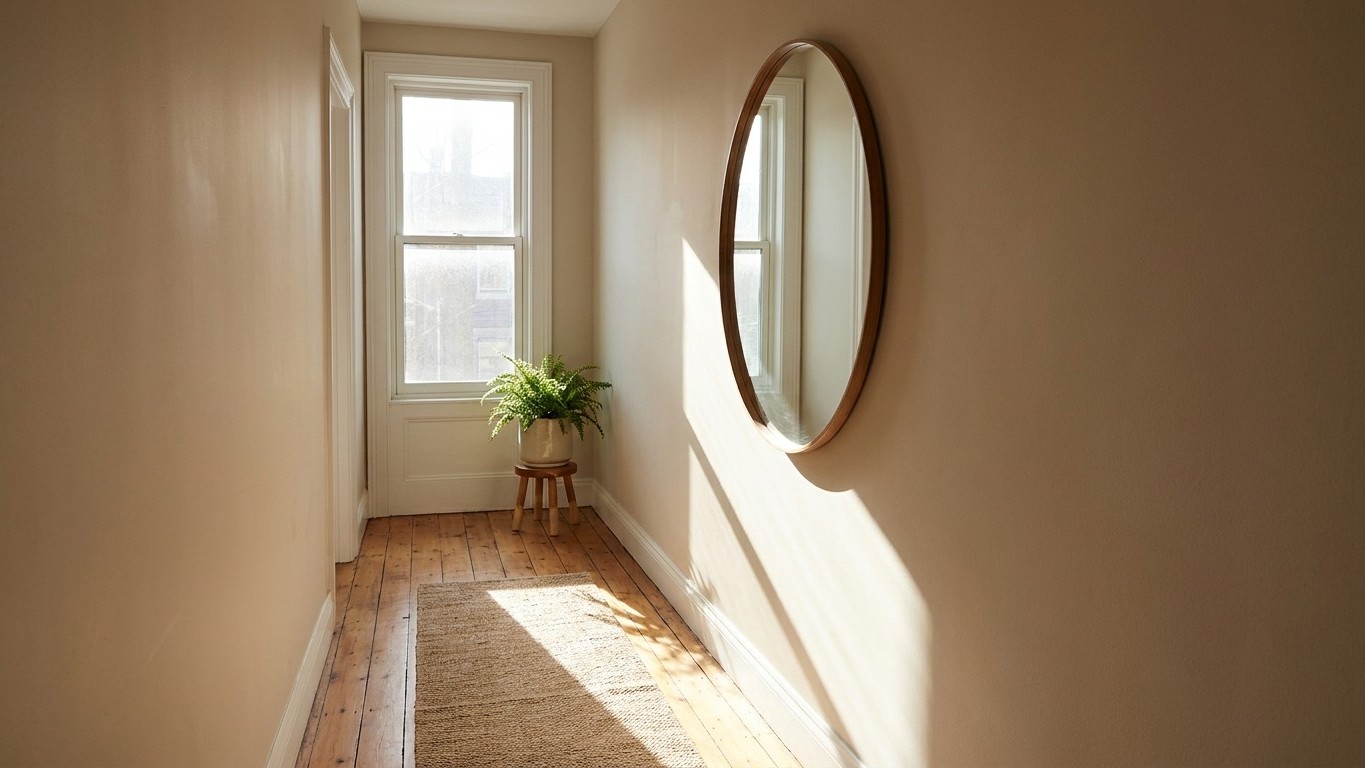
Stand at the far end of your corridor and look toward the window at the other end of the house. If your mirror hangs on the wall beside that window rather than facing it head-on, you are only catching a sliver of what daylight has to offer. The trick That Actually Works is hanging the mirror on the wall directly opposite the window, or at the far end of the hallway facing back toward it, so the glass catches the full beam of daylight and throws it straight down the length of the passage.
This is not decorating folklore. Reflection follows the law of physics stating that the angle of incidence equals the angle of reflection, meaning light striking a mirror at a specific angle will bounce off at the same angle on the opposite side. A mirror facing a window catches light head-on and sends it straight back out into the room in a controlled beam. A mirror sitting beside the window only ever catches light glancing across its surface at an angle, so most of it skids off sideways into a wall rather than travelling down your corridor.
Key takeaways
- The angle of incidence equals the angle of reflection—but most people position mirrors all wrong
- A mirror opposite a window reflects 90% of light straight down your corridor; beside it, light just skids off sideways
- Height matters as much as position: too low and you’re reflecting the floor instead of the sky
Why “opposite” beats “beside” every time
A silvered mirror is a remarkably efficient light-mover. A silvered mirror reflects roughly 90 to 95 percent of the visible light that lands on it, and it reflects that light directionally rather than scattering it. Compare that with plain window glass, which barely reflects anything at all under normal daylight conditions, since the glass reflects about 4% of the incident light and transmits 96%. That gap, roughly 90 percent versus 4 percent, is the whole reason your grandmother’s trick of “catching the light” with a looking glass actually holds water.
Position matters just as much as the mirror itself. One of the most effective and widely used techniques for enhancing natural light is to place a mirror directly opposite a window, doubling the visual impact of the window and reflecting the light. Also, the view outside. I think of the mirror as standing in for a second window, a trick your corridor desperately needs when it has none of its own. If a hallway runs perpendicular to the window rather than in line with it, all is not lost: positioning it on an adjacent wall can still be highly effective, angling the mirror slightly to catch and reflect light from the window into the room. The angle is the whole game here, not the address.
This matters more in some homes than others. North-facing hallways, the ones that never get a direct shaft of sun even at midday, are exactly where this technique earns its keep, because this technique works particularly well in north-facing rooms that receive less direct sunlight, helping to brighten them considerably. I have one such corridor myself, and moving a plain oval mirror from the side wall to the end wall facing the kitchen window transformed it from a place I switched the light on for at 2pm to one that stays readable until early evening.
Getting the height and size right
Height is where most people go wrong even after they have the position sorted. Hang the mirror too low and it catches skirting board and floor rather than sky. The rule worth following is that you should position the mirror at a height that captures the most light throughout the day, often aligning with the top of the window frame. In a Victorian terrace with tall sash windows, that might mean your mirror sits higher than instinct suggests, closer to picture-rail height than eye level, so it is catching sky rather than the neighbour’s fence.
Size counts too, and there is no getting around simple arithmetic here: a bigger sheet of glass returns a bigger patch of daylight. A larger mirror will reflect more light and a greater portion of the view, making a more significant impact. For a narrow corridor, a full-length mirror at the far end does more useful work than a small round one, since it is capturing daylight across its entire surface rather than a modest circle of it. Budget-wise, this is good news for anyone rummaging through a charity shop or car boot sale. An unloved, slightly foxed full-length mirror costs a fraction of a made-to-measure piece and works just as well once it is hung in the right spot, foxing and all.
What to avoid, and one thing worth checking first
A mirror is entirely unfussy about what it reflects, which is both its strength and its weakness. Point it at daylight and it earns its keep; point it at a cluttered coat rack or the murky end of a cupboard and you have simply doubled the mess rather than the brightness. It is also worth remembering, gently, that a mirror is a redirector rather than a generator: a mirror cannot increase the total amount of daylight entering your home, only a bigger window or a skylight does that, since a mirror does not make new light. If your corridor window is small or heavily obscured by a hedge outside, no amount of clever mirror placement will turn it into a conservatory. It will, however, make every drop of light that does arrive work twice as hard.
One detail people rarely consider is what happens once the sun has gone down. The same trick that flatters daylight also flatters a lamp. You can place a mirror behind a lamp so the reflective surface catches the bulb’s light and doubles the illumination, preventing dark, “dead” corners at the far end of the passage once evening draws in, which means the same mirror that solves your daytime gloom quietly earns its keep after dark too, without you lifting a finger or spending another penny on lighting.
Sources : physicsforums.com | glasstailors.co.uk