
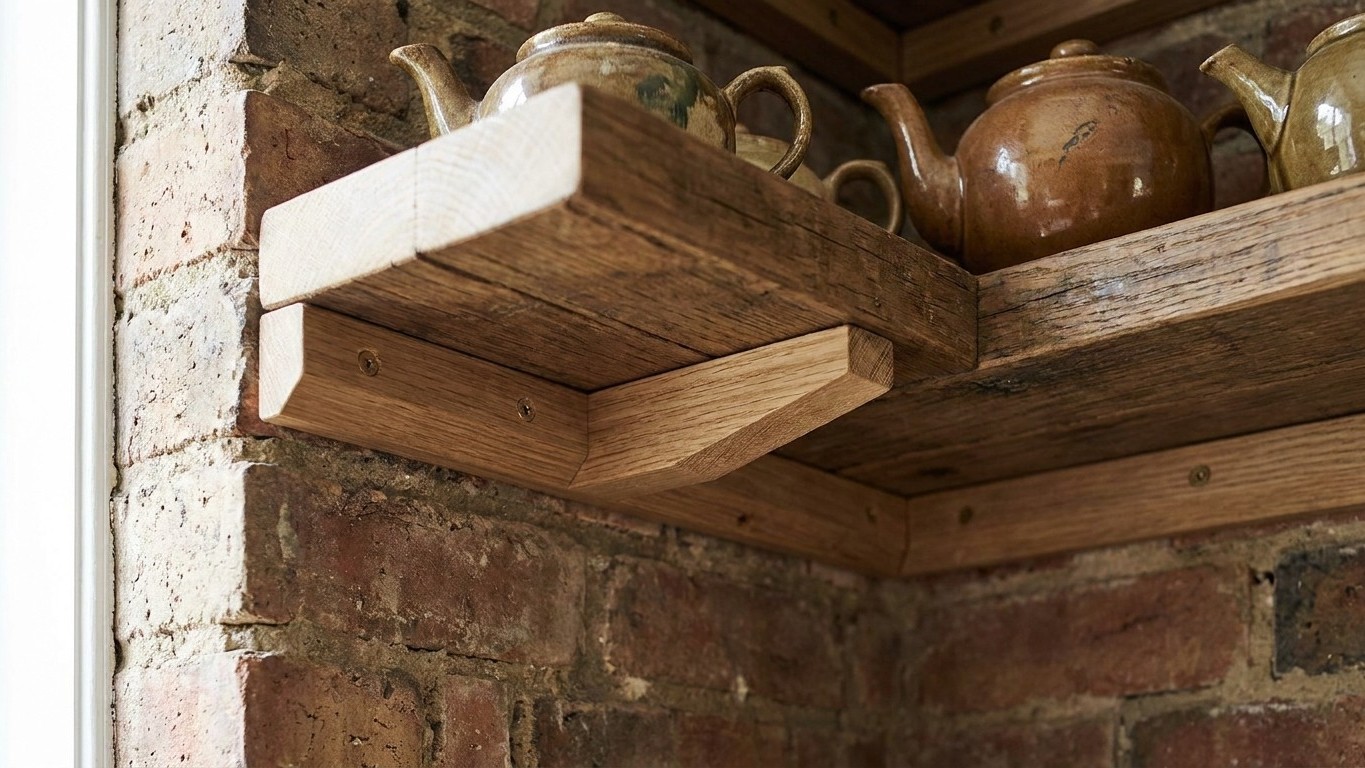
That corner shelf wobbling precariously on two chunky L-brackets bolted straight into next door’s brickwork? It’s the wrong tool for the job. A single splayed timber batten, cut at 45 degrees and fixed with just two screws into sound masonry, will carry that same shelf more securely, more cheaply, and with far less damage to a wall you don’t even fully own the rights to alter.
This trick has a proper name, the French cleat, though nobody in my kitchen ever called it that until fairly recently. It’s simply two strips of wood, each with a matching angled edge, one screwed to the wall and one screwed to the back of the shelf. Slot them together and gravity does the rest. It consists of two strips of wood with beveled edges, one attaching to the wall with the sharp edge pointing upward and sloping downwards toward the wall, the second attaching to the back of the cabinet with the sharp edge pointing downward and also sloping away from the cabinet. The weight of your shelf actually pulls the two halves tighter together rather than trying to shear the screws sideways, which is exactly what a plain bracket asks its fixings to resist all day, every day.
Key takeaways
- A simple £7 timber batten can hold the same weight as multiple expensive brackets using just two screws
- Party wall corners are unpredictable—what’s behind your bracket mounting point might be crumbling rubble, not solid brick
- The angled design uses gravity to pull the two pieces tighter together, not shear your fasteners apart like brackets do
Why brackets struggle on a party wall corner
Party walls in older British terraces and semis are rarely the uniform, predictable surface you’d like them to be. Solid brick coursing near a corner (what a bricklayer calls a quoin) is often cut and patched, mortar joints wander, and there’s frequently a skim of old lime plaster hiding softer material behind. Bolt a bracket directly under each arm of a corner shelf and you’ve committed to whatever happens to be behind that exact spot, good brick or crumbling rubble fill. You get no choice in the matter.
A batten changes that equation entirely. Instead of needing two, three or four separate brackets each demanding a decent fixing in an awkward corner, you need just two solid screw points anywhere along the length of the wall-mounted cleat. The strength of the French cleat is directly tied to successful mounting, and if it is properly anchored to multiple wall studs, this system is incredibly strong. You slide the fixing points along the batten until you find brick that gives you real resistance when you drill, rather than being locked into wherever a bracket’s pre-drilled holes happen to land. On stud partition walls this matters even more, since UK timber stud walls typically have studs at 400mm or 600mm centres, with the first stud usually 50 to 100mm from a corner or doorframe, an awkward distance that rarely lines up neatly with where you actually want your shelf brackets.
The mechanics behind those two screws
Skeptics in my family (my son-in-law, mainly) assumed two screws couldn’t possibly hold what four brackets manage between them. The woodworking world disagrees rather firmly. A French cleat does not add any additional strength beyond the fasteners in each half, it’s basically a convenient way to hang something such as a cabinet or framed mirror on a wall. But that’s precisely the point. Because the load is spread along the entire interlocking edge rather than concentrated at two or four small points, solid cleats mounted into wood studs can easily handle 50 to 100 or more kilograms, which is considerably more than most of us will ever pile onto a corner shelf.
The one non-negotiable rule is finding solid fixing for the wall-side cleat. The strength depends on the anchoring wood screw hitting the centre of the wall stud, which is why it’s essential to use a quality stud finder to mark the edges of the studs, generally about 1.5 inches wide, so the anchor screws can locate the centre. Miss the centre and drive in at an angle, and even the sturdiest batten will eventually work loose. It’s the same principle whether you’re screwing into timber studwork or solid party wall brick, though for masonry you’ll want a decent wall plug rather than relying on the screw alone.
Building and fitting your own for under a fiver of timber
You don’t need anything exotic. A length of 70mm by 20mm planed timber batten, the kind sold by the metre in any builders’ merchant or DIY shed for a few pounds, does the job perfectly well for a modest corner shelf. Cut it at 45 degrees along its length (a mitre saw makes this trivial, though a sharp panel saw and a steady hand manage fine too), then cut a shorter matching piece from the offcut for the shelf side.
Screw the longer piece to the wall first, angled edge facing up and out, checking it’s dead level with a spirit level before you commit. Using a spirit level, level the cleat and screw and fix the opposite end, and the shelf unit should now hang just fine. Glue and screw the shorter matching cleat to the underside of your corner shelf, angled edge facing down and in towards the shelf, then simply lift the shelf and let the two bevels drop together. No wrestling a heavy corner unit into position while trying to mark drill holes with your elbow. No filling four ugly holes if you get the spacing slightly wrong the first time.
For anything genuinely heavy (a chunky oak corner shelf loaded with box files, say), add a second cleat further along the same wall run or fix a small screw through both halves once positioned, purely to stop lateral creep over years of use. Most kitchen and hallway corner shelves never need this belt-and-braces step. My own oak corner unit has held a rotation of teapots for the better part of six years on nothing more than the interlocking bevel and its own good sense, and it hasn’t budged a millimetre.
Sources : shopfittingsstore.com.au | lumberjocks.com