
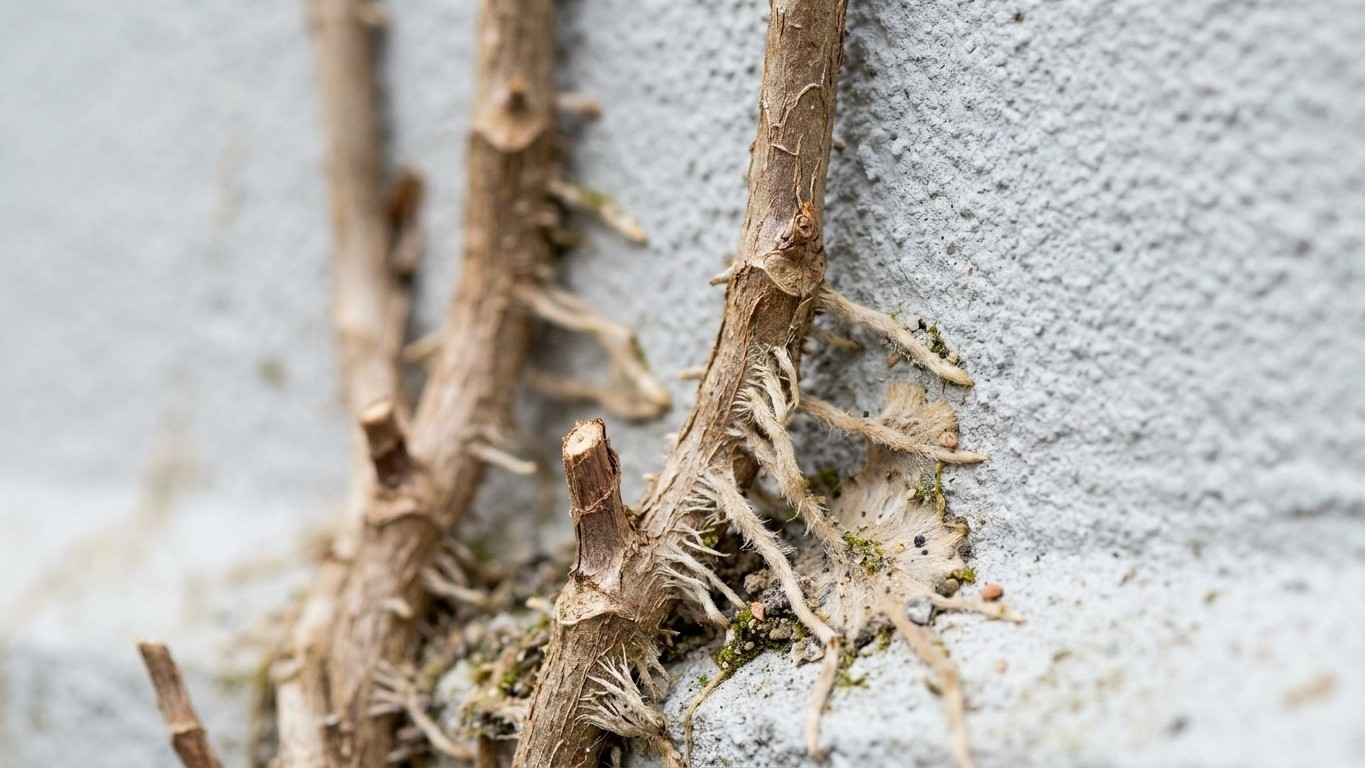
Cut ivy flush against a wall and within weeks two things happen at once: fresh green shoots start pushing up from the base, and the old aerial roots stay bonded to the render like they’ve been set in glue. Neither surprise is unusual, though most people find it baffling the first time. The plant hasn’t actually died where you cut it, and the bits left stuck to your wall aren’t roots in the way we normally think of them at all.
I’ve had letters from readers convinced their ivy is somehow “immortal” because a stump they thought they’d dealt with sent up shoots the following spring. It isn’t magic, it’s biology, and once you understand what’s actually happening under that green curtain, the whole business of clearing it becomes far less mysterious.
Key takeaways
- Cutting ivy flush doesn’t kill it—dormant buds hidden near ground level can regrow like a reset button
- Those stubborn pale tendrils aren’t feeding roots; they’re attachment structures that use natural adhesive and mechanical hooks
- The safest removal method involves patience: cut stems, wait for them to die, then gently remove the brittle remains from top down
Why a flush cut rarely finishes the job
All cut surfaces should be treated immediately with herbicide to prevent regrowth, because there may be dormant buds where the roots become stems, and these are difficult to see and can regrow. That’s the crux of it. Somewhere near ground level, tucked into the bark of an old woody stem, sit little buds you’d never spot with the naked eye. Snip the ivy off flush and leave that stump in the ground, and you’ve essentially pruned it rather than killed it.
Historic England, who deal with this on listed buildings and old churches all the time, are blunt about the ground-level approach: cutting ivy at ground level in an attempt to kill it off is not recommended, as it may lead to rooting-in problems higher up the wall. The theory goes that a stem severed low can sometimes still root in further up if conditions are damp enough, though this mostly applies to older buildings with soft, crumbly mortar rather than a modern rendered semi. On a well-built house, a clean cut through the main stems will normally see the top growth die back over several weeks, since this cuts off the water and nutrient supply to all the growth above, causing it to die within a few weeks.
The trouble is what’s left behind at soil level. Even a fragment of root can restart the whole show. As one tradesperson put it plainly when asked about ivy pushing up through paving and cracking a wall, it is always best to remove ivy from the root as it will always grow back once cut and potentially grow back stronger. That’s why I always tell readers to fork out along the base and lift as much root as they can, rather than relying on secateurs alone.
The bit that “welds” itself to your render
Now, the part that genuinely fascinates me. Those pale, fuzzy little tendrils you find still gripping the wall months later aren’t feeding roots at all, they’re attachment structures, and the way they work is rather clever. As ivy begins to climb, it is triggered to adapt its aerial roots to fit the surface and increase their contact with the wall. Tiny hairs grow on the aerial roots, and they secrete a chemical to help them stick to the surface, and attachment is further strengthened by hook-like growths on the root hairs, which then dry out into spiral shapes that lock the ivy onto the wall. It’s essentially a natural adhesive and mechanical clamp working together, which is why a dead stem can still cling on stubbornly weeks after you’ve cut it through.
Here’s the reassuring part for anyone worried their render is being eaten alive: although the attachment is remarkably strong, it is entirely superficial, and the attachment roots do not penetrate the masonry material or extract moisture or nutrients from it. The RHS backs this up, noting that its aerial roots are unable to bore into sound masonry, and they often only cause damage when they are removed with force. the ivy itself was never really the villain, your crowbar approach to pulling it off might be.
That said, don’t get complacent if your wall already has cracked mortar or flaking render. In some circumstances ‘proper’ roots are produced, usually at leaf nodes, which may occur if the base of the plant is cut, if a wall is very damp, or if there is organic matter from which ivy can extract nutrients, and these roots can penetrate the structure via any small crack or hole, growing in size and number under suitable conditions. So a sound wall has little to fear; a tired, damp one genuinely can suffer.
How to tackle it without scarring your wall
The most sensible method, and the one professionals tend to favour, is doing the job in two stages rather than one violent yank. Cut the main stems low down, treat the stumps, and simply leave the dead growth up on the wall for a while. Dead ivy is lighter, more brittle, and comes away from the wall much more easily than live growth, reducing the risk of masonry damage. If your render is delicate, you can even leave the withered aerial roots to weather off on their own, since where pulling would cause damage to fragile surfaces, cutting the ivy flush with the wall and allowing the remaining aerial roots to weather away naturally can take 6–12 months.
When you do come to strip the tendrils off, work from the top down rather than the bottom up. Historic England’s conservators explain why: it is usually best to start removing stems from the top and outer edges, because the youngest growth at the top is often the hardest to remove, as the young aerial roots adhere tightly to the surface, while older stems farther down have little or no attachment to the structure, so the work becomes easier as you move down the wall. A slim wooden or plastic scraper slid flat behind the stem, rather than metal, will save your render from scratches.
One thing worth checking before you start hacking away at a mature, thick stand of ivy on an older property: works must also be timed to avoid disturbing bats, which sometimes roost behind dense growth, and it’s a legal protection, not just good manners. Ring your local wildlife trust if you’re at all unsure, particularly with anything more than a season or two old. A little patience now saves a great deal of scrubbing, swearing, and render repair later.
Sources : diynot.com | rightwash.uk