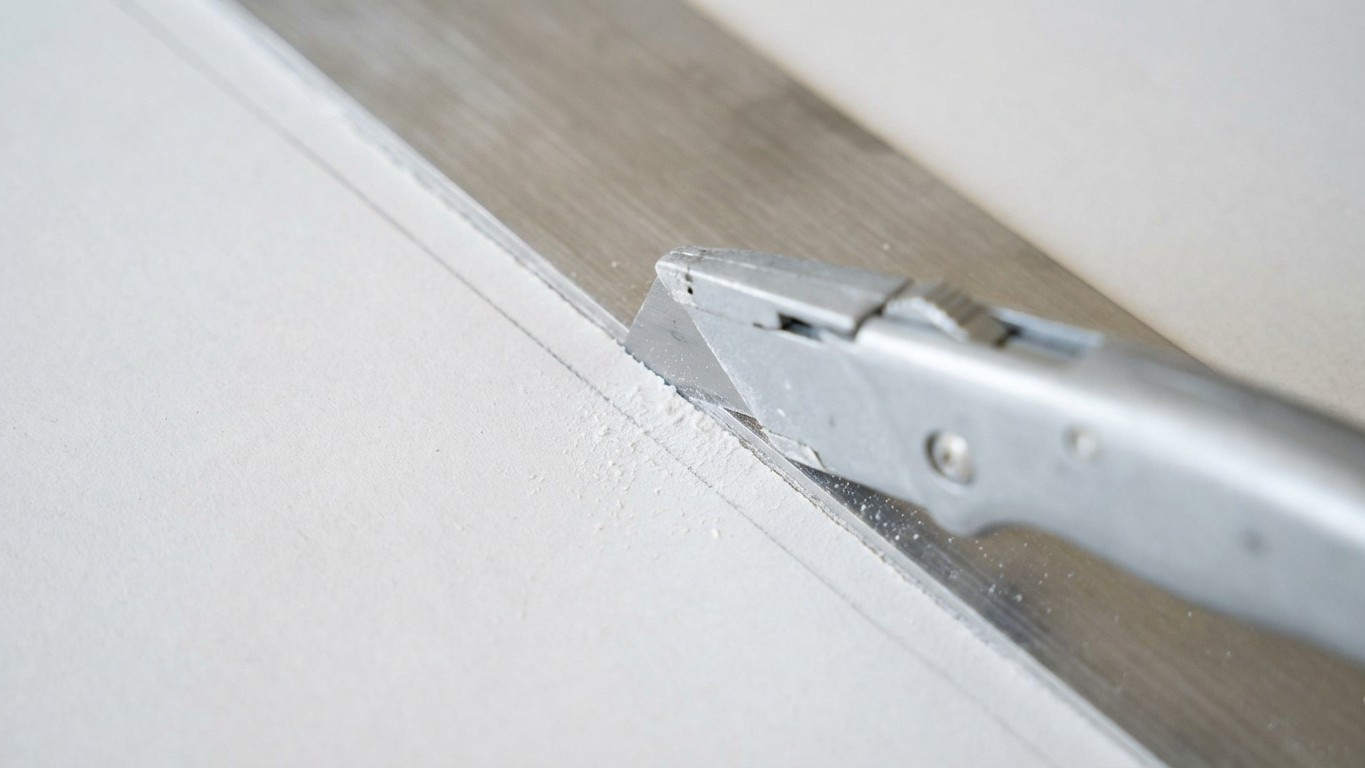
Pulling a utility knife toward yourself when scoring drywall is one of those habits that looks perfectly logical until you examine the edge it leaves behind. The blade flexes slightly under the load, the paper facing tears rather than cuts, and the gypsum core crumbles instead of snapping cleanly. One small change in direction fixes all of that, and once you understand why, you will never go back to the old way.
Key takeaways
- Why the direction you move your knife blade completely changes what happens to the drywall’s paper facing
- The hidden mechanics inside a score line that determine whether edges end up ragged or razor-clean
- How professionals eliminate the most common mistake that sabotages jointing work downstream
What actually happens inside that score line
Drywall is a sandwich: a gypsum plaster core pressed between two layers of paper. The front face paper is slightly denser and smoother than the back. When you score it, you are not cutting through the panel; you are slicing cleanly through that front paper so the gypsum can snap along a straight line. The paper does the structural work, and the quality of your cut depends entirely on whether that paper is severed or torn.
Pulling the knife toward you puts the blade in a trailing position relative to your hand’s movement. The natural tendency is to grip tighter as the knife comes closer, which increases downward pressure unevenly. The tip of the blade, being the sharpest point, wants to track in the direction the handle is angled, and that angle shifts constantly as your wrist rotates during the pull. The result is a shallow, wavering groove with torn paper fibres sticking up on both sides. When you snap the board, those torn fibres prevent a clean break, and you end up with a jagged edge that needs laborious trimming or simply looks dreadful under the skim coat.
Pushing the knife away from you, keeping the blade perpendicular to the surface, allows the cutting edge to enter the paper at a consistent angle throughout the stroke. Your elbow extends rather than retracts, which is a more stable movement for most people. The blade stays upright, the score is uniform in depth, and the paper fibres are severed rather than dragged.
The right method, step by step
Measure twice, mark with a pencil, then lay a straightedge firmly along the line. A decent aluminium spirit level works beautifully here because its weight keeps it from shifting. Position your knife at the far end of the line with the blade nearly vertical, hold the straightedge firmly with your non-dominant hand (keeping fingers well back from the blade), and push the knife smoothly away from you in a single continuous stroke. One firm pass is enough. You are not trying to slice through the whole panel; you want to cut through that front paper and score perhaps three millimetres into the gypsum beneath.
Once scored, lift the panel slightly, grasp both sides of the score line, and snap it smartly away from you. The gypsum will fracture cleanly along the groove. Then fold the two pieces back on themselves so the back paper is taut, and run the knife along the crease to cut through it. That back paper cut can be done with a pull stroke if you find it easier, since at that stage the board is already bent and the paper is under tension, which does most of the guidance work for the blade.
One practical note: blade sharpness matters more than most beginners expect. A dull blade requires more pressure, which causes more tearing regardless of direction. Snap off a segment of the blade every two or three cuts on thick plasterboard. The cost of a packet of replacement blades is trivial compared to the time spent cleaning up ragged edges.
Why edges matter beyond aesthetics
A clean edge is not merely satisfying to look at. When two panels meet at a butt joint, ragged edges prevent the faces from sitting flush, which creates a ridge that no amount of jointing compound will fully hide. On tapered edges, the same problem means the tape bed is uneven, and the tape bubbles or cracks as it dries. Professional plasterers spend considerable time feathering out bad joints, and most of that remedial work traces back to poor cuts made at the start of the job.
There is also a safety dimension. A rough edge with protruding gypsum crumbs is abrasive; handling it without gloves will roughen your hands quickly, and the fine dust that flakes off when you rub two poor edges together is worth avoiding, since gypsum dust irritates the respiratory tract. A clean snap produces far less airborne debris.
A few common mistakes worth knowing
Scoring too lightly is as problematic as scoring in the wrong direction. If the groove does not penetrate the paper fully, the board will not snap cleanly no matter how perfectly straight your line is. Run your fingernail along the scored groove before snapping; you should feel a definite channel, not a faint scratch.
Using a retracted blade is another pitfall. Some people extend only a few millimetres of blade for control, but on 12.5mm plasterboard that means the blade body is dragging against the surface before the tip has finished cutting. Extend the blade by at least 15mm, keep it perpendicular, and let the tip do the work.
Cutting around electrical boxes and irregular shapes is where a jab saw or a rotary cutting tool earns its keep; scoring and snapping simply does not work for inside curves or small rectangular cutouts, and attempting it produces the worst edges of all.
One small detail that surprises many people: the back paper is actually slightly rougher and more porous than the front, which is why it bonds well with the wall studs when the board is screwed. That difference in paper texture is precisely why a push stroke on the front face works so reliably: the smoother, denser face paper responds beautifully to a firm, consistent blade angle, and once you have felt a panel snap cleanly along a proper score line, the satisfying crack it makes becomes oddly addictive.