
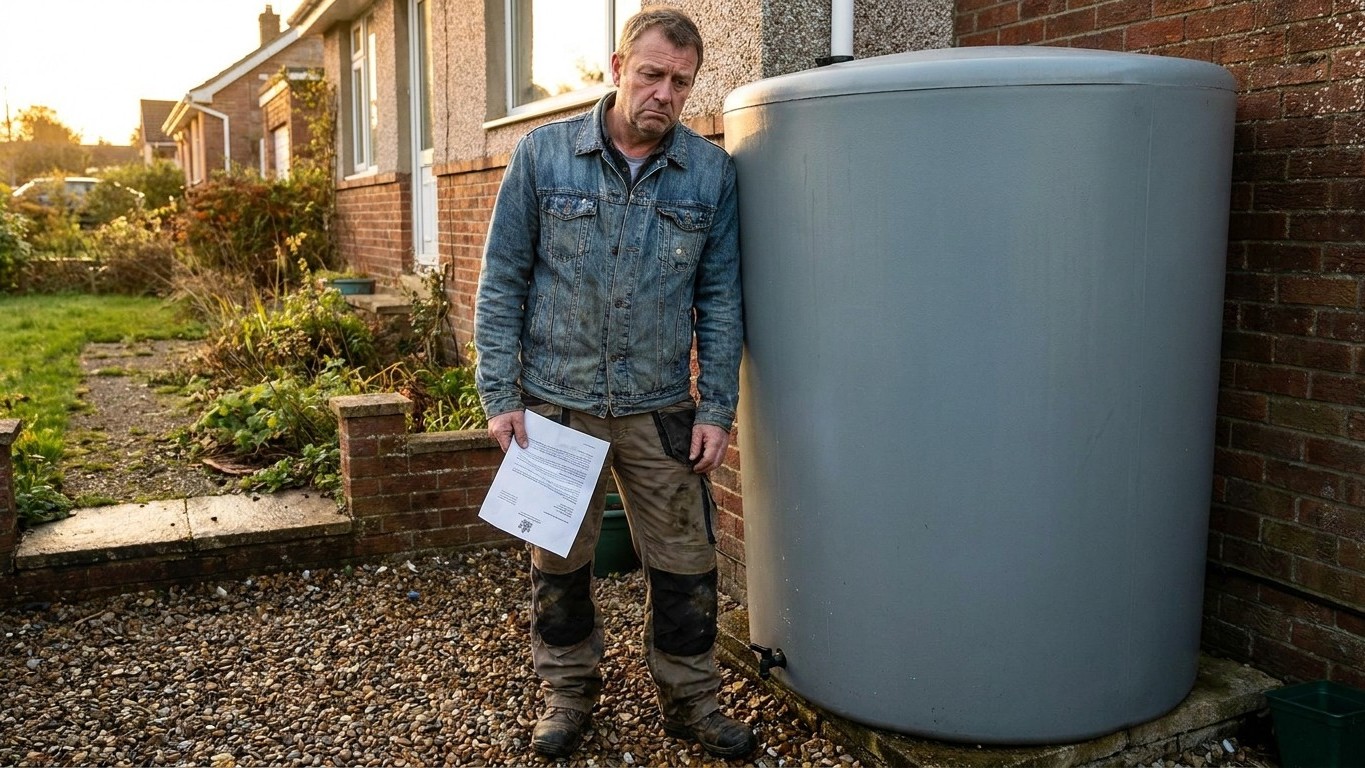
Rainwater harvesting is perfectly legal in the UK. You do not need planning permission to collect rainwater for non-potable reuse in your home. And yet, a surprisingly large number of enthusiastic, well-meaning homeowners install their system first and discover the complications only after a letter lands on the mat. The good news: that council letter almost certainly isn’t telling you to rip Everything out. The less comfortable news: there are real rules you Should Have Known before you dug the first hole, and some of them bite.
Key takeaways
- Planning permission isn’t always automatic—listed buildings and conservation areas have hidden traps
- Your water company must be notified, and one missed regulation could contaminate the mains supply
- Labelling requirements are oddly specific, but there’s a chilling reason they exist
Why the council probably wrote to you
Installing a rainwater harvesting system typically falls under “permitted development,” meaning planning permission is generally not required, but there are exceptions. If your property is a listed building, you may need to obtain planning permission before installing one. Properties located within conservation areas might have additional restrictions, necessitating planning approval. If you live in a Victorian terrace in a designated conservation area, or a handsome old farmhouse on the Historic England register, that rather changes things.
Large visible above-ground tanks in prominent locations may also trigger planning requirements regardless of property type. So if your 1,000-litre tank is sitting in your front garden on a road that the council considers architecturally sensitive, do not be surprised to hear from them. There have been previous cases where people have had to dismantle their system due to planning permission issues. Not many, but enough to make the point. A quick call to your local planning office before installation costs nothing. The retrofitting, on the other hand, costs rather a lot.
There is also a notification duty that catches many homeowners off guard. Anyone installing a rainwater harvesting system needs to inform their water supplier. This is not about asking permission, it is about preventing the worst-case scenario: harvested water leaching back into the mains. The most important safety requirement comes from the Water Supply (Water Fittings) Regulations 1999, which mandates a physical air gap wherever rainwater systems connect to mains water backup. This Type AA or Type AB air gap must prevent any possibility of rainwater backflowing into the potable water supply. Skip this, and your water company has very good reason to be unhappy with you.
What the regulations actually require
The rules governing rainwater harvesting sit mostly within building regulations and the Water Supply (Water Fittings) Regulations 1999, and they are focused on one thing above all others: keeping your harvested water firmly separate from the mains. These regulations state that all non-potable water must be in separate pipework and labelled clearly, to stop any non-potable water causing contamination of drinking water which might cause E. coli.
The labelling requirement is more specific than many people realise. Harvested rainwater must be labelled as non-potable (otherwise known as “non-wholesome”). Pipes that convey rainwater, whether below ground or within a property, must be identified as such. Similarly, valves, outlets and appliances should be labelled or tagged in accordance with WRAS Guideline IGN 9-02-5. For example, labels should be applied to the back of a washing machine or inside the lid of a WC cistern. It sounds fiddly, but there is a very practical reason for it: should a plumber come to work on your home in twenty years’ time, you do not want them accidentally connecting your toilet’s rainwater feed to the drinking supply.
The technical standard governing system design is BS EN 16941-1:2024, which supersedes the previous standard and establishes best practice for system design, sizing, installation, and maintenance. While not legally mandatory, compliance has become effectively essential for professional installations due to its incorporation into sustainable drainage requirements and building assessments. In plain terms: the standard is not law, but any qualified installer worth their salt will follow it, and if they do not, you should probably find someone else.
The bit about mixing water sources
Here is where people sometimes wander into genuinely murky territory. The Environment Agency will not regulate harvested rainwater provided its use does not harm the environment, either alone or combined with other abstractions or transfers. Rainwater harvesting within a catchment must not affect the normal watercourse flow. You do not need an abstraction licence to use water that only consists of harvested rainwater. However, you may need a water abstraction licence if you combine harvested rainwater with ground or surface water, which you then abstract or transfer.
This is the one situation to be aware of, as falling foul of it could land you with a significant fine. If you combine harvested rainwater with water from sources such as any watercourse, land drainage, underground strata, or a gravity intake into a reservoir storage system that discharges to inland waters, then you will need an abstraction licence. For the overwhelming majority of domestic homeowners collecting roof water into a tank to flush the loo and water the roses, none of this applies. But if you have a large garden project that mingles rainwater with a stream or borehole, do check first.
The real-world case for getting it right
The average UK household uses approximately 350 litres of water per day, with a significant portion going towards non-potable uses such as toilet flushing, garden irrigation, and washing machines, activities that account for roughly 50% of total household water consumption. A properly installed system can address all of those uses without a drop of treated mains water. For a typical family of four, this translates to savings of £200 to £400 annually on water bills, and over the 25-year lifespan of a well-maintained system, cumulative savings of £5,000 to £10,000.
Retrofitting is possible, but complex and can cost on average 50% more than installing during a new build or major renovation. So if you have already gone ahead and the council letter is simply asking for confirmation of compliance, take a breath. A qualified installer can usually assess and correct a non-compliant system without starting from scratch. Professional installation typically runs £4,000 to £8,000 depending on complexity, but sorting out a compliance issue after the fact is rarely that serious, provided you have not done anything that structurally alters a listed building or grossly interfered with the mains supply.
One final wrinkle that rarely appears in the glossy brochures: all UK water companies must offer surface water drainage rebates under Ofwat regulations. If your rainwater system’s overflow connects to a soakaway rather than the public sewers, you can apply with evidence to receive ongoing reductions in sewerage charges of £20 to £60 or more annually. The irony is that many homeowners who have gone through the bother of installing a full system have never claimed this rebate, largely because no one told them it existed.
Sources : rainwaterharvesting.co.uk | commonslibrary.parliament.uk