
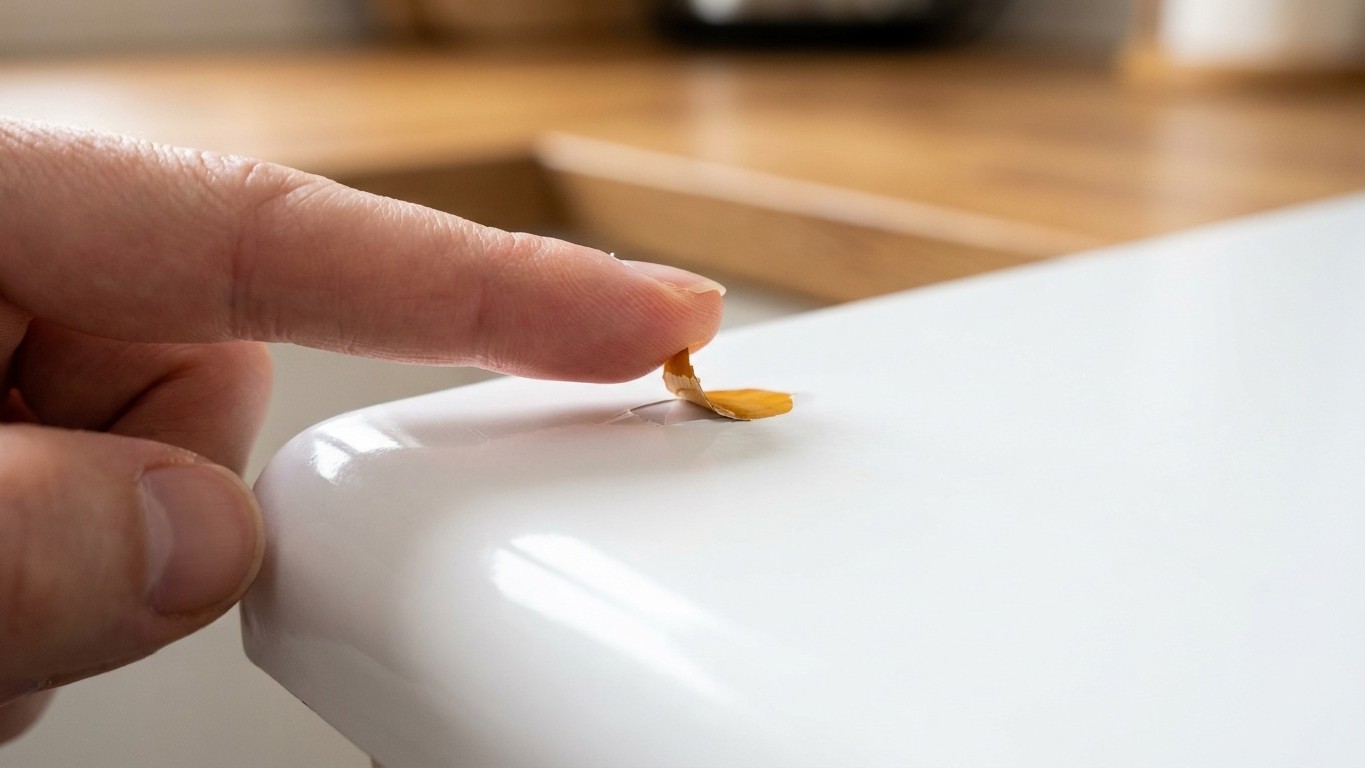
Copper amber flaking off at the first scrape of a fingernail means one thing: the paint never actually bonded to the laminate underneath. It was only ever resting on top, like icing on a cake that never set. Laminate isn’t timber, however much it might look the part with its wood-grain print, and that’s precisely why so many careful, well-intentioned paint jobs come undone within days.
Here’s what Nobody Tells You at the DIY shop: laminate is essentially a plastic-like layer over a cardboard or particle board filling. Real wood has grain, pores, tiny channels that let paint soak in and grip mechanically. Laminate has none of that. Unlike real wood, the finish cannot soak down into the laminate, so it is important to get a strong bond between the paint and the laminate surface. Skip that step, and you’re not painting furniture at all. You’re just laying a fragile skin over a slippery skin, and skins peel.
Key takeaways
- Laminate is plastic, not wood—ordinary paint slides right off without proper adhesion
- One missing bonding primer is the difference between a finish that lasts and one that flakes in days
- The fingernail test actually works, and it reveals whether your prep work was honest
Why laminate treats paint like an unwelcome guest
Anyone who’s tried it will tell you the same sorry tale. One blogger admitted the first laminate top I came across I did what I normally did, and the paint scratched right off, which put her off laminate pieces entirely until she worked out where she’d gone wrong. Another painter described the exact scenario in your headline almost word for word: I learned early that if you don’t prep, the paint will scratch right off. You touch your fingernail to it, and the finish is gone.
The culprit is nearly always adhesion, not the paint itself. As one furniture restorer put it after years of trial and error, most paint failures on laminate furniture happen because of inadequate prep, not because of the paint itself. Ordinary emulsion or standard furniture paint simply beads up or sits loosely on that glossy plastic surface, waiting for the first knock, the first scratch, the first fingernail test to prove it was never really there at all. Some paints won’t even lay down properly. According to one guide, some paints will just bead up on the surface of the laminate, while others go on with a splotchy, uneven finish and the first coat begins peeling off as soon as you try to paint a second coat.
The missing coat that changes everything
That missing coat is a proper bonding primer, and it isn’t optional showmanship, it’s chemistry doing the job your fingernail is about to test. A powerful bonding primer offers strong adhesion properties to any surface, even shiny ones like laminate. Without it, you’re relying on ordinary paint to cling to plastic with nothing but hope, and hope has never been a durable finish.
Before that primer goes anywhere near the surface, a light scuff sanding helps enormously, not to strip anything back but to give the primer some texture to key into. Sand too vigorously, though, and you risk cutting straight through the thin decorative layer, which is why the advice is consistently gentle: use sandpaper finer than 220-grit and sand the shiny surface down to a dull finish before applying paint, while also being careful not to oversand, since laminate is a thin material, so you need to be gentle to make sure you don’t break through the top layer. A wipe with a damp cloth afterwards clears the dust that would otherwise sit trapped under your primer, quietly undermining the very bond you’re trying to build.
Prefer to skip sanding altogether? You can, provided you swap in a liquid deglosser instead, something many painters now favour precisely because it saves the mess. As one home renovation guide notes, it is best to use durable latex paint, along with a good quality bonding primer, to ensure a smooth finish that is unlikely to chip with general use, sanding or no sanding. Either route, primer stays non-negotiable. Once it’s dried fully, thin even coats of your chosen paint go on next, ideally two, with proper drying time between each, because applying thin, even coats once the primer has fully dried and allowing each coat to dry completely before the next makes the difference between a finish that lasts and one that flakes off in your hand within the week.
The fingernail test, and what it actually proves
That instinctive scratch test with a nail isn’t just fussy checking, it’s a genuinely useful diagnostic, even if painting professionals argue about how scientific it really is. One contractor forum thread put it bluntly: how fair is “the fingernail test” really? Maybe my nails are made of steel or something, pointing out that nail strength varies wildly from person to person. Still, the same discussion concluded that if it passes the fingernail test it’ll hold up against basic wear and tear or at least be good enough till you get paid, which is really all any of us are after with a chest of drawers or a kitchen cupboard door.
If your amber paint has already flaked, all isn’t necessarily lost. Bonding primer can sometimes rescue a failing job even after the fact. Bonding primer, like Zinsser BIN Peel Stop, is designed to glue down peeling paint, and can be lightly brushed over the existing paint, left to dry, then repainted on top. But be honest with yourself about the damage first. If it’s flaking or peeling off in big sheets, or mostly intact and just easy to scratch with a fingernail, the answer differs, and heavily flaking pieces are usually better sanded back to bare laminate and started afresh rather than patched.
One quirk worth knowing before you reach for the tin: a fully cured coat can still fail the fingernail test weeks later on certain finishes, particularly over old polyurethane, which behaves nothing like laminate and needs its own separate approach entirely. Test a hidden patch first, always, whatever the tin promises on the label.
Sources : homesandgardens.com | themorrismansionblog.com