
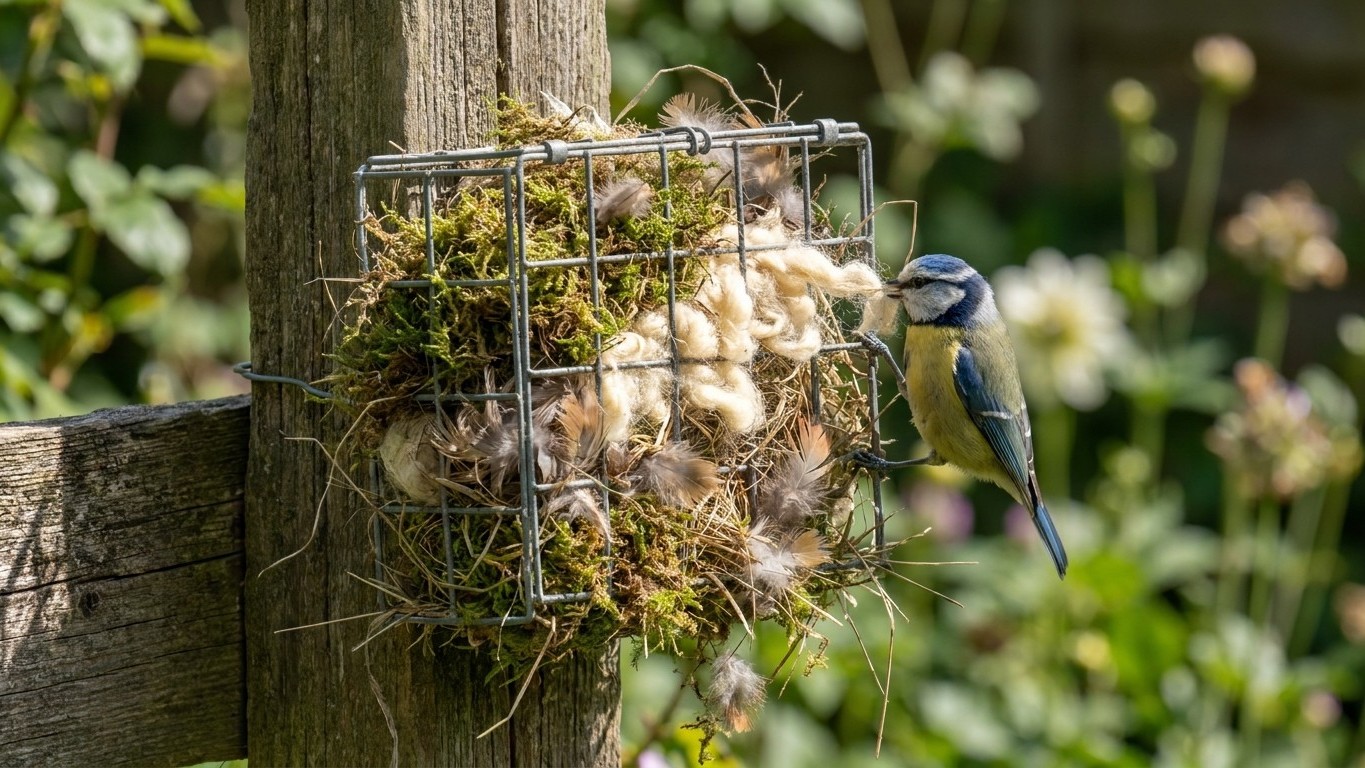
Pop a wire suet-ball holder or an old hanging basket frame on your fence, stuff it with sheep’s wool, dry moss and short lengths of dead grass, and you’ve built something far more useful to a nesting blue tit than another wooden box. Nest boxes get all the attention every March, yet a female blue tit still has to find every scrap of material to line that box herself, and a lawn mown to bowling-green perfection simply doesn’t have it to give.
Key takeaways
- Pristine, mown lawns are stripping birds of essential nesting materials
- A wire hoop filled with natural fibers costs almost nothing to make
- Blue tits need soft materials more than they need another wooden box
The tidy garden problem
Blue tits start scoping out potential homes early. During March, blue tit pairs can be seen prospecting nestboxes in gardens, looking for a place in which to rear their young, and over the next few weeks nest building will begin in earnest. The trouble is that finding a box isn’t the hard part any more, thanks to how popular they’ve become. Natural nest sites on which many of our bird species depend are fast disappearing as gardens and woods are tidied and our houses are better maintained, but a nestbox or natural cover in your garden gives birds a safe environment to rear their young.
What’s harder to come by is the raw material for the nest itself. As urban areas spread and gardens get tidier there are fewer and fewer places for species such as robins, blue tits and blackbirds to nest. A close-cropped lawn with no moss, no seedheads and no rough tussocky corners is essentially an empty larder for a bird that needs to build an entire nursery from scratch in under a fortnight. I’ve always thought it’s a bit like handing someone a lovely empty flat with no furniture and wondering why they’re taking so long to move in.
What a blue tit nest is actually made from
Watching the process is genuinely charming, and it explains exactly why bare lawns fall short. Blue tits transform empty cavities into cosy nurseries, with the female spending nearly two weeks gathering materials, gathering moss from old walls, pulling apart fluffy seedheads, or even making off with stray pet fur left on garden bushes, until each nest becomes a masterpiece of natural engineering, a deep cup of moss lined with the softest materials they can find. The male, meanwhile, mostly just sings nearby and supervises, which feels a touch unfair on the female doing all the graft.
A few well-known moss patches around the neighbourhood simply can’t supply every pair setting up home, especially once fences are power-washed and borders stripped bare for spring. Robins and wrens face the same squeeze, since you may well see birds darting to and from the hedgerow, taking in nesting material such as moss and small twigs, but only if that hedgerow is still there to visit.
Making a nesting-material hoop for next to nothing
This is where the hoop comes in, and it costs almost nothing to put together if you’re a bit resourceful. Any wire suet-ball cage, an old hanging basket liner frame, or even a homemade funnel of chicken wire will do the job, since the whole point is a mesh loose enough for birds to tug bits free. A collection of natural bird-nest building materials includes Spanish moss, reindeer moss, sheet moss, jute twine pieces, wool fibres, dog or cat hair, ornamental grass trimmings, pine needles, and natural raffia. Pack the coarser stuff, like moss and straw, in first, then tuck softer things such as wool or feathers into the gaps so there’s something for every stage of the build.
A few materials genuinely shouldn’t go anywhere near the hoop, however tempting they seem. Don’t offer yarn or string, and if you do use any fabric off-cuts, keep them to a couple of centimetres at most, since scraps of yarn or string should be cut into short lengths no longer than one or two inches to avoid bird entanglement. Steer clear of dryer lint too, since it may seem nice and fluffy, but it becomes crumbly after it’s rained on and dries, leaving chicks with a nest that’s falling apart around them.
Everything you use should be free of chemicals, so give any wool or fur a sniff test if it’s come from a treated animal, and skip grass clippings from a lawn that’s had feed or weedkiller on it. Good options to gather from your own patch include:
- Dry moss raked gently from a shaded corner or old wall
- Short, untreated pet fur brushed off after grooming
- Sheep’s wool caught on fences near grazing fields, if you’re lucky enough to live near some
- Dead leaves and fine twigs left over from autumn tidying
- Undyed cotton wool or natural coir fibre from hanging basket liners
Where to hang it and how long to leave it up
Position matters almost as much as contents. A hoop hung too low or too exposed just becomes an easy target, so treat it the way you’d treat feeder placement, tucking it somewhere with a clear flight path but decent cover nearby. To make your own birds’ nest dispenser, you need a wire bird feeder and a selection of natural nesting materials, and once it’s totally full, you can hang it up nice and high, ideally in a tree, though it can also be hung from a hook on a fence or shed. A fence panel near a hedge or shrub gives blue tits somewhere to dart to and from without an open dash across the lawn.
Timing is more forgiving than you’d think, because blue tits don’t all get the memo on the same day. In the UK some birds start nesting in February, but the busiest months are from March until July. That means a hoop put up now in high summer, or one refreshed after a first brood has fledged, still earns its keep, since many pairs will attempt a second brood before the year’s out. Keep an eye on it every couple of weeks and top up whatever’s been plundered, because an empty hoop swinging in the wind helps nobody.
One small detail worth knowing: while a female blue tit builds her nest alone, with her mate following her around to make sure no other males mate with her, over 40% of blue tit nests still end up containing at least one chick reared by a male that isn’t its genetic parent. All that vigilance, and nature finds a workaround anyway. Rather reassuring, really, that even blue tits don’t have everything under control.
Sources : amazon.com | gardenbirds.net