
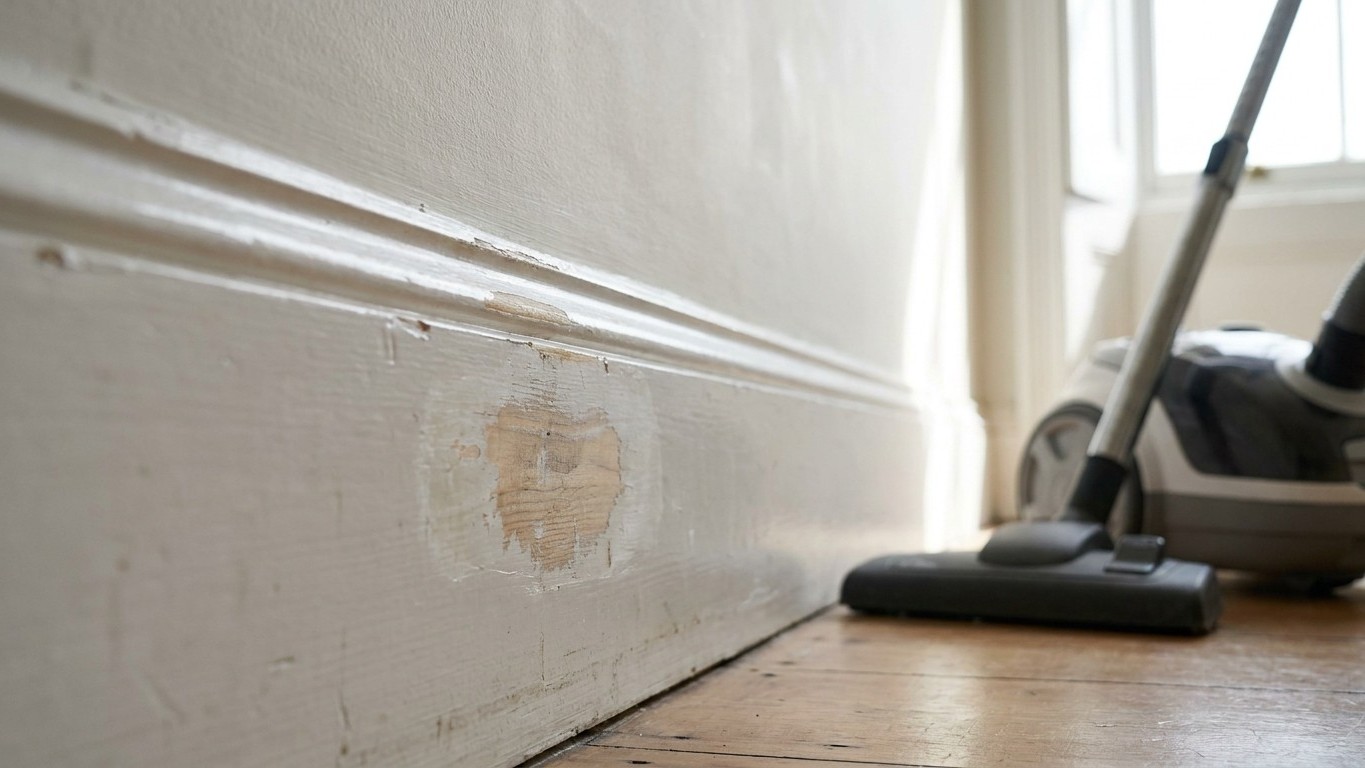
Three weeks after painting her skirtings and door frames in the same tin of wall emulsion, one reader watched a single knock from the vacuum leave a scuffed, rubbed-through patch right there on the paintwork. It wasn’t bad luck or clumsy hoovering. It was simple chemistry, and it’s a mistake decorators see time and time again.
Wall emulsion and woodwork paint might sit on the same shelf at the DIY shop, but they’re built for entirely different jobs. The reason it’s not tough enough comes down to its chemical makeup. Emulsion dries to a rigid, slightly porous film that simply wasn’t engineered to handle the knocks and bangs that woodwork in a busy home takes every day. Skirting boards and door frames, meanwhile, are exactly where these are high-impact areas that take a constant beating from knocks, scuffs, and the vacuum cleaner. Your vacuum, your shoes, the pram wheels, the dog’s lead dragging past, none of that was ever part of the design brief for a tin of matt emulsion.
Key takeaways
- A single tin of wall emulsion painted across walls, skirtings, and door frames seemed like the perfect budget hack—until the vacuum cleaner revealed the fatal flaw
- Wall emulsion and woodwork paint are chemically engineered for completely different environments, and ignoring this costs you far more than it saves
- The affordable workaround exists on most paint shop shelves, but almost nobody knows to ask for it
Why one tin for everything never quite works
It’s tempting, I know. One tin, one colour, no faff matching shades between the wall and the trim. But as one interiors expert puts it plainly, never be tempted to buy one large tin of emulsion and paint the walls, skirting, radiators and doors all in the same paint. Wood and metalwork in a room work harder as things like the skirting get knocked by the hoover, while the window frames can get dirty and need cleaning regularly. That’s the whole story in a nutshell, really. Your walls mostly just sit there looking pretty. Your skirtings get walked into, mopped, hoovered, and occasionally used as a handy step by small children.
Emulsion is designed for walls and ceilings, not skirting boards. It marks easily and is not tough enough for regular knocks, scuffs and cleaning. And once that first mark appears, it tends to spread. Unlike a proper woodwork paint, standard emulsion has no real resistance built in, so if you choose to paint Your Skirting Boards with emulsion paint, you should bear in mind that the paint will easily scuff due to its poor durability. That’s precisely what happened three weeks in: not a fluke, but the paint doing exactly what everyone in the trade knows it will do.
What’s actually going on beneath that scuff mark
The finish matters just as much as the formula. Paint sheen sits on a scale, and durability climbs alongside it. As we ascend the sheen scale, we encounter eggshell with its gentle 20% sheen that strikes a balance between durability and aesthetics. Flat matt emulsion sits right at the bottom of that scale, which is exactly why it looks so soft and lovely on a wall and so vulnerable on a door frame.
According to Earthborn Paints founder John Dyson, “Eggshell paint is durable, washable and scuff resistant”, with a low sheen finish that still copes with daily wear. That’s the trade-off Nobody Warns You About when you’re stood in the paint aisle trying to save a few pounds: the softer and flatter the finish, the prettier it looks, but the less it can take a knock.
The budget fix that doesn’t cost you a repaint in a month
Here’s the good news, and it really is good news for anyone counting the pennies. You don’t need two completely different colours to get a durable finish. Most paint ranges will mix your exact wall shade into a woodwork-appropriate finish, and there’s actually a neat halfway option worth knowing about. By an emulsion paint, this often refers to a water-based paint that is used on interior walls and ceilings. Acrylic eggshell can be used on interior walls and on woodwork, which would make it an emulsion paint. This is the only emulsion paint that can be typically used on skirting boards. So if the phrase “emulsion” is what’s drawing you towards a single tin, ask for your colour mixed as an acrylic eggshell instead. Same shade, same colour-matched harmony between wall and trim, but a finish that’s actually built to survive the vacuum.
A little preparation goes a long way too. Rather than slapping on one thick coat and hoping, apply two thin coats instead of trying to finish the job in one heavy pass, and if you’ve used tape to get a crisp line, remember that pulling tape away too sharply can lift fresh paint. Remove it slowly at a 45-degree angle. These small habits cost nothing extra and make the difference between a finish that lasts and one you’re touching up again by autumn.
Worth bearing in mind too: even correctly painted skirtings aren’t a job for life. In most homes, skirting boards need repainting every few years, depending on wear. Hallways, kitchens, children’s rooms and rental properties may need attention sooner because they take more knocks and cleaning. So even with the right paint, a hallway skirting board might want a fresh coat sooner than the spare room ever will, simply because it does more work. Choosing the Right tin from the start just means those touch-ups become a five-year job rather than a five-week one.
Sources : ratedpeople.com | mumsnet.com