
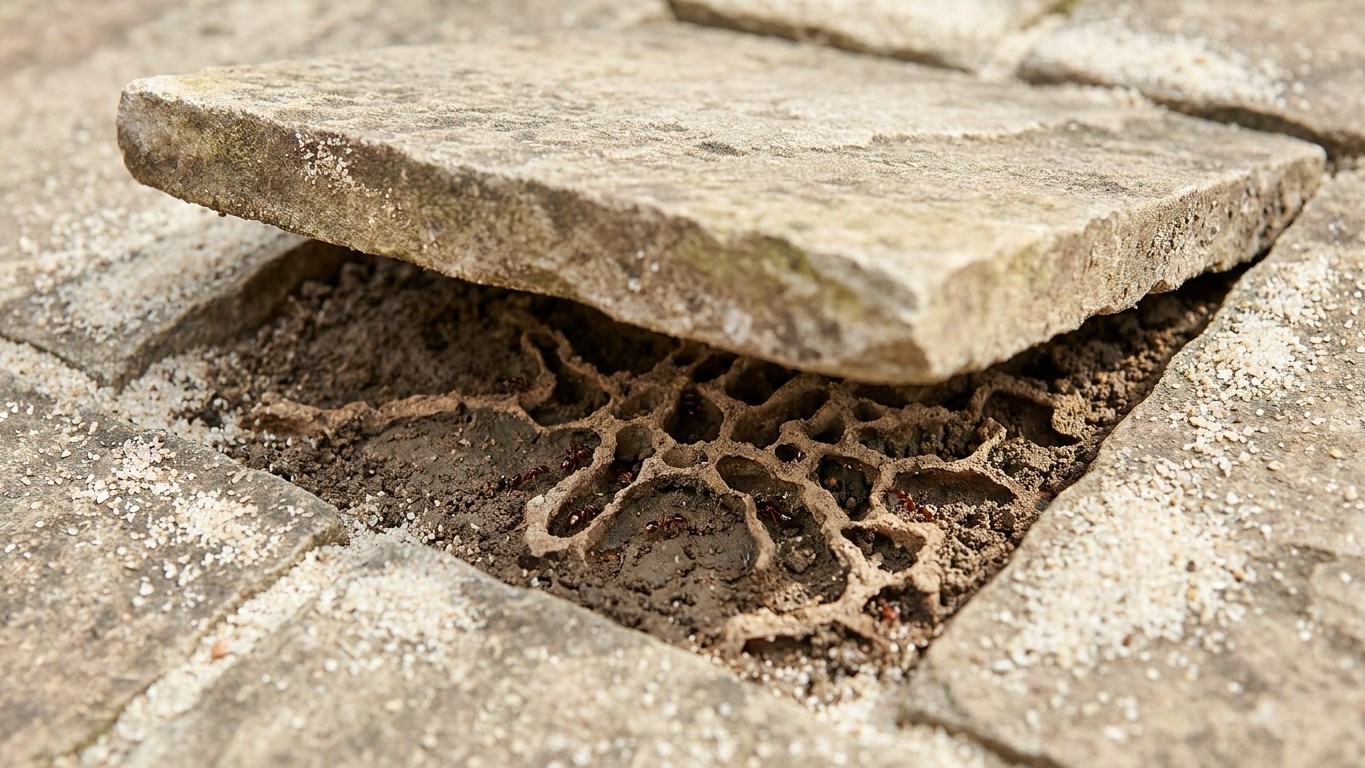
Ants. That’s what I found staring back at me from beneath that lifted slab, a whole thriving metropolis of tunnels and chambers, all built from the pale, gritty sand I had been so proudly brushing in every April for the best part of a decade. I’d thought I was tidying up my patio. In truth, I’d been running a takeaway service for insects.
It started as an ordinary Saturday job. One slab near the drainpipe had been rocking slightly underfoot for months, so out came the bolster chisel and a bit of elbow grease. When it finally came free, the sight underneath wasn’t damp soil or a few stray woodlice, it was a honeycomb of dry, hollowed-out channels running in every direction, with a fine trickle of loose sand still cascading into the void as I watched. The joints I’d topped up so conscientiously each spring hadn’t been sitting neatly between my slabs at all. They’d been quietly disappearing downward, carried grain by grain into an ant colony that had been living rent-free under my feet for years.
Key takeaways
- A routine patio maintenance task revealed something shocking hiding underneath
- Loose jointing sand isn’t just convenient—it’s an invitation for underground tunneling
- What seemed like separate problems (weeds, wobbling slabs, pest damage) all pointed to one cause
Why loose sand is basically an open invitation
It turns out this isn’t some freak occurrence unique to my garden. If joints are filled with loose sand, ants can dig through it easily, push it aside, and build tunnels and nesting areas below the surface. Ordinary kiln dried sand, the stuff sold in every builders’ merchant and garden centre up and down the country, is brushed dry into the gaps between slabs with nothing binding it together. That looseness is exactly what makes it so easy to sweep in, and exactly what makes it so easy for a determined colony to excavate.
What surprised me most wasn’t that ants had moved in, it was how much damage their housekeeping had done. It is amazing how much base and joint material these little creatures can displace, tunnelling through the sand under and between blocks and pavers. Every spring I’d been replacing exactly what they’d hollowed out the year before, without ever realising I was the reason the joints kept sinking. My “neat little ritual” was, in effect, an annual delivery of fresh building supplies to a colony that had learned my routine better than I had.
The knock-on effect is that once those tunnels form, the whole structure above starts to wobble. This causes damage to the integrity of the joints and provides an opportunity for weeds and moss to grow. That rocking slab I’d noticed wasn’t a one-off fluke of an uneven base, it was a symptom. Once the sand beneath and between the slabs turns to Swiss cheese, the slabs themselves lose their support and start to tip and settle unevenly, which is precisely what had been happening to mine.
The weeds were never really about dirt
I’d always assumed the odd dandelion poking through was just bad luck, a stray seed on the wind. Turns out the sand itself was setting the table for that too. Traditional joint sand can shift, wash out, or get displaced over time, and once gaps form, wind-blown seeds and organic debris settle in. Add a bit of moisture, and weeds get everything they need to germinate between pavers. The ants doing their excavating underneath only made those gaps bigger and more welcoming.
What I found genuinely reassuring, in a funny way, is that this isn’t a sign of a poorly built patio or bad luck with pests. Weeds between pavers and ants between pavers usually come from the same root issue, joints that are acting like soil because of debris and moisture, or joints loose enough to tunnel through. Two seemingly separate garden nuisances, one cause. That was oddly satisfying to learn, even if it didn’t make the sight under my slab any less alarming.
What I’m doing differently now
Once I’d dealt with the immediate problem (a kettle of boiling water poured straight down into the exposed tunnels did the job on the spot, and a good soaking wash the following morning showed just how many ants hadn’t made it), the real question was what to fill those joints with going forward. Plain kiln dried sand is cheap and forgiving, and I won’t pretend I don’t appreciate a bargain, but regular sand for paving is prone to erosion and damage from weeds, whereas polymeric sand prevents weeds from taking root and holds pavers firmly in place thanks to the durability of its seal. The polymer binders in that type of sand react with water to set almost like a very thin, breathable grout, rather than sitting there as loose grains waiting to be carted off.
It isn’t a silver bullet, mind. It’s not a guarantee that this type of sand will stop all ants and weeds, however, it is a huge deterrent. And it does cost more per bag than traditional sand, plus it needs dry weather and careful watering-in to cure properly, so it’s not a job to rush on a whim between showers. For anyone with very narrow joints, particularly on porcelain paving which is increasingly common on newer patios, porcelain is typically laid with very tight joints, often as narrow as 2mm to 5mm, and at that width, polymeric sand does not have enough depth to perform reliably, so a proper resin-based jointing compound is worth asking your installer about instead.
For my own patio, laid with fairly generous joints and no fancy porcelain in sight, polymeric sand felt like the sensible middle ground between cost and peace of mind. I still keep an eye out each spring, not with a fresh bag of loose sand this time, but with a torch and a bit of curiosity, checking for any tell-tale trickles or soft spots before they become someone else’s des-res under my feet.
Sources : easymixsales.com.au | gardenworldconstructionltd.com