
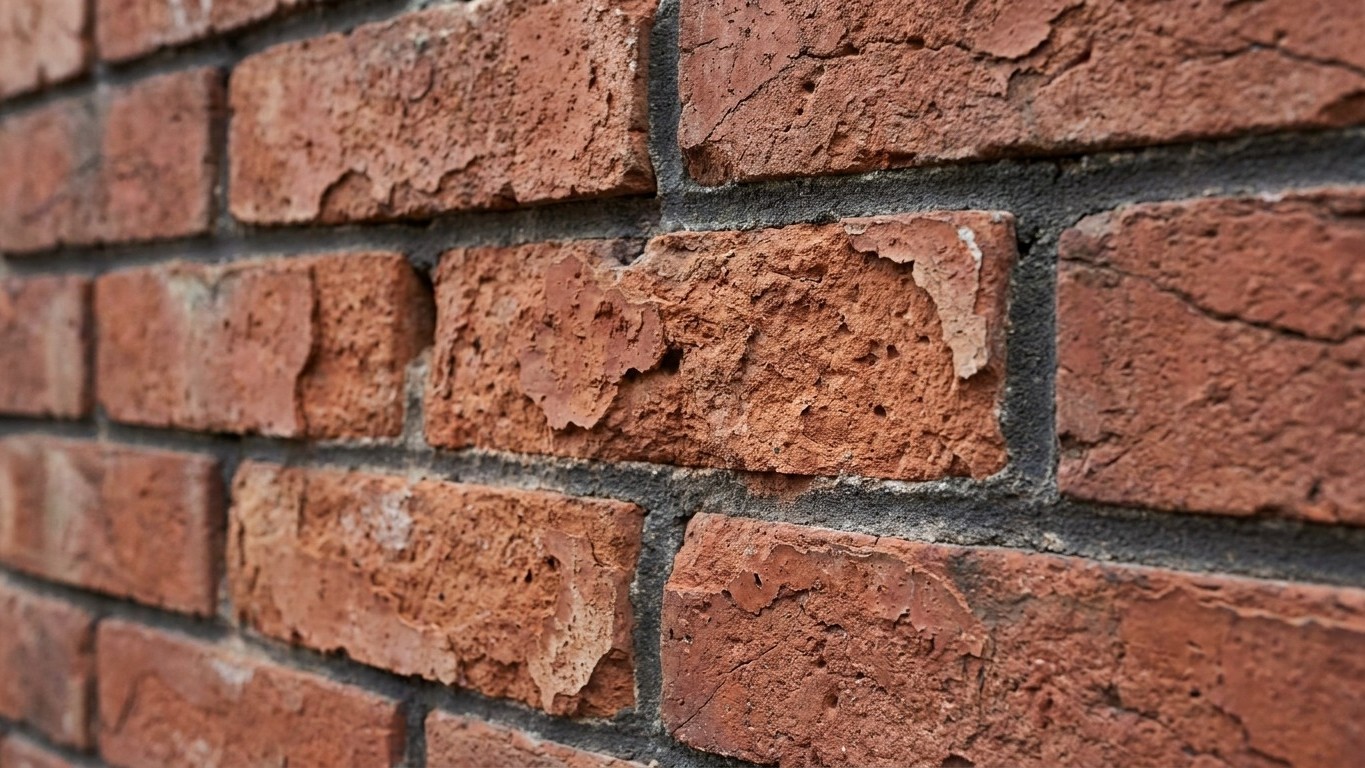
Portland cement is roughly three times harder than the soft London stock or handmade red bricks used in most Victorian terraces, and that mismatch is exactly what turns a weekend DIY repointing job into an expensive lesson. Two winters of frost is often all it takes for the damage to show: brick faces flake away in thin, brittle layers, leaving a rougher, paler stone-like surface underneath while the mortar joints themselves look perfectly intact. It’s a cruel irony, because the pointing usually looks like the best bit of the wall.
Key takeaways
- A homeowner’s weekend repointing project with cement mortar turned into an expensive disaster after just two winters of frost
- Victorian bricks are softer and more porous than modern standards, and cement mortar blocks the wall’s natural moisture escape route
- The damage compounds invisibly at first, then frost-thaw cycles progressively chip away at brick faces that took over a century to age properly
Why the “quick fix” backfires so fast
Victorian houses weren’t built with cement at all. Modern cement is far denser and more impermeable than that used in Victorian buildings; lime was slaked on site as late as the inter-war period, and it wasn’t until the 1930s that cement really took over from lime in general building. That matters because the whole wall was designed around a soft, breathable joint. Mortar acts as a structural cushion, absorbing the slight movement caused by settlement, temperature changes and moisture, and it also acts as a moisture escape route, since traditional lime mortar is deliberately softer and more porous than the bricks or stones around it, so moisture evaporates through the joints instead of the masonry units. Swap that soft joint for hard cement and you’ve effectively sealed off the wall’s only exit route.
Rain still gets in through the brick face, as it always did, but now it has nowhere to go. Old brickwork relies on breathability; rainwater enters through the face of the wall and evaporates back out through the mortar joints, but cement mortar blocks that escape route, so trapped moisture leads to damp patches on internal walls, frost damage during cold winters as water freezing inside saturated brickwork expands and blows the face off the brick, and salt crystallisation that gradually weakens the masonry from within. One tradesman put it plainly on a DIY forum: the mortar will be fine but your bricks will erode, because you want a weak mortar that lets evaporation of water in the wall pass through it.
What two winters of frost actually does
The timeline isn’t dramatic at first, which is exactly what catches people out. The pointing cures hard, looks smart, and the wall seems drier than ever, because water simply isn’t escaping the way it used to. Then the first proper cold snap arrives and moisture trapped just behind the brick face freezes and expands. This leads to spalling of the brickwork outer face, caused by the pointing being blocked by dense cement, forcing moisture to evaporate through the brick face instead and causing spalling as the salts contained in the moisture crystallise. Do that twice, and you’ve got two winters’ worth of freeze-thaw cycles chipping away at faces that took over a century to look right.
Walk any London Victorian street and the evidence is everywhere once you know what to look for. Properties where the mortar joints look sharp and clean but the brick faces are flaking and pitted have almost certainly been repointed with cement at some point in the past 30 years. There’s a simple way to check your own wall before committing to any repair: try scratching the surface of the brick with a coin, and if it resists without marking, cement mortar is usually acceptable, but if the coin leaves a visible scratch, the brick is softer than modern standards and lime mortar is the safer option. I’d add my own rule of thumb here: if your house predates the First World War, assume lime until proven otherwise. It’s rarely wrong.
Putting it right without breaking the bank
The good news is that this particular mistake is entirely fixable, though it does mean redoing the work properly. Raking out cement mortar is harder graft than raking out lime, since it grips the brick edges far more stubbornly, but it has to come out to a decent depth, generally around 20mm, before repacking the joint with a breathable mix. Not all limes are equal, and getting the strength right matters as much as choosing lime over cement in the first place. Natural hydraulic lime comes graded by how quickly and hard it sets: a weak NHL 2 suits sheltered walls and soft bricks, while NHL 3.5 is the workhorse for most exposed external pointing, and the very strong NHL 5 is reserved for chimneys and coastal walls that take a real battering. Getting this wrong in the other direction causes problems too, since choosing the correct lime is essential because using a mix that is too strong can cause exactly the same problems as cement.
Budget-wise, professional lime repointing on a standard Victorian terrace front typically starts from around £3,400 including scaffolding, which sounds steep until you weigh it against the alternative. Lime mortar lasts 30-50 years on historic brick compared with 10-15 for cement, so you’re not just buying better breathability, you’re buying decades of not having to do this twice. If you’d rather tackle it yourself, the trickiest part isn’t the mixing but the curing. Lime mortar is much more sensitive to drying conditions than cement, and getting this wrong means your pointing will crack and crumble within months, so keep it damp for at least three to five days. A few offcuts of damp hessian sacking, kept misted with a garden sprayer, does the job without any expense at all.
One detail worth tucking away: lime mortar is meant to be sacrificial. Conservation specialists deliberately describe it as a “sacrificial material” because it’s designed to wear away slowly over decades so the brick behind it never has to. That’s not a flaw in the system, it’s the entire point of it, and it’s the one thing cement, for all its strength, was never built to do.
Sources : citysuburbinc.com | roofingtoday.co.uk