
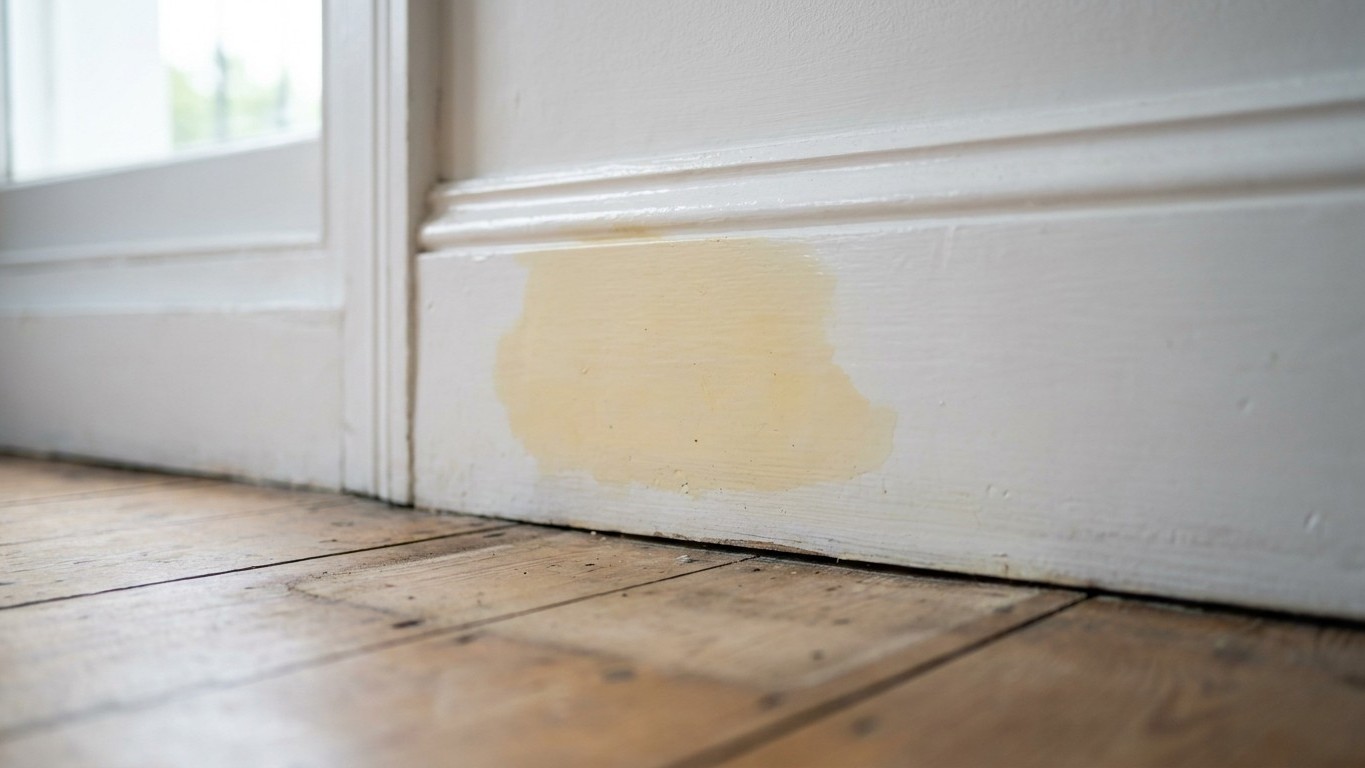
That mustard-yellow patch you’ve just uncovered isn’t dirt, and it certainly isn’t damp. It’s your own paint, betraying you slowly and quietly for two whole years while the dresser stood guard in front of it. The good news, and I promise there is some, is that what looks like a disaster might not be nearly as permanent as you think.
Oil-based gloss has been the go-to for skirting boards, door frames and architraves in British homes for generations, prized for how tough it is against scuffs and grubby little fingerprints. But for all the benefits of oil-based paint, including dent and scuff resistance, it has a notable drawback: it can turn yellow with time, an effect that’s particularly unsightly on white or off-white surfaces. You did nothing wrong. You painted it exactly as everyone else has done for decades. The paint simply did what oil-based paint does.
Key takeaways
- Chromophores in oil-based paint create yellow tints when hidden from light—a problem manufacturers made worse after 2010
- Your paint might actually recover its color if light starvation is the culprit, not oxidation
- Water-based alternatives and hybrid glosses now exist that won’t yellow, even after eight years
Why your gloss turned that particular shade of custard
The chemistry is oddly fascinating once you understand it. As oil-based paint coats dry, unwanted colour-producing molecules known as chromophores also form in the paint. These chromophores break down when paintwork is regularly exposed to light, either natural or artificial. Behind your dresser, tucked away from daylight and lamp glow alike, those chromophores simply had nowhere to go. When the paint doesn’t get much light, chromophores remain in the paint coat and cast a light to dark yellow tint across the surface, and if your paintwork is located in a dimly lit area, such as a cabinet interior or behind a tall piece of furniture, a lack of light is the likely cause.
There’s a second culprit lurking here too, and it’s one most people have never heard of. Since 2010, EU rules forced paint manufacturers to cut the volatile organic compounds in their formulas, and as one of the leading paint manufacturers explained, when reducing the amount of solvent, they had to increase the amount of drying oil, which has a yellowish tinge that will eventually bleed through the paint, regardless of its colour. So if you painted your hallway any time in the last fifteen years or so, you were working with a chemically different product than your mother or grandmother used, and one considerably more prone to this exact problem. This affects white oil-based gloss more than tinted colours, though the discolouration happens to some extent in every colour.
Is it really too late? A gentler verdict than you’d think
Here’s where I can offer you some genuine comfort. If the culprit is simply lack of light (which, hidden behind a dresser for two years, it almost certainly is), the situation is not permanent at all. The effects of chromophores are reversible, as exposing yellowing paintwork to light should break down the problematic molecules in the paint and gradually restore its original colour; to shed more light on the paintwork, move any furniture blocking it and draw open the curtains of a nearby window during daylight hours. Some accounts suggest the paintwork may begin to lighten in as little as one day, though you’ll need to continue exposing it to light over time to minimise future yellowing. Leave that dresser pulled away for a few weeks, angle a lamp at the skirting board of an evening, and you may well watch the yellow retreat before your eyes. It sounds almost too simple to be true, but it’s genuine, well-documented chemistry, not old wives’ tales.
Where things get trickier is if oxidation, rather than simple light starvation, is the deeper cause. That process is the natural curing and ageing of the alkyd resins in oil paint, and it behaves rather differently. Industry guidance from Dulux is blunt about this one: unfortunately, the yellowing effect is irreversible and the colour can often be irregular or patchy in appearance. If you’ve moved that dresser and given the woodwork weeks of good light with no real improvement, you’re likely dealing with oxidation proper, and the only genuine fix at that point is to allow the enamel paint to harden and lightly sand to remove the gloss prior to repainting with a non-yellowing water-based coating system. Not the news you wanted, perhaps, but at least it’s a clear path forward rather than endless guesswork.
What to reach for next time you’re near the paint tins
If you’re standing in the DIY aisle wondering how to avoid a repeat performance in five years’ time, the good news is that the market has genuinely moved on. Fully water-based satinwoods and eggshells have become popular precisely because they sidestep this whole problem, and testimony from homeowners bears this out rather nicely: one described their eggshell paint as being as white now as it was when first applied 8 years ago. There’s also a middle-ground option worth knowing about called hybrid gloss, essentially an “alkyd emulsion” that is mostly water-based but with an oil carrier, giving you something closer to that traditional glossy shine while yellowing far more slowly than the old-fashioned stuff.
Whatever you choose, remember the golden rule that applies regardless of tin or brand: light is the great preserver. Position lamps to catch dark corners, keep curtains open where you can, and think twice before pushing that dresser flush against freshly painted skirting. And here’s a small detail worth tucking away: even radiators play their part in this, since heat from stoves and heating pipes can hasten the very same oxidation process that dims light does behind furniture, so a hallway radiator cover might be quietly ageing your paintwork just as effectively as any absent sunbeam.
Sources : quora.com | hunker.com