
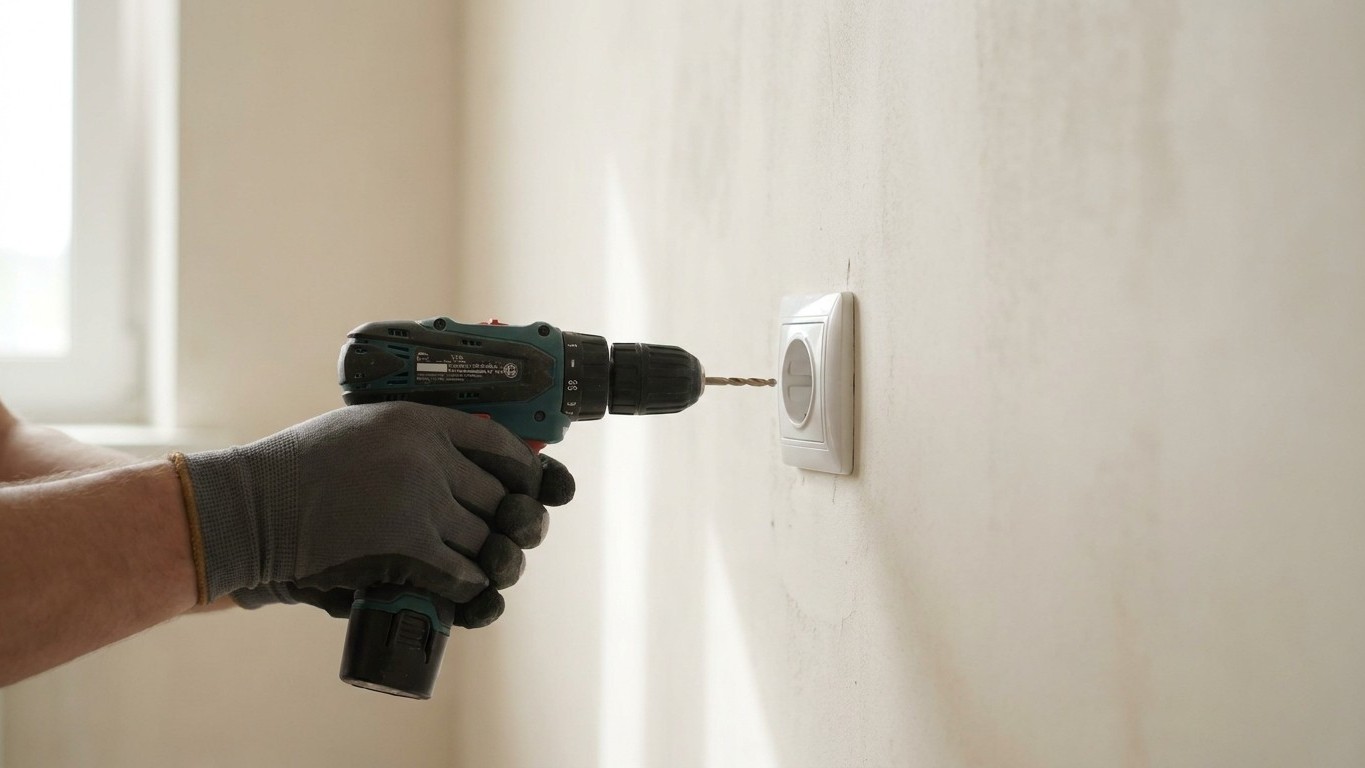
Diagonal drilling is exactly the sort of shortcut that feels harmless until it isn’t. You had a socket in one corner, a light switch a little further along, and a shelf bracket that needed fixing somewhere between the two. Rather than measuring twice and drilling straight, you took the quickest line, a neat diagonal cutting across the plaster. That’s precisely the move an electrician friend flagged as the one thing you should never do near an accessory, because cables in British homes are only ever supposed to travel in straight lines.
Key takeaways
- Why did an electrician friend react with alarm to your diagonal drilling, and what invisible danger had you just narrowly missed?
- Under British electrical code, cables must follow an invisible ‘plus sign’ pattern around every socket and switch—but what happens when older homes break this rule?
- A cable detector costs £15, but ignoring this safety zone could cost far more—so what’s the real price of getting this wrong?
Why cables only ever go up, down, left or right
Under the UK’s national wiring standard, BS 7671, concealed cables are expected to follow what the trade calls prescribed zones (once known as “safe zones”, a name that still causes confusion because it makes people think the areas are safe to drill into, when actually the opposite is true). The safe wiring zones around electrical accessories such as socket-outlets, light switches, and cooker switches extend directly above and below the electrical accessory and directly to the left and right of it. Nothing runs at an angle. Nothing wanders off in some convenient diagonal to save the electrician a metre of cable.
The logic is refreshingly simple once you see it. By installing cables in predictable locations, anyone who later drills or fixes into the wall knows where cables are likely to be, reducing the risk of accidentally penetrating a live cable. An electrician thinks of a socket almost like the centre of a plus sign: a vertical strip running straight up to the ceiling and straight down towards the skirting, and a horizontal strip running left and right at the same height. If you see a plug socket, imagine a line running straight up to the ceiling and straight down to the floor, cables could be anywhere along that path. The same goes for a line running left and right, at the height of the socket or switch, all the way to the next wall or obstacle. Step outside those four straight lines and, in a properly wired house, you should be in the clear.
Two more zones apply regardless of whether there’s a socket nearby at all. Along the top of the wall, running where the wall meets the ceiling, there’s a 150mm-thick strip where cables commonly travel before dropping down to an accessory. And where one wall meets another, there’s a safety zone on each wall for 150mm from the corner, whether that corner is internal, as in the corner of a room, or external, as you’d find on the edge of a chimney breast. A diagonal line between a socket and a switch crosses none of these predictable strips cleanly, which is exactly why it’s such an unwelcome discovery for the person holding the drill.
The 150mm figure, and why depth matters too
That 150mm isn’t an arbitrary number plucked from thin air. It’s measured from the top of the wall or partition, or from the angle where two walls adjoin, and gives a reasonable margin for anyone drilling or fixing into the wall to avoid the cable zone. It’s roughly the width of your hand plus a bit, generous enough that a competent electrician has room to work but tight enough that it doesn’t turn half your wall into a no-go area.
Depth matters just as much as position. The safe zone rules apply to cables concealed in walls and partitions at a depth of less than 50mm from the finished surface, which is the sort of shallow burial you’d expect behind standard plaster or plasterboard. Go outside the prescribed zones and the rules tighten rather than relax: a cable concealed at a depth of less than 50mm must either be installed in a prescribed zone and have additional protection by a 30mA RCD, or comply with other measures, for example an earthed metallic covering, earthed conduit or trunking, nail-proof mechanical protection, or a SELV/PELV circuit. a properly certified installation should never leave a bare, unprotected cable sitting in the exact diagonal path you’d naturally choose for a shelf bracket, because the regulations simply don’t allow cables to sit there unprotected in the first place.
There’s a helpful shortcut for thick walls too. On a wall or partition 100mm thick or less, a zone formed by an accessory whose position can be determined from the other side extends to the reverse side of the wall as well, which matters if you’re drilling from an adjoining room and assume you’re safely away from the socket you can see on the other side.
Where the rule breaks down, and how to stay out of trouble
All of this assumes whoever wired your house followed the current standard, and that’s a big assumption in older properties. Electricians in the past didn’t have these rules. Cables could be, and were, run in all sorts of odd places. One electrician’s survey found exactly the pattern you fell foul of: cables run diagonally across walls, doing sudden 90 degree bends and all sorts. Victorian terraces that have seen several rounds of rewiring, flats converted from bigger houses, and rental properties with modern sockets bolted onto much older circuits are all particularly prone to this. A Victorian terrace may have had several rounds of alterations, a flat conversion may hide cables from more than one refurb, and a rental property might have modern accessories on an older layout. DIY rewiring carried out before Part P came into force adds another layer of unpredictability, since nobody was checking the work against BS 7671 at the time.
So the rule about avoiding diagonals is really a rule of thumb for new work, and a rough guide, not a guarantee, for existing walls. Before you drill anywhere near a socket or switch, whatever the angle, run a decent cable detector over the area first (cheap ones can give false readings, so don’t bet a nasty shock on a £15 model), switch off the relevant circuit at the consumer unit if you’re at all unsure, and keep your fixing at least 150mm clear of any accessory unless you’ve confirmed there’s nothing behind the plaster. It costs you two minutes. A severed live cable costs a great deal more, in both money and nerves, and if your consumer unit lacks a working RCD, that gap between “close call” and “hospital visit” narrows considerably.
Sources : flameport.com | nod-electricalservices.co.uk