
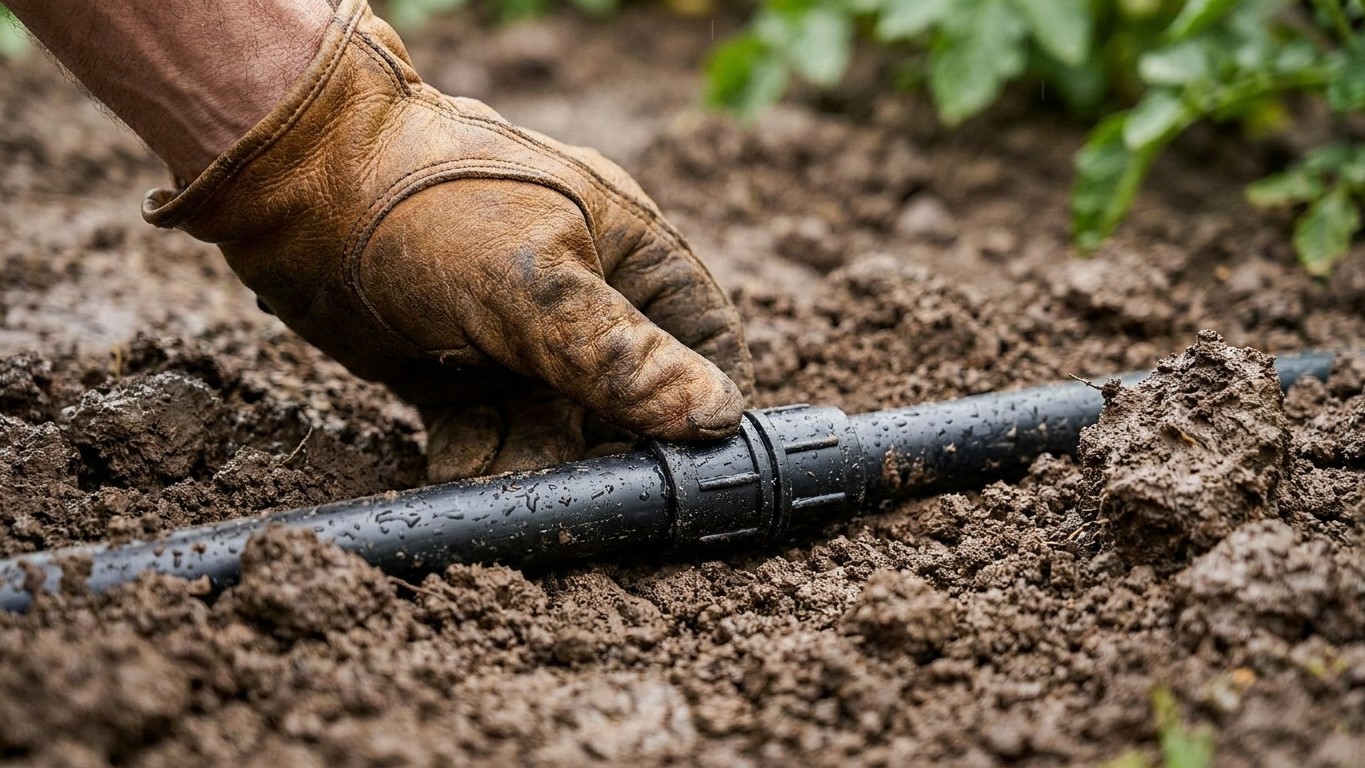
Six inches. That’s how far down the landscaper found my supply line before he stopped digging and looked up at me with the sort of expression you give someone who’s just admitted to reversing into a bollard. My pipe, buried with my own two hands three summers before, sat barely below the surface of a lawn that had spent every winter since being nibbled at by frost, flattened by football boots, and occasionally sliced by my own edging shears. That one exposed section told him Everything about why my sprinklers had been dribbling, spluttering and finally giving up altogether.
Key takeaways
- A single exposed trench section told a professional everything about why an entire sprinkler system was failing
- Burying pipes at the wrong depth unleashes multiple enemies: frost, clay expansion, mower damage, and undetectable leaks
- The unsealed joints and rigid fittings nobody sees become the most expensive mistakes when they silently waterlog your lawn
What One Dug-Up Section Revealed
I’d saved myself several hundred pounds trenching my own irrigation pipe rather than paying for professional installation, and for the first summer it worked a treat. Then the following spring, one zone stopped popping up properly. By the second winter, two more had gone the same way. When I finally called someone in to have a proper look, he only needed to open one trench to diagnose the whole system.
A big mistake that people make is putting the pipe trenches either too deep or too shallow, and pipe trenches for an in-ground sprinkler system need to be at least 7 inches underground and no more than 10 inches. Mine, it turned out, wandered anywhere between three and five inches depending on how tired my arms had been that particular afternoon. If the pipe is less than 7 inches underground, the PVC pipe is susceptible to the weight of anything above ground and could develop cracks. Every time the grandchildren had a kickabout, or I’d wheeled the mower over the same strip week after week, I’d been quietly stress-testing my own handiwork.
The general rule most professionals work to is more forgiving than I’d assumed. The general recommended depth for sprinkler lines ranges from 6 to 12 inches (15 to 30 centimeters) below the soil surface, though this range shifts based on your local climate, soil type, and potential for external damage. I hadn’t accounted for a single one of those variables. My garden sits on heavy clay that swells like a sponge every wet November, and nobody had told me that matters.
Depth Isn’t Just About Frost
I’d assumed frost was the only enemy, so I’d gone shallow in places thinking a British winter was hardly Minnesota. Wrong reasoning, right instinct about the cold at least. Clay soil retains moisture and can expand when wet, which may exert pressure on shallow pipes, so aiming for 10–12 inches helps avoid cracking from soil expansion. My lazy, shallow sections were exactly where the clay had been squeezing the pipe every time it swelled with rain, and where a slice from a garden fork had gone clean through one connector nobody could see.
Soil type isn’t the only variable that trips people up. If the soil is sandier, water drains from it faster, so the sprinkler line should be buried deeper, meaning well-draining soils such as sandy, loamy, and silty soils should be buried at least 8 inches deep. Depth also depends on what’s attached at the end of the line: the length of the sprinkler head body impacts how deep you bury your lines, and most sprinkler heads are usually two, four, or six inches tall, varying with the head type. I’d fitted taller pop-up heads on a whim from the garden centre without adjusting my trench depth to suit, which left barely any margin of pipe below them at all.
There’s also such a thing as digging too deep, which I hadn’t considered when I overcorrected on one run after a wobbly first attempt. If the pipe is deeper than 10 inches, it may be difficult to tell if the pipe is broken or cracked and it will take some work to dig them up. That’s precisely what happened with my furthest zone. A leak had clearly been trickling away for months, quietly waterlogging a patch of lawn, and I’d walked past it dozens of times assuming it was just a boggy corner rather than a buried problem.
The Fittings Nobody Warned Me About
Depth wasn’t my only sin. The landscaper also pointed out a joint that had never been sealed properly. Properly connecting PVC pipes requires a specific two-step process of priming and cementing to create a permanent, watertight seal, and improperly sealed joints will inevitably lead to underground leaks. I’d rushed that particular fitting on a Sunday afternoon with rain due, and it had clearly never bonded as it should. These hidden issues are among the most expensive mistakes because they are difficult to detect early, which explained why my water bill had crept up quietly for two seasons before I noticed anything obviously wrong above ground.
The other thing I’d skipped entirely was flexible connector pipe at the sprinkler heads themselves, joining Everything with rigid pipe straight into rigid fittings because it seemed sturdier. It wasn’t. Funny pipe also allows the head to move a bit in case it’s run over by a vehicle or pushed around by the frozen ground, whereas when a head is connected directly to the rigid poly pipe, any movement could crack the fitting that connects them. Every head I’d rigidly connected had a hairline crack somewhere in the joint by year two.
Doing It Properly the Second Time
We didn’t rip everything out. We only needed to redo the shallow, badly clayed runs and swap in flexible risers at each head, which kept the bill sensible. I marked out consistent trench depths with a bit of bamboo cane notched at the right measurement rather than eyeballing it as I had the first time, and I finally used a proper cutter rather than a hacksaw, since cutting pipes with a saw can leave behind plastic shavings that could clog the sprinkler heads, and an inexpensive poly pipe cutter works great for a few pounds from any hardware shop.
My mistake wasn’t attempting the job myself, it was rushing the bit nobody sees. A trench dug on a wet Tuesday afternoon, glue applied without waiting the recommended minute or two, and heads chosen for their looks rather than their height above the trench, that’s what unravelled quietly under my lawn for two winters. Redo those few details properly and there’s genuinely no reason a keen gardener can’t manage the whole job themselves, saving the same money I did the first time round, minus the January morning spent watching someone else dig up my mistakes.
Sources : irrigationpackages.com | turfmechanic.com