
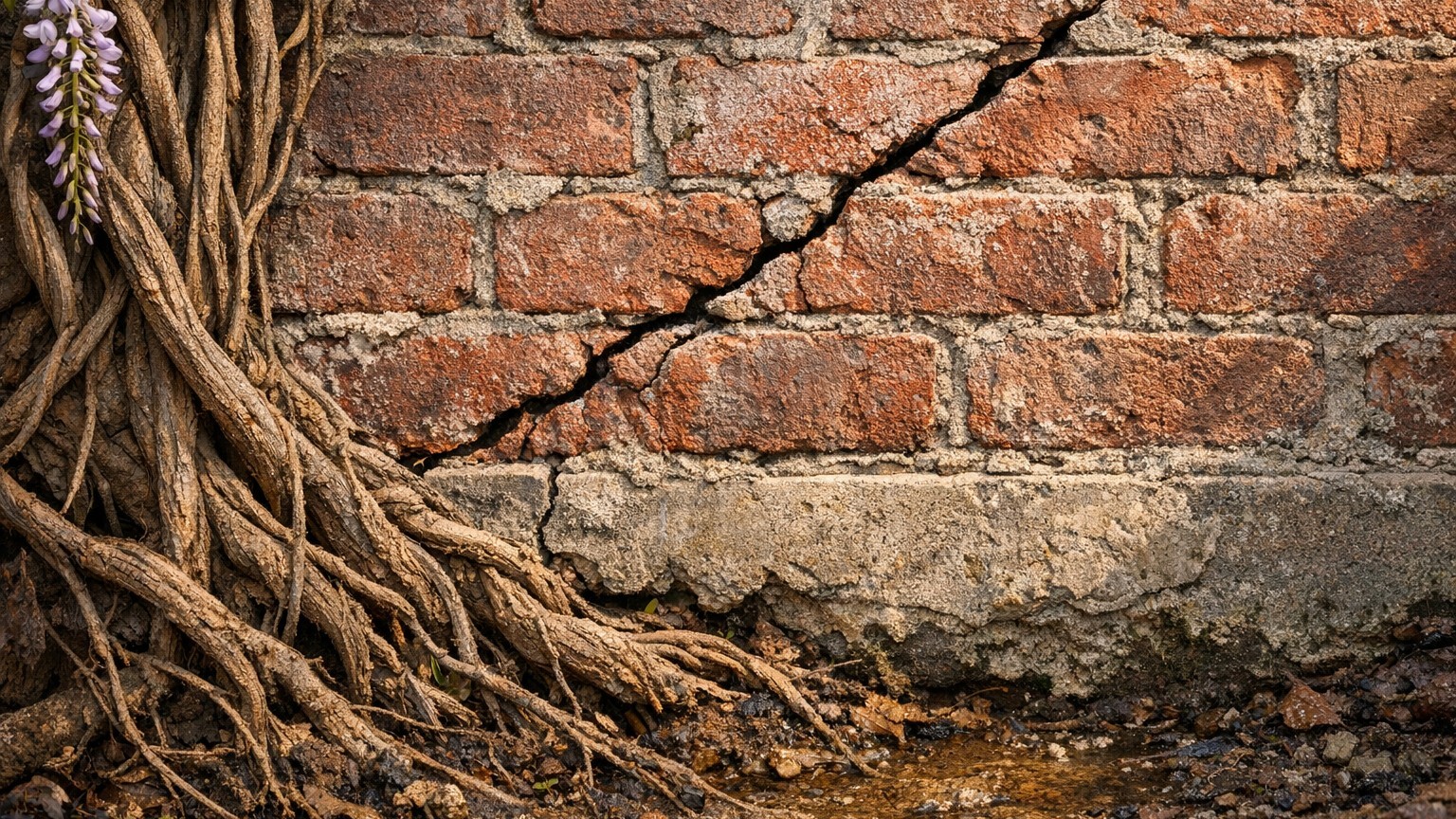
Roots do not knock politely before causing damage. They simply grow, quietly and persistently, following moisture and nutrients through the soil, and by the time you dig near the foundation and see what has taken shape underground, the process has often been going on for years. What starts as a neat-looking shrub planted flush against the house wall can, over time, become a hidden threat to the very structure holding your home up. This is not a worst-case horror story. It is a pattern that plays out in British gardens up and down the country, season after season.
Key takeaways
- Shrubs planted against house walls send roots deep into clay soils, causing them to dry out and shrink beneath foundations
- Wisteria and pyracantha look beautiful but are among the most dangerous wall plants for structural damage
- Diagonal cracks that open in summer and close in winter are telltale signs of soil movement happening under your home
The Hidden Life Beneath the Surface
Roots will extend as widely underground as the shrub extends above ground, sometimes more. That tidy pyracantha or established wisteria that looks so charming against the brickwork may be sending a root network far wider than you ever imagined. Roots are opportunists. They do not seek out foundations, yet they will follow moisture and oxygen. That is the key distinction: the root is not targeting your house, but your house happens to sit on top of exactly the kind of damp, nutrient-rich soil that roots seek out.
The mechanism of damage is less dramatic than you might expect. In most UK homes, the problem is rarely a giant root physically forcing its way through sound concrete. The more common pathway is ground movement. Large parts of the UK have shrinkable clay soils that change volume as moisture levels rise and fall. When roots draw water out of the clay, the ground literally shrinks beneath the foundations. As the soil loses moisture, it causes the soil to shrink. This soil shrinkage is what causes the foundations to move, as they are no longer sitting on top of soil that is dense and stable.
This shrink-swell cycle is, according to the British Geological Survey, “the most damaging geohazard in Britain today.” Heat waves in 2003 and 2006 led to peaks in subsidence claims. More recently, over 10,000 households made claims worth a total of £64 million during just one quarter in 2018. Clay soil is the villain in most of these stories, and the rock formations most susceptible to shrink-swell behaviour are found mainly in the south-east of Britain.
The Shrubs You Should Never Plant Right Against the Wall
Most people assume that the risk comes only from large trees. Oaks, poplars, willows, yes, those are well-known offenders. Oaks account for the highest number of subsidence cases in the UK. But the assumption that a modest shrub is harmless is exactly where homeowners can be caught out. Large wall shrubs, most Pyracantha and Wisteria, can cause localised subsidence. Level monitoring will demonstrate which vegetation is most likely to be involved. This comes directly from the Royal Horticultural Society, and it is a detail that far too many gardeners never hear.
Wisteria is perhaps the most beguiling of all. That cascade of purple blooms in May makes it almost irresistible as a wall plant. When allowed to spread unchecked, wisteria can even dislodge roof tiles or gutters. And if planted too close to a property, its root system may also begin to interfere with underground drainage or shallow foundations. Pyracantha, beloved for its berries and its ability to deter intruders, carries a similar risk when established directly against the wall. Avoid planting pyracantha, rose-shrubs, and wisteria close to your building is advice often given by insurers and surveyors, though rarely printed on the label at the garden centre.
Then there is the moisture problem above ground, which runs parallel to the root risk below. The single biggest issue with regards to shrubbery growing near or on the structure is moisture, which will accelerate deterioration of practically any type of exterior cladding. A dense shrub planted flush against a wall traps damp air against the brickwork, prevents it from drying out between rain showers, and quietly encourages the kind of creeping damp that eventually works its way inside. Ivy’s small aerial roots are deceptively powerful, capable of digging into cracks and mortar joints. As the plant grows, it thickens and pulls at these weak spots, widening gaps and potentially dislodging roof tiles, pulling gutters away from walls, and leading to water ingress.
Reading the Warning Signs Before It Gets Expensive
The good news is that soil movement rarely happens overnight, and there are usually early signals if you know what to look for. Cracks that run diagonally or zig-zag across brickwork are classic signs of subsidence. These typically appear around doors and windows, are often visible both inside and outside the property, and are wider at the top than the bottom. A crack that opens slightly during a dry summer and then partly closes after autumn rain is particularly telling. Pay attention to cracks that open in hot, dry periods and then partly close after prolonged wet weather. That seasonal “breathing” is a classic clue of soil moisture variation.
Inside the house, noticeable signs can include large cracks that often appear next to a door or window. Other signs may include shrinkage in wallpaper, jarring of windows and doors, and cracks running along the masonry. A door that starts sticking in July and swings freely again by November is not just an inconvenience, it may be telling you something about what is happening beneath the floorboards. This is generally only a problem on shrinkable clay soils. Buildings up to four storeys constructed before the 1950s are most at risk, as they frequently have comparatively shallow foundations.
There is also a financial dimension that catches many homeowners off guard. Although wisteria is not restricted by law, any damage it causes is typically considered a preventable maintenance issue. Most standard insurance policies will not cover claims related to overgrown climbing plants. If you are letting it roam freely without regular pruning, and it leads to structural or moisture issues, insurers may reject the claim on grounds of negligence. The plants, are your responsibility, and so is the damage they cause.
What to Do If You Already Have a Shrub Against the Wall
The instinct, once you have seen roots spreading under the foundation, is to grab the spade and dig everything out immediately. Resist that impulse. If you have well-established shrubs planted close to the foundations of your property, do not be tempted to dig them out right away. By disrupting the established root systems of the shrubs, it could cause the soil to become unstable or for water to build-up. Either regularly prune the shrubs to help reduce their water intake, or speak to a specialist tree surgeon or gardener who can advise on the safest way of removing them.
Pruning is genuinely useful here, not just cosmetically. On trees or large shrubs that cannot be moved, consider crown thinning or crown lifting, which removes branches either throughout the plant or at the base, to reduce moisture uptake. Less foliage means the plant transpires less water, which means it draws less from the surrounding soil. Plant any trees or bushes that will reach 6 feet or more at maturity so that when fully grown, their foliage still remains at least 5 feet away from the house, or 3 feet for smaller shrubs. That gap between plant and wall is not wasted space, it is insurance.
For new planting, the National House Building Council offers a practical rule on clay soils: on clay soils, the National House Building Council recommends planting trees at a minimum distance of three-quarters of the maximum height of the tree. Trees with high water needs should be planted even further away, at a distance greater than their maximum height. As a simple working guide for smaller shrubs, make sure all trees and shrubs are planted away from your property, ideally around 5 to 10 metres, to reduce the risk of drying out the soil.
One final thing worth knowing: removing a well-established shrub or tree is not automatically a clean fix. Removing large trees and shrubs can also damage foundations, as soils can swell when the plants, once drawing in water, are no longer there. This upward movement, called heave, can be just as damaging as subsidence itself. It is one of those situations where acting too fast causes a different problem. If the plant is large, the roots deep, and the soil clay-heavy, the removal should be staged and supervised by a qualified arborist, not done in an afternoon with a mattock and good intentions.
Sources : nortonib.co.uk | ask2.extension.org