
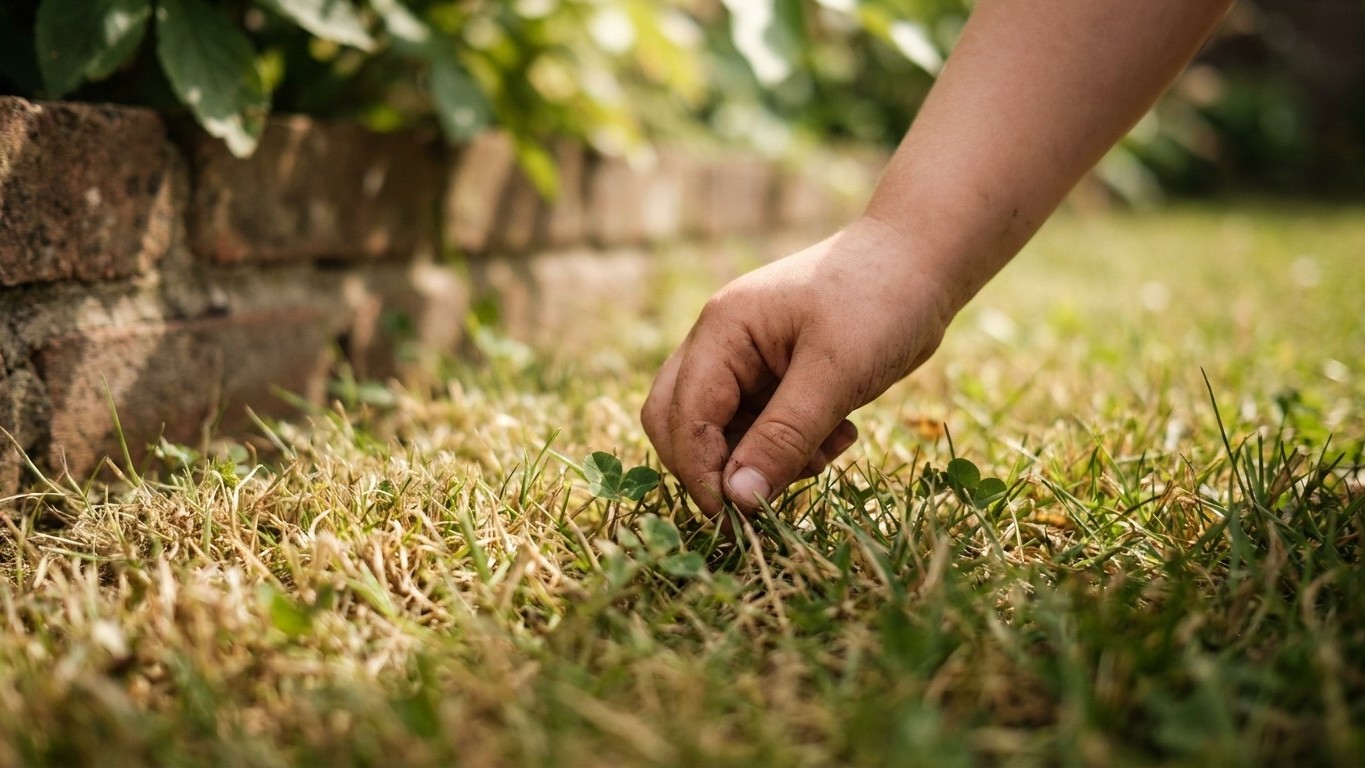
Lead paint dust from sanded sash windows doesn’t stay where you left it. It settles on grass, soil and hard surfaces, and children who play outdoors then touch their mouths are the ones most exposed. My own experience of testing the lawn two weeks after a weekend’s sanding work brought this home rather sharply, and it’s a lesson I’d spare every parent and grandparent in an older home.
Key takeaways
- Lead paint dust from sanded sash windows travels further than you’d expect and settles where children play
- A soil test two weeks after one afternoon’s work revealed dangerous contamination levels beneath the window
- Standard dust masks offer no protection against fine lead particles—and the health risks to young children are irreversible
Why sash windows are a particular problem
Sash windows are a beloved feature of Victorian and Edwardian housing : Britain has millions of them. The trouble is that any property built before 1978, and especially before the 1960s, almost certainly has layers of lead-based paint on its woodwork. Sash windows are especially problematic because they have multiple moving parts: the sashes, the channels, the pulleys and the beading all accumulate paint over decades of repainting. When you sand them back, as many of us do before a fresh coat, you release a fine dust that contains lead particles small enough to be invisible and light enough to travel surprisingly far.
I used a belt sander on a dry, breezy Saturday in spring. No mask beyond a standard dust mask, which offers essentially no protection against fine lead particles. By lunchtime the window ledge looked pristine. What I hadn’t considered was where Everything else had gone. The window faced the back garden. Two weeks later, acting on the advice of a neighbour who’d had a similar scare, I bought a soil-testing kit and swabbed a patch of grass directly below the window. The result came back positive for lead contamination at a level well above what’s considered safe for areas where children play.
The risks are real, and the science is settled
Lead has no safe level of exposure for children. That statement comes from the World Health Organization, and it’s been the scientific consensus for some years. In children under six, even relatively low blood lead levels are linked to reduced IQ, attention difficulties and behavioural changes. The exposure route that catches many families off guard isn’t eating paint chips, it’s hand-to-mouth contact after touching contaminated soil or dust. A toddler crawling on grass below a sanded window, then putting a hand in their mouth, can ingest meaningful quantities without anyone noticing a thing.
Public Health England (now the UK Health Security Agency) has consistently identified lead paint disturbance in older homes as a significant source of childhood lead exposure in the UK. This isn’t a distant, theoretical hazard. Surveys of blood lead levels in children living in pre-1960s housing with disturbed paintwork have shown elevated readings compared with children in newer properties. The garden contamination route is one of the less-discussed pathways, which is precisely what makes it catch people out.
What I did to address the contamination, and what I should have done beforehand
Once the test confirmed contamination, I cordoned off the area of grass beneath and around the window while I worked out a plan. The most pragmatic advice for contaminated garden soil, where the lead is concentrated in the top few centimetres, is to either remove and bag the affected turf and soil (which must be disposed of as hazardous waste through your local council), or to cap it, laying a thick layer of clean topsoil over the affected area and then re-turfing. Capping doesn’t remove the lead, but it creates a barrier that prevents children from contacting it directly. For a small patch beneath a single window, removing the top five to eight centimetres of soil is often the cleaner solution.
I also power-washed the exterior windowsill, the wall below it and the paved path, capturing the runoff carefully rather than letting it drain freely. This is an imperfect fix, water disperses fine particles rather than eliminating them, but it reduced the surface concentration considerably.
What I ought to have done before picking up the sander is rather more straightforward. A proper lead paint test on the window (inexpensive swab kits are widely available in hardware shops) takes minutes and answers the fundamental question before any work begins. If lead is present, the Health and Safety Executive guidance is clear: minimise dust generation by using wet sanding or a chemical stripper rather than power sanding, work with all windows and doors leading to the exterior closed, and wear a proper half-face respirator with P100 particulate filters, not a paper dust mask. Sheeting the ground below the window with polythene and taping it securely means that whatever dust does fall can be gathered up and safely bagged.
For larger stripping jobs, or where the paint is in poor condition across multiple windows, the HSE recommends considering a licensed contractor. That feels like an expense many of us quietly sidestep, but the cost of professional abatement is considerably less alarming once you’ve stood in a garden testing the soil your grandchildren run about on.
Testing your own garden after renovation work
Soil and surface-wipe lead test kits are available from most large hardware retailers and online suppliers. They’re not laboratory-grade analysis, but a positive result at high concentration is reliable enough to warrant proper follow-up. If you want a definitive answer, local environmental health departments can sometimes advise on accredited laboratory testing, or you can send a soil sample to a private analytical laboratory, the costs vary but are not extravagant for a small sample.
One thing worth keeping in mind: lead contamination in older urban gardens doesn’t always come from renovation work. Decades of traffic exhaust from leaded petrol, which wasn’t fully phased out in the UK until 2000, left measurable lead deposits in roadside soil across the country. A study published in Science of the Total Environment found elevated lead levels in urban garden soils across multiple UK cities, with older properties near busy roads showing the highest concentrations. If you grow vegetables in a front garden close to a main road and your house predates the 1980s, testing the soil before eating homegrown produce is a genuinely sensible precaution, no renovation required.