
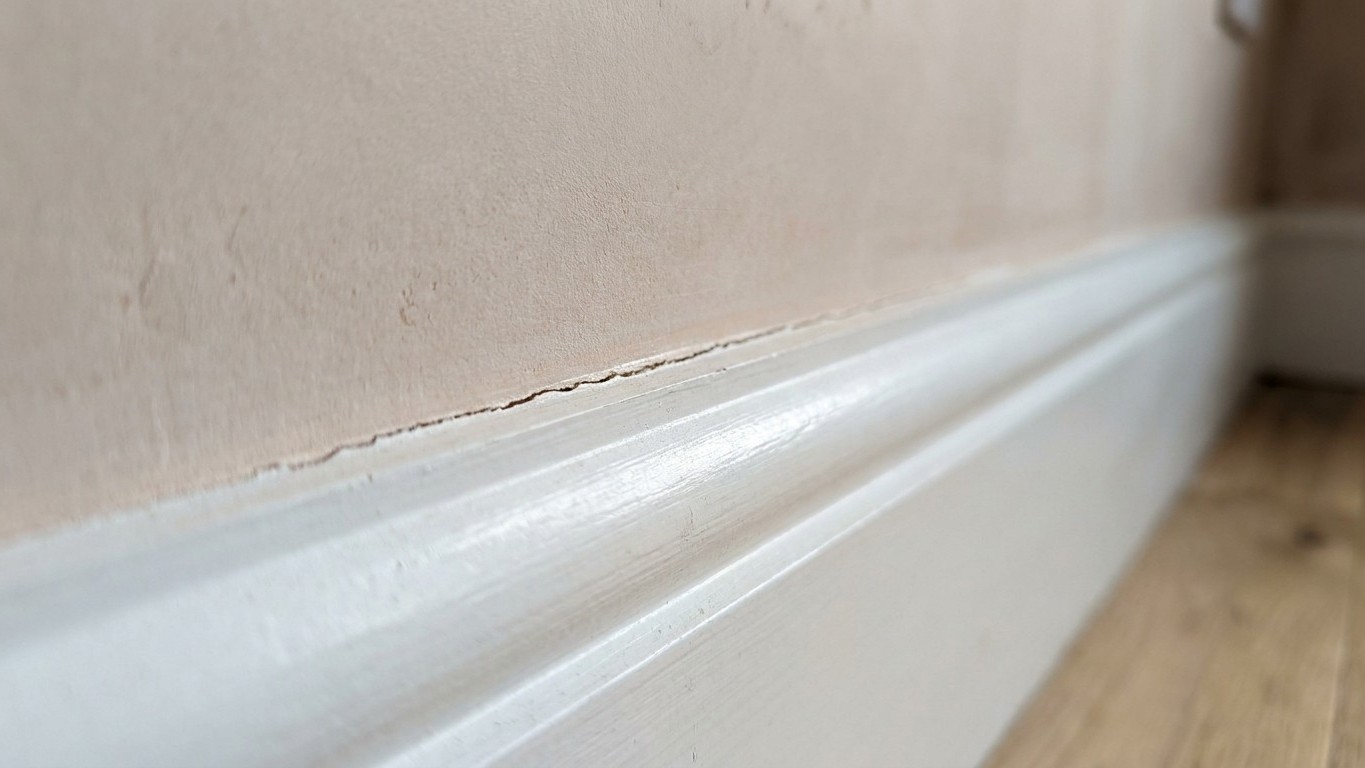
Fitting skirting boards the day after fresh plaster has dried enough to touch is one of those shortcuts that feels perfectly reasonable until someone who installs timber for a living watches you do it. The plaster looks solid. The surface is pale and firm. You crack on, pin the boards, fill the gaps, and feel rather pleased with yourself. The problem reveals itself six weeks later when a thin, persistent crack appears along the top edge of every single board you fitted.
That crack is not a fitting error. It is a shrinkage gap, and it is entirely predictable once you understand what newly plastered walls are actually doing behind the scenes.
Key takeaways
- Freshly plastered walls contain gallons of hidden moisture that shrinks invisibly over weeks, not days
- A joiner reveals the exact measurement that separates amateur mistakes from professional results
- There’s a simple 30-second test you can do right now with materials in your kitchen
What fresh plaster is doing that you cannot see
Sand and cement render, and particularly the finishing coat of gypsum plaster most of us use in British homes, contains a surprising amount of moisture when it goes on the wall. A standard 25kg bag of finishing plaster, mixed to a workable consistency, holds roughly three to four litres of water. That water does not simply evaporate from the surface. It migrates through the plaster body slowly, over days and weeks, causing the whole coat to shrink very slightly as it cures. On a typical room, that shrinkage can account for a measurable vertical drop along the wall height, sometimes fractions of a millimetre at the base, but enough to pull the plaster surface fractionally away from anything rigid fixed against it.
The joiner who spotted my mistake did not lecture me. He simply asked how long I had left the plaster before fitting. When I said “overnight, sometimes two nights,” he nodded and said I had been fitting two millimetres too early. Not two days. Two millimetres of residual movement. That is roughly the thickness of two stacked credit cards, and it is enough to open a visible gap along a skirting top edge once the room heats up with central heating for the first season.
The two-millimetre mistake explained properly
Gypsum plaster typically reaches what builders call “initial set” within an hour or two of application. It hardens enough to walk past, touch, and even sand lightly within 24 hours in warm weather. But “hard” and “finished moving” are two entirely different conditions. The residual moisture content in a freshly plastered wall can remain elevated for three to four weeks in a well-ventilated room, and considerably longer in a poorly heated one during winter.
The British Standard guidance for internal plastering recommends allowing plaster to dry naturally before decorating or fixing, and the plastering trade generally advises a minimum of one week per millimetre of plaster thickness before the surface is considered genuinely stable. A standard finishing coat sits at roughly 2 to 3mm thick. A scratch coat beneath it adds another 8 to 12mm. Do the arithmetic and you start to understand why a room plastered on a Monday might not be truly ready for fixed timber until three or even four weeks later.
The 2mm figure my joiner friend mentioned is not a random number. It represents the approximate gap that opens at the top of a skirting board when the plaster above it contracts after the board has been fixed rigidly. Fix the board while the plaster still holds moisture, and as that moisture leaves and the surface drops fractionally, the gap appears. Fix it after full drying, and the plaster has nowhere new to go. The board sits snug, the top edge stays tight, and the decorator’s caulk along that joint has a fighting chance of lasting more than one winter.
How to get the timing right without waiting forever
A useful and inexpensive tool worth keeping in a renovation toolkit is a plaster moisture meter, available from most builders’ merchants. These cost very little and give you a reading of the moisture content at the wall surface. General guidance from the plastering industry suggests waiting until moisture readings fall below 5% before fixing skirting or architrave, and below 3% before painting. You do not need to guess or tap the wall hopefully with your knuckle.
If you do not have a moisture meter, the low-tech approach is the brown paper bag test. Press a piece of dry brown paper flat against the plaster for 30 seconds. If it feels noticeably cool and damp against the back of your hand when you peel it off, the wall is still releasing moisture. If it feels barely different to a dry surface, you are getting close to safe. It is not scientific, but it catches the obvious cases where people rush ahead far too early.
Ventilation makes a very real difference to drying time. Opening windows and running a dehumidifier in the plastered room can cut the waiting period by almost half compared with a sealed, cold room. Conversely, cranking the central heating up to its maximum in an attempt to speed things along can cause the surface to dry too quickly relative to the core, leading to hairline shrinkage cracks in the plaster itself, quite separate from any skirting issue.
One last thing worth knowing about timber movement
The irony of this whole situation is that even if you wait perfectly for the plaster to cure, timber skirting introduces its own movement into the equation. Softwood boards acclimatise to the humidity of a room over several days. Fitting skirting boards that have been stored in a cold garage and brought straight into a warm, dry room means the timber itself will move as it adjusts, potentially pulling fixings slightly or opening mitre joints at corners. The standard advice among joiners is to stand the boards in the room where they will be fitted for at least 48 hours before cutting. Plaster moves, timber moves, and the only sensible response is to give both of them time to settle before asking them to live together permanently.