
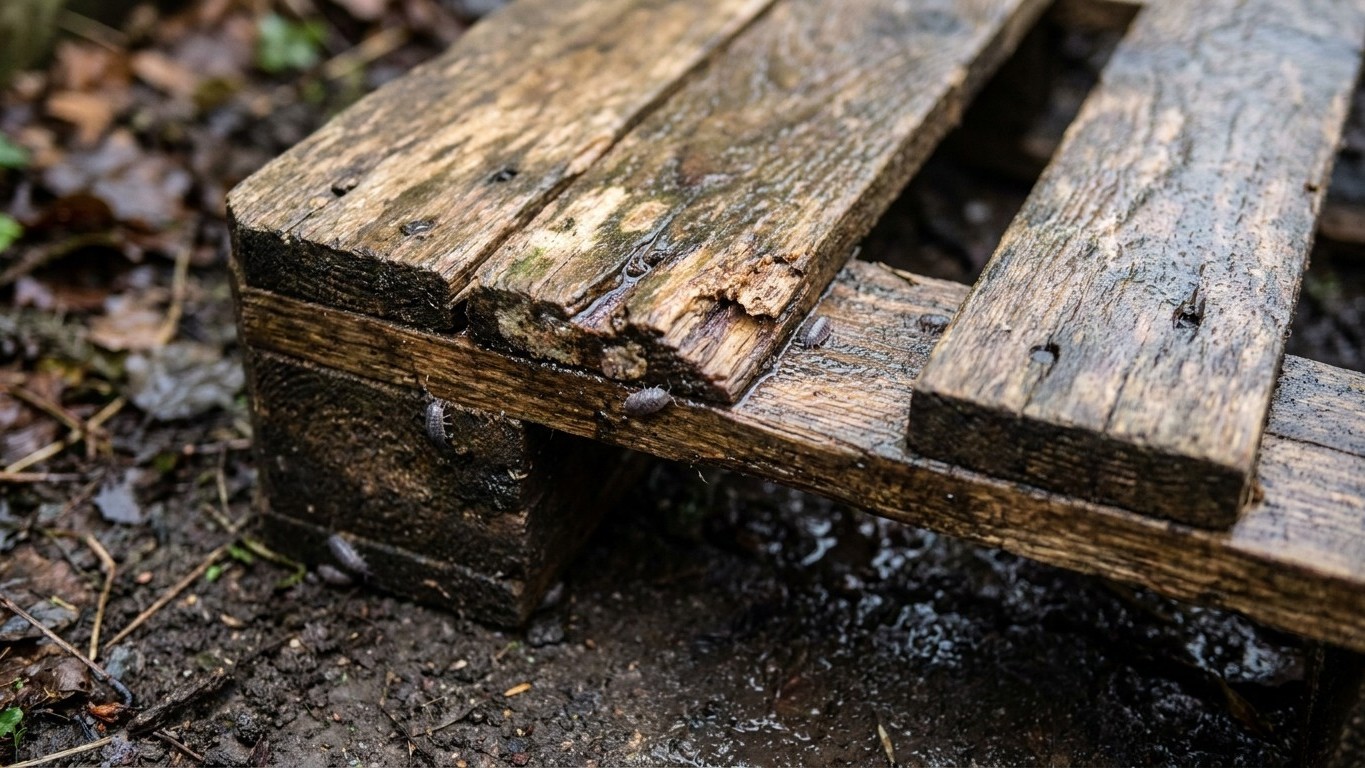
Pallet furniture is one of Britain’s favourite budget garden projects, and for good reason: the wood costs next to nothing, the builds are satisfying, and on a dry July afternoon the result looks rather handsome. The trouble arrives the moment the rain does. Lift the corner of a pallet bench after a good downpour and you may find a world of activity you never invited, soft, darkened timber, a scatter of fine dust, and a colony of grey, armoured creatures scuttling for the shadow. This is the hidden cost of skipping preparation, and it is entirely preventable.
Key takeaways
- A hidden ecosystem of decay is already at work beneath your pallet furniture the moment moisture gets trapped
- Those grey scuttling creatures aren’t the problem—they’re a warning sign that something worse has already started
- One structural change costs nothing but makes the difference between furniture lasting two years or ten
What actually happens under a pallet left on damp ground
Wood is susceptible to rot when exposed to moisture for prolonged periods. Rain and high humidity cause the wood to absorb water, promoting fungal growth and decay. The underside of a pallet bench is the worst possible spot: pressed flat against soil or paving, with almost no airflow, it stays wet long after the top surface has dried. Poor airflow around wood can create an environment where moisture becomes trapped, promoting fungal growth and accelerating decay.
Wood-decaying fungi, such as those that cause white rot or brown rot, thrive in the UK’s moist but mild climate. They break down the cellulose and lignin that form key structural material in wood, causing it to weaken over time. You will often know fungi are at work before you see them: the presence of fungi is indicated by discolouration, a musty smell, and a softening of the wood. Soft spots in an otherwise solid-looking slat are a reliable warning sign.
The grey visitors themselves, woodlice, are a different matter. Woodlice are usually found outside in damp areas, under the bark of rotting wood and the underside of rocks and slabs. They are often referred to as the ‘recyclers’ of the insect world due to their desire to feed on anything rotten. Strictly speaking, they are not insects at all. Woodlice are crustaceans with 14 legs, and they are harmless, primarily feeding on decaying wood and other organic matter. Finding them beneath your pallet sofa is less an infestation and more a signal: the wood is already rotting and has become attractive to scavengers. They are the symptom, not the cause.
More serious are woodworm beetles. Wood-boring insects such as woodworms are attracted to damp wood and will burrow into it, causing significant structural damage, and their presence can be incredibly difficult to detect as they are often only visible during the summer months. Wood-boring beetles leave behind tiny round holes when they emerge, usually 1–2mm in diameter. Check the underside of every slat, particularly near joints. The presence of small holes in the wood, sawdust-type frass, or insects such as wood-boring beetles and carpenter ants is indicative of a problem.
The stamp on the side matters more than most people realise
Before any treatment, there is a prior question worth answering: what kind of pallets did you actually use? Most UK pallets either carry no treatment (for domestic use) or are heat-treated under ISPM15 for export. Heat treatment uses only heat, no chemicals, and HT pallets are safe to reuse. Methyl bromide (MB) pallets were fumigated with toxic gas and must never be repurposed for DIY or indoor use.
Heat treatment involves heating the pallet to 56°C core temperature for 30 minutes. It kills pests without any chemical agent, so HT pallets are chemically identical to untreated pallets, and they are safe for DIY, furniture, planters and indoor use. The stamp appears on the stringer (the thick supporting board on the side). If you are looking at pallets already in use and cannot find a stamp, a pallet with no stamp at all is most likely a domestic untreated UK pallet — generally fine to work with, though it carries no pest-resistance whatsoever.
There is one more thing to note: pallets are commonly crafted from various wood species, each with its own characteristics. Softwoods like pine, often used in pallet construction, are more susceptible to rot compared to hardwoods. Scots pine, European whitewood and Sitka spruce are the dominant timbers used in UK pallets. These are serviceable woods, they built half the housing stock of this country, but left bare outdoors, they simply will not last.
How to rescue and protect pallet furniture properly
If your furniture is already showing signs of damage, work through it methodically before reaching for the paint tin. First, inspect carefully for any signs of existing rot or insect damage, and replace pieces that cannot be salvaged. There is no point treating wood that has gone soft through to the core, that board needs to come out entirely.
For woodworm, the key is penetration. Most UK treatments work by soaking into the timber to reach the larvae deep inside. Boron-based products are water-soluble, penetrate well, kill larvae and adult beetles, and give long-term protection, often the first choice for significant woodworm infestations. Apply generously to bare, sanded wood, paying particular attention to undersides and end grain. Leave the treated wood for 48 hours before applying any top-coat such as a paint, oil or varnish.
Once any active infestation is dealt with, protection against moisture is what keeps Everything else at bay. Successfully treating pallet wood for outdoor use requires a systematic approach: ensure safety by selecting heat-treated pallets and avoiding chemically treated ones, thoroughly clean and sand the wood, apply a wood preservative to prevent rot and insects, then finish with an exterior wood stain or sealant for moisture protection. A good exterior oil or sealant applied to clean, dry wood, including the backs, undersides and cut ends, can make an enormous difference to how long the furniture survives. This process typically takes two to three days including drying time, but results in weatherproof furniture that can last five to ten years outdoors.
The single most effective structural change costs nothing at all. Elevating pallet wood projects off the ground to minimise direct contact with damp surfaces can significantly reduce the likelihood of moisture absorption. Ensuring proper ventilation around pallet items helps dissipate moisture and prevents the conditions that lead to rot. A pair of rubber feet, a row of bricks, or even a strip of treated batten underneath each pallet base, any of these gives the wood a fighting chance to dry out between showers. In Britain, that is not a luxury. It is a necessity.
Keeping on top of it through the seasons
Pallet furniture does not demand constant fussing, but it does respond well to a brief annual inspection. Regularly inspect your furniture for any signs of wear, damage or mould growth, and remove debris such as leaves to prevent moisture accumulation and potential rot. Autumn is the time to be thorough: fallen leaves pack into every gap between slats, hold rainwater through the winter, and create exactly the damp, decaying habitat that woodlice and fungi find irresistible.
Use a suitable high-quality outdoor wood sealant, varnish, wax, oil or paint to add a protective barrier against moisture, and reapply periodically, typically every one to three years. The end grain (the raw cut ends of boards) deserves special attention, as it absorbs water far more readily than the face of the wood. A double coat there will serve you well. In the UK, wood-boring beetles typically emerge between May and September, making that the best window to monitor for new holes or dust. A quick check on a warm June afternoon, torch in hand, peering at the underside of every slat, takes five minutes and can save the whole set.
One final detail worth knowing: pallet pine, for all its limitations outdoors, is a reasonably good wood to work with once it has been properly dried before use. Pallets are exposed to the elements during their working life, meaning the wood can have high moisture levels when you first acquire them. Drying them out properly before building prevents warping and rot from the start. Stack your pallets somewhere sheltered with gaps between them for a few weeks before you reach for the drill. It is the kind of patience that pays dividends for years.
Sources : quora.com | unakafp.com