
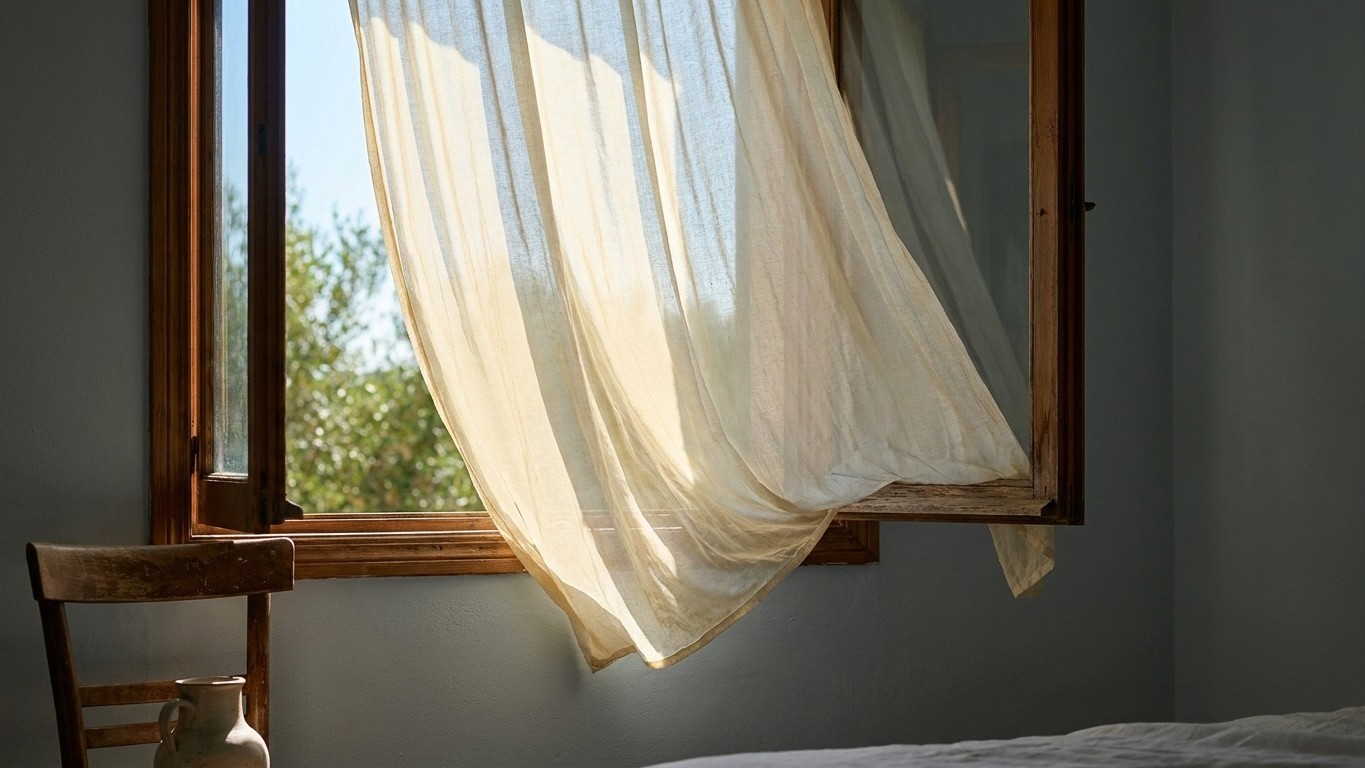
That damp sheet draped over the window frame wasn’t some quaint superstition. It was basic physics doing exactly what my grandmother said it would: pulling heat out of the air before it ever reached her bedroom. Water needs energy to turn into vapour, and it borrows that energy from whatever is nearby, in this case, the warm air trying to sneak through her window on a sweltering July night. The air on the far side of that sheet came through several degrees cooler, and she knew it decades before I ever bothered to ask why.
I spent my teenage years rolling my eyes at this ritual. We had an electric fan, after all, sat gathering dust in the cupboard because Nan insisted her “old way” worked better with the window open. It wasn’t until I studied a bit of chemistry, much later than I’d like to admit, that the penny dropped. She’d been running a miniature version of an evaporative cooler, the same principle used in industrial cooling systems and in those swamp coolers common across the drier parts of the United States, without spending a single penny on electricity.
Key takeaways
- A wet sheet in the window uses a physics principle called evaporative cooling—the same technology behind industrial cooling systems
- Your grandmother likely learned this from her mother, part of a tradition stretching back centuries across Britain, India, and the Middle East
- There’s a crucial trick to getting it right: the sheet must be damp, not soaking, and works best in dry conditions with moving air
The science your grandmother never needed a textbook for
Turning liquid water into vapour takes a surprising amount of energy, roughly 2,260 kilojoules for every kilogram at boiling point, and still a hefty amount even at room temperature. That energy has to come from somewhere, and it comes from the surrounding air, which loses heat in the process. The US Department of Energy describes this exact mechanism behind evaporative cooling systems, noting that they work by using water’s evaporation to lower air temperature rather than relying on refrigerants (evaporative coolers).
A wet sheet hung across an open window does the same job on a domestic scale. As air passes through the damp fibres, moisture evaporates, and the air that emerges on your side of the sheet has genuinely lost some of its warmth. It’s not a dramatic drop, perhaps two or three degrees under the right conditions, but on a night when you’re lying awake at 24°C, that difference is often the gap between tossing about and actually drifting off.
This wasn’t only a British habit, either. Traditional homes across India and the Middle East used similar tricks for centuries, hanging wet grass mats called khus or khaskhas in doorways and windows long before anyone had heard of air conditioning. Wind towers in Persian architecture channelled air over water specifically to cool it before it reached living quarters. My grandmother’s sheet was a humble English cousin of the same idea, born from necessity rather than engineering degrees.
Getting it right without flooding your bedroom carpet
The trick lies in the wringing, not the soaking. A dripping sheet does nothing but make a mess and raise the humidity in your room to uncomfortable levels. Wet the fabric thoroughly under a tap or in a basin, then wring it out properly, twisting hard, until it’s damp rather than saturated. Cotton or linen works better than synthetic fabrics because natural fibres hold moisture in a way that releases it gradually rather than all at once.
Hang it so air must pass through it to enter the room, ideally across an open window with some breeze coming from outside, however faint. If there’s no natural draught, positioning a fan to blow through the damp sheet toward you multiplies the effect considerably, since moving air evaporates water far faster than still air. This combination, a slight breeze plus dampened fabric, is essentially how those American swamp coolers function, just without the motor and the electricity bill.
One detail people often get wrong is fabric weight. A heavy sheet or thick towel holds too much water and dries too slowly, meaning you get a soggy, muggy room rather than a cool one. Thinner cotton sheets, the kind that have gone a bit worn and see-through with age, actually perform this job better than your best Egyptian cotton set. Nan always used her oldest sheets for this very reason, and I assumed it was thrift. Turns out it was technique.
Where this trick falls flat, and why nobody tells you
Evaporative cooling has one significant limitation that explains why it isn’t universally recommended: it struggles badly in humid conditions. When the air already carries a lot of moisture, as it often does in Britain during a muggy summer night, evaporation slows right down because the air has less capacity to absorb more water vapour. On a dry, warm evening the sheet trick performs beautifully. On a sticky, overcast night after rain, you may notice barely any difference, and you risk making the room feel clammy rather than cool.
There’s also a practical concern worth mentioning: rooms prone to damp or mould shouldn’t be subjected to nightly doses of extra moisture without decent ventilation, since trapped humidity encourages the very problems you don’t want near soft furnishings or plaster. If your bedroom already struggles with condensation on the windows in winter, this probably isn’t the summer cooling method for you. A bowl of ice in front of a fan, or simply opening windows on opposite sides of the house to create a through-draught, might serve you better.
My grandmother, incidentally, never once considered any of this scientific reasoning. She just knew her mother had done it, and her mother before that, tracing back to a time when nobody had electric fans and certainly no air conditioning, and hot nights simply had to be endured with whatever household ingenuity could muster. It turns out that ingenuity was sound thermodynamics all along, tested by generations rather than laboratories, and costing nothing more than a spare sheet and a willingness to get up and wring it out at midnight.