
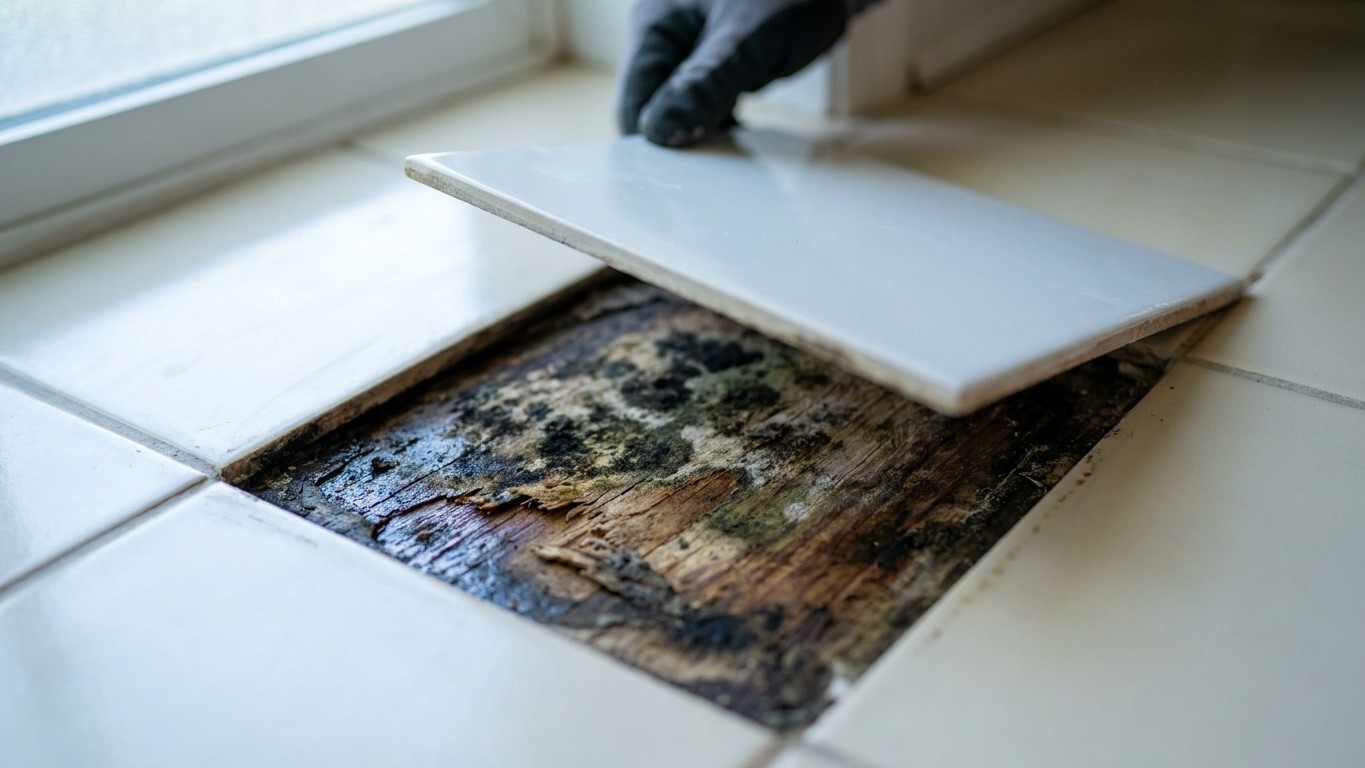
The Italian shower (or douche à l’italienne, as the bathroom industry rather grandly calls it) is one of the most popular bathroom choices in British homes right now. Sleek, barrier-free, easy to clean, on paper, it has Everything/”>Everything going for it. The trouble is, when a tiler finally lifts a failed floor after a few years of use, what they find underneath is almost always the same unpleasant story: blackened joists, saturated screed, and rot that nobody knew was there. The Italian shower is not failing because it’s a bad idea. It’s failing because the way most of them are installed leaves no room for error, and grout and silicone alone simply aren’t up to the job.
Key takeaways
- Tilers uncover a disturbing pattern of hidden damage when removing failed Italian shower installations
- Tiles and grout alone provide zero waterproofing—water invisibly migrates through grout lines into substructures
- Most Italian showers are installed without required waterproofing membranes, violating British Standards and voiding home insurance
The great illusion: tiles are not waterproof
The most common misunderstanding about tiled showers is also the most damaging one. Tiles, tile adhesive, and tile grout on their own will not inherently protect against water damage. That glossy porcelain floor may look impervious, but the grout lines between every tile are a different matter entirely. Ceramic tiles don’t absorb moisture, but the grout that fills tile joints is a cement-based product. If it isn’t sealed properly, grout allows condensation to form behind tiles. That damp eventually soaks into the wall. In a standard shower cubicle with a raised tray, a small amount of seepage can drain away. In a flush Italian shower, water vapour is an invisible enemy that can migrate through tile settings and cause moisture problems without being apparent.
There is also the grout itself to consider. Cement-based grouts are porous, and if they aren’t sealed, they can absorb moisture. This moisture will eventually build up behind the walls and cause extensive harm. Most homeowners seal their grout once when the bathroom is new, then forget about it entirely. Meanwhile, the grout quietly degrades. If your grout is visibly cracked or crumbling, it’s likely going to be letting water behind your tiles. The Italian shower design compounds this risk, because water sits directly on the floor tiles with every use, there is no raised edge, no tray lip, and no margin for the slightest failure.
What tilers actually find underneath
If you tear up shower tile, you’ll find a host of catastrophes, including horrifying mildew and mould growth as well as failed framing, rotted through after long-term exposure to water. The pattern is depressingly consistent. A tiler called in to investigate a “slight smell” or a couple of loose floor tiles peels back the surface and discovers months, sometimes years, of accumulated moisture damage. Moisture that gets behind tiles can destroy the drywall backing, it can cause rot, and it can cause the tiles to begin to fall off if left too long. Worst-case scenario, water damage behind your tiles can lead to mould problems.
The subfloor tells the saddest tale. Once the tray’s out, you should assess the floor condition, as this is your only opportunity to address underlying problems. Check for water damage, rot in wooden floors, or deteriorating screed on concrete. Any damp or damaged areas need sorting before a new tray goes in, otherwise you’re just covering up problems that’ll worsen. One particularly sobering real-world example from a UK tiler describes finding that water had soaked the wall adjacent to the shower into the next room and had rotted the joists, which could be inspected from the basement below, as a result, the whole enclosure was at risk of falling through the floor. This isn’t an exceptional horror story. It is, unfortunately, a fairly routine discovery. By the time you see evidence, a paint blister, sunken floorboard, crumbly skirting, the internal damage is often extensive.
One clue that often arrives before the catastrophe: the hollow tap test. Water-damaged tiles may make a hollow sound if there’s a leak. Try tapping your tiles with a coin or other object if you suspect a leak. A tile that was once firmly bonded to the substrate sounds dead and resonant when tapped, the adhesive beneath has been softened or dissolved by moisture. Tile and stone do not like movement. When a subfloor rots and moves, that stress goes straight through to the tile.
The real culprit: skipped tanking
Ask any experienced tiler why Italian showers fail at such a rate, and the answer is almost always the same: the waterproofing membrane wasn’t installed, or was done badly. In British Standards terms, this has been a recognised problem for years. In July 2018, the British Standards Institute (BSI) introduced changes in regulations for tiling in wet areas. Under the new revision, if you are tiling a wet area, a suitable tanking membrane should be fitted first. And yet installation without proper tanking remains common, particularly in budget refurbishments.
The standard BS 5385 Part 4 is unambiguous on this point. It states that the use of a ceramic tile together with an impervious tile grout and tile adhesive are not a substitute for a tanked shower or wet room installation. This is the core of the problem. Most homeowners (and not a few fitters) assume that porcelain plus waterproof adhesive equals a waterproof floor. It doesn’t. The only true defence is a continuous tanking membrane installed before a single tile goes down, covering floors, walls, and critically, every internal corner. Corners are natural weak points where leaks often occur. Reinforce these areas using waterproof tape or pre-formed corner seals.
There’s also the matter of your home insurance to consider. Not following the BSI guidance can become costly. With the new standards in place, you could find your home insurance void and invalid for water damages including the tiled wet area and adjoining rooms. Worth pausing on, that. A bathroom renovation done on the cheap could, in the event of a claim, leave you entirely unprotected.
A lack of waterproofing around the shower allows water to seep underneath and potentially into the floorboards where it can cause structural damage leading to costly repairs. The silicone seal around the tray edge, meanwhile, has a limited lifespan. Over time, seals around the edges of the shower tray become worn and cracked, allowing water to seep out onto the floor underneath. In a correctly tanked installation, this failure is caught by the membrane beneath. Without it, the water has a free run directly into the subfloor.
How to tell if yours is at risk, and what to do
The good news is that a careful eye can catch most problems before they become structural disasters. A persistent musty smell that survives thorough cleaning is usually the first warning. If you experience dank mildew smells you can’t seem to get rid of, there is a chance you might have water damage developing behind your bathroom tiles. Alongside that, watch for tiles that creak or flex underfoot, grout that has shrunk back from the tile edges, or any dark staining working up from the base of the walls.
If you’re planning a new Italian shower installation, a shower will be in contact with water every time it’s used, so it’s critical that the area is waterproof before and after tiling. You will need to waterproof the walls and floors before you start. The options include liquid tanking compounds (rolled on in two coats) and rigid backer boards, which come waterproofed as standard. An under-tile tanking kit is a waterproofing system specifically designed for use in bathrooms and wet rooms and is the simplest route for a renovation project. For walls, extending the membrane well above the spray zone matters too: it’s recommended to extend the waterproofing up the walls by at least 150mm from the floor to prevent moisture ingress where floors and walls meet.
Finally, there is one little-mentioned fact that catches many people out when things go wrong: with showers, it is nearly always down to silicone failure between the tiles and the shower tray. Silicone degrades over time, especially in bathrooms with hard water or chemical cleaners. Reapplying it is a straightforward job, but the old silicone must be fully removed first, you rarely get a good seal between new and old silicone. A small tube of sanitary silicone, a Stanley knife, and an hour on a Saturday afternoon may genuinely be the most cost-effective maintenance job in the whole house.
Sources : quora.com | restorationlocal.com