
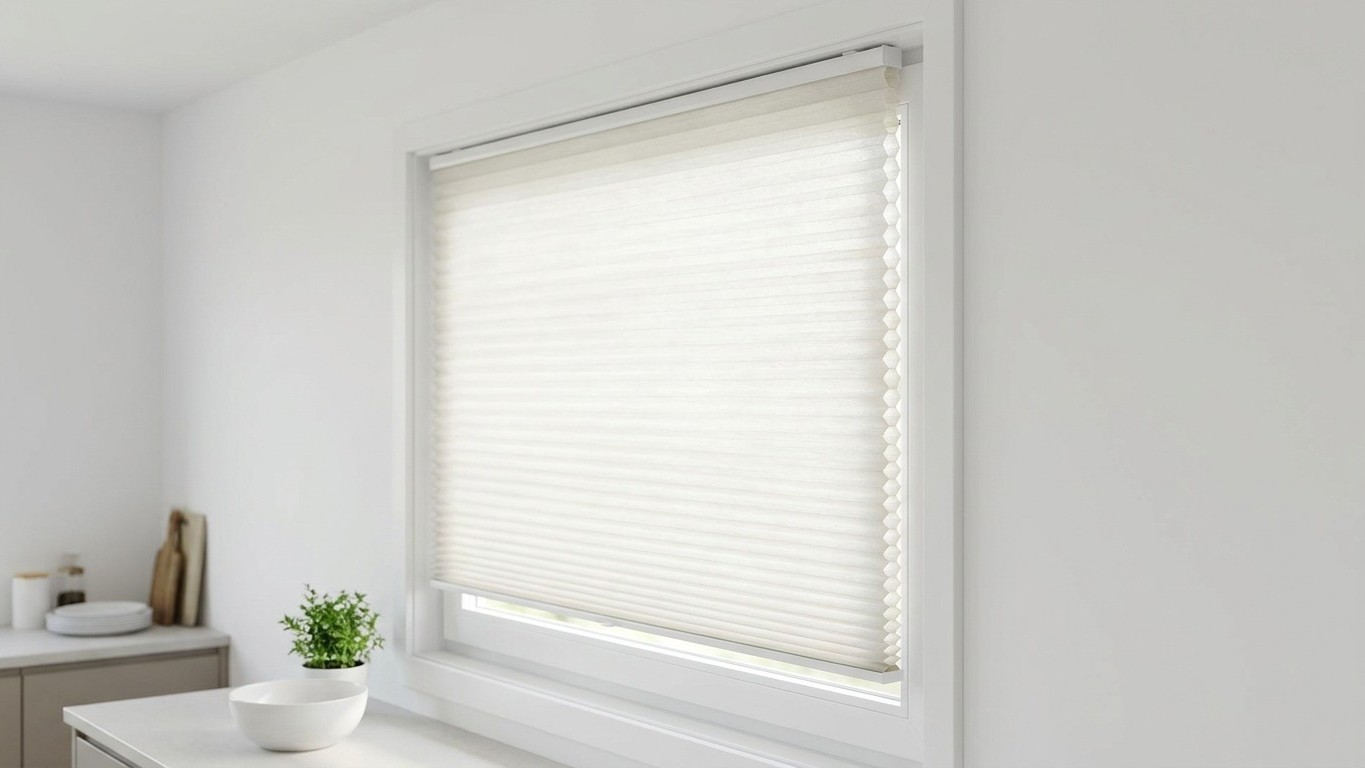
No-drill blinds are not a workaround or a makeshift solution. Done properly, they can make a window look cleaner, more modern and more considered than a set of curtains ever managed, and you can have the whole room transformed before the kettle’s boiled twice. The trick, specifically, is the Perfect Fit or tension-mounted cellular blind: a slim, tailored shade that clips or presses directly into your window frame without a single hole in the wall or window surround.
Key takeaways
- A spring-loaded mechanism can grip your window frame without a single hole—but the measurements have to be absolutely perfect
- Honeycomb cellular blinds reduce heat loss by up to 50% compared to curtains, while also absorbing sound
- Perfect Fit frames clip directly into uPVC window beading, making this the fastest option for most modern British homes
Why curtains are quietly losing the argument
Certain interior design elements can instantly modernise, or date, any space, and window treatments are high on the list. Curtains with dated prints, overly puffy balloon drapes, or shiny mini blinds of yesteryear can drag down an entire room. But even a perfectly ordinary set of lined curtains carries an invisible cost that people rarely talk about: the rail, the brackets, the rawl plugs, the filler when you change your mind, and the ever-present risk of a wonky finish. For anyone renting, that cost also includes a potential deduction from your deposit.
Motorised blinds, light-filtering and blackout roller blinds, zebra blinds, cellular blinds, Roman blinds, and no-drill blinds dominate current interior trends, with a focus on smart technology and eco-friendly materials. Curtains, by contrast, are increasingly being reserved for statement rooms where the fabric itself is the point, a bedroom with floor-to-ceiling velvet, say, or a sitting room where you want softness and theatre. For everyday kitchens, bathrooms, spare bedrooms and home offices, they have become the more complicated option.
What “no-drill” actually means in practice
There are three main methods, and they are not equally suitable for every window. The first is the tension-mounted headrail, where a spring-loaded mechanism expands to grip the inside of your window frame with firm, even pressure. Tension rod blinds are a classic no-drill option, especially for inside-mount installations. These blinds come with a spring-loaded tension rod; you extend the rod to fit snugly between the sides of your window frame, and the tension holds the blind in place. The second is the Perfect Fit frame, popular in the UK particularly for uPVC windows: a tool-free Perfect Fit frame clips directly into your window beading, no drilling, no screws, no damage. The third option uses adhesive-backed brackets, where the surface must be clean and dry, many instructions recommend wiping with rubbing alcohol first — and adhesive can weaken in high humidity or heat, working best with lighter blinds or shades.
The Perfect Fit system deserves special attention because it sidesteps every measurement headache associated with tension mounts. The blind fits straight onto brackets that hold under the seal around your window, so no drill is required for installation. A frame around the blind reduces light leakage and enhances privacy, making Perfect Fit an excellent choice for tilt-and-turn windows, doors, or any space where traditional blind installation can be challenging. If your home has uPVC windows, and most homes built in Britain since the 1990s do, this is the route I would reach for first.
The cellular blind: the one worth choosing
Not all no-drill blinds are equal, and the one that genuinely repays your afternoon is the honeycomb cellular blind. The name describes the cross-section exactly: look at the edge of a honeycomb blind and you see a row of enclosed hexagonal cells running across the width of the fabric. Each cell contains a column of still air, and still air is a good insulator, resisting the transfer of heat from one side of the cell to the other.
The thermal performance is where things become genuinely interesting. Independent research by the British Blind and Shutter Association (BBSA) indicates that honeycomb blinds can reduce heat loss through windows by up to 33%, highlighting the energy-saving potential for British homes, particularly during winter when heat retention is crucial. If you step up to a double-cell version, two stacked layers of hexagonal pockets rather than one, the depth of insulating still air doubles, with studies suggesting single-cell blinds reduce window heat loss by 20 to 35 percent and double-cell blinds pushing that figure toward 40 to 50 percent on older or less efficient double glazing. A set of curtains, even lined ones, simply cannot match that physics.
The honeycomb structure also helps absorb sound, reducing noise levels within the room, an advantage particularly for bedrooms or media rooms. And roller shades and roller blind styles are simple and light, while cellular (honeycomb) shades are light and add insulation, some coming in light-filtering or blackout options. The blackout versions contain a foil interior backing within the cell structure, which pushes the insulating properties further still.
Measuring and fitting: getting it right first time
The golden rule of any no-drill blind, and I cannot stress this enough, is that “no-drill” does not mean “no-measure.” You need precise instructions to avoid mistakes, as these blinds rely on exact fit for tension or adhesive mounting. A drill-fitted bracket forgives a millimetre or two; a tension mount does not.
For an inside mount, grab a steel tape measure (not a fabric one, which stretches). Measure the window’s width at three spots: the top, the middle, and the bottom, and use the smallest of the three measurements. Then take height measurements on the left side, in the centre, and on the right, using the largest number. Write everything down clearly before ordering anything. If the difference between the smallest and largest width measurements exceeds 6mm (¼ inch), the no-drill headrail may not fit properly — in which case an adhesive outside-mount blind, positioned to overlap the frame by a few centimetres on each side, becomes the better choice.
Installation itself, once the blind arrives, follows a simple sequence. For adhesive mounts, clean the mounting surface with rubbing alcohol and a lint-free cloth, letting it dry completely before applying brackets. For tension mounts, make sure the inside of the frame is free of debris and that the frame is sturdy. Then place the headrail inside the frame and expand it by lever or twist until it locks securely. Finally, test operation by raising and lowering the blind several times, it should move smoothly and the mount should not shift or wobble.
One thing curtain enthusiasts often miss: a cordless cellular blind fitted flush to the frame looks almost architectural from the outside. No-drill blinds are installed using adhesive strips or tension rods, quick and damage-free to install and uninstall, perfect for flats and rented homes. But they suit owned homes just as well, particularly in rooms where the window surround itself is a feature worth showing rather than hiding behind heavy fabric. The window becomes part of the room’s composition rather than something to be covered up. That, more than any trend, is what makes curtains look so thoroughly dated by comparison.
Sources : housedigest.com | lowes.com