
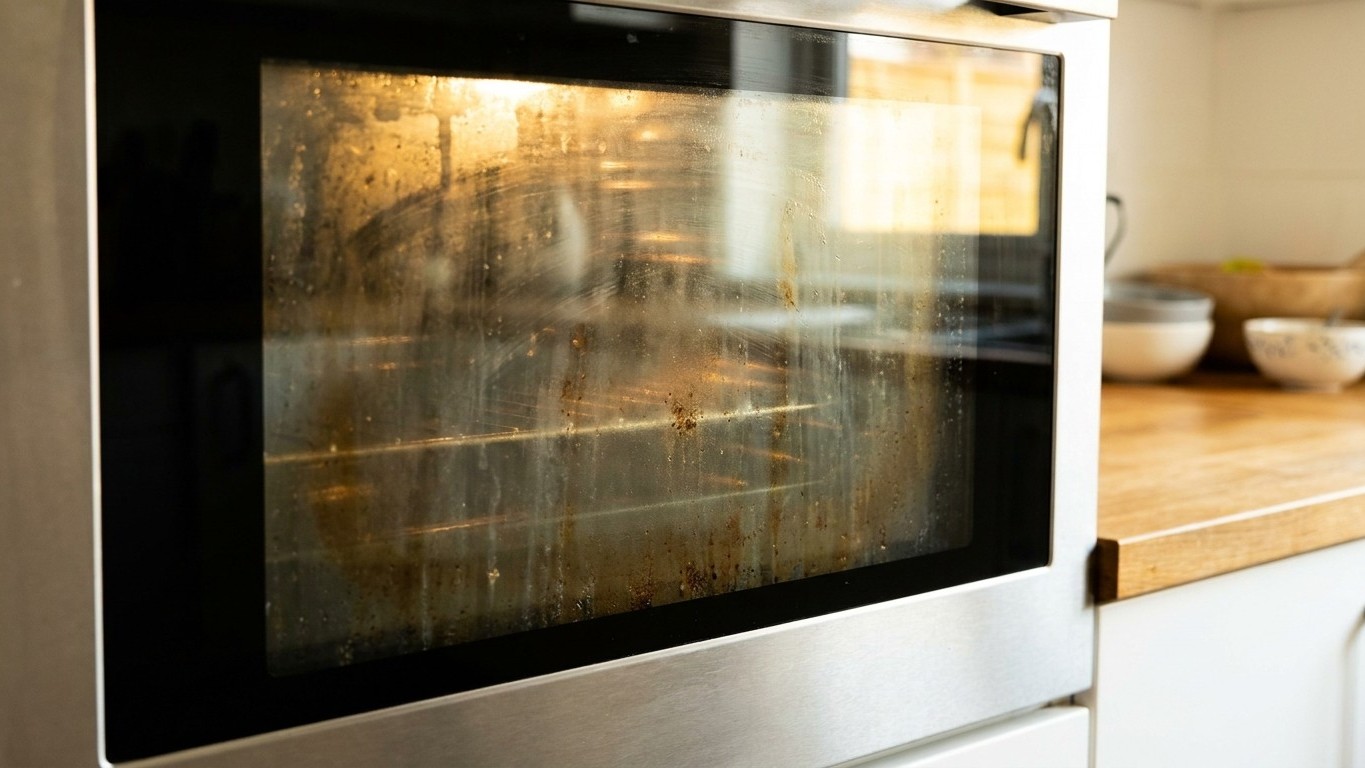
Most oven doors are not made from a single sheet of glass. They are built from two, sometimes three, separate panes with a gap between them, and that gap is exactly where the stubborn haze lives that no amount of spraying and scrubbing on the outside will ever touch. Most people don’t know that oven doors actually have two glass panels, and while you cleaned the outside of both, each has an inner side that is easily missed. That inner surface, facing into the sealed cavity, collects grease vapour every time you roast a chicken or bake a batch of scones, and because nobody’s cloth can reach it, the residue just sits there, layer after layer, for years.
This is why scrubbing the front of the glass with a cream cleaner or a bicarbonate paste, however vigorously, will never fully restore that crystal-clear view of your Sunday roast. You are cleaning the wrong surface. The dirty one is tucked away between the panes, and the drips and grime left behind even after you’ve cleaned the outside of the glass are obnoxious enough to rival even the foulest odours. I learned this the hard way myself, wondering for years why my oven door always looked a bit tired despite my best efforts, before I finally understood the glass had an inside face I’d never once touched.
Key takeaways
- Most oven doors hide a second glass pane between the frames where years of grease accumulate invisibly
- Aggressive scrubbing the outside glass is futile—the stubborn film lives on the inner surface you’ve never cleaned
- Safe disassembly or a wrapped-tool technique can restore clarity without voiding your warranty or cracking the glass
Why the door needs to come off, not just be prised open
Here’s the bit that trips people up: you cannot simply slide a finger or a flat cloth into that gap from the front, because the panes are held rigidly in a frame and the gap is only a few millimetres wide. Cleaning between oven glass panels requires disassembly of the oven door, and manufacturers such as Wolf state that only trained factory-certified service providers should complete this disassembly, as failure to properly assemble the door and glass pack can cause performance issues. That’s a stronger warning than most cleaning blogs give you, and it’s worth taking seriously if your oven is still under warranty.
For most domestic cookers, though, the door can be removed and opened up safely at home if you’re patient and methodical. A glass oven door is made up of two, sometimes three, panes of glass that are held in place by a set of screws. The general approach, once you’ve checked your model’s manual, goes like this. Lift the door off its hinges first (most modern ovens have small hinge locks you flip down before lifting), then lay it flat on a folded towel with the inner pane facing up so nothing scratches or cracks. Remove the screws above the window or at the base of the door that hold the two sides together, then lay out the two sides with their innermost surface facing up. Take a photograph before you start unscrewing anything. It sounds fussy, but with several fixings of slightly different lengths, it saves a good deal of head-scratching later. Glass oven doors can be heavy, so you may want to make this a two-person job, and it’s a smart idea to take photos of the door while it’s still assembled, particularly where the screws are located, which will make putting Everything back less of a headache.
Once the panes are separated, the actual cleaning is refreshingly gentle. You don’t need harsh chemicals here, just an Old-Fashioned paste of bicarbonate of soda and a little water, left to sit for a good twenty minutes so it can lift the baked-on grease before you wipe it away. Mix about half to one cup of baking soda with enough water to form a soft, shaving-cream-like paste, or sprinkle baking soda on the glass and spray it with a one-to-one solution of vinegar and water, then let the cleaner sit for up to twenty minutes. Finish with a lint-free microfibre cloth, never paper towel, which sheds fibres that end up right back between the panes you’ve just spent twenty minutes clearing.
A safer route if you’d rather not dismantle anything
Not every oven is designed to be pulled apart by an amateur, and if yours has a built-in camera or a side-swing door, manufacturers actively warn against attempting this yourself. For models that have cameras in the door and for models with side-swing doors, manufacturers recommend against cleaning between the oven door glass, since damage to the camera or the door could occur, and instead recommend contacting service. If that’s your situation, or you simply don’t fancy wrestling with screws and heavy glass on your kitchen table, there’s a gentler workaround that skilled home cleaners have been using for years, feeding a wrapped tool through the ventilation gaps at the base of the door rather than dismantling anything.
You can use a microfiber wand, yardstick, or rod of any sort, even a bent wire hanger, as long as it’s sturdy enough not to break and thin enough to fit between the glass. Wrap the end tightly in a microfibre cloth, dampen it with warm soapy water, and work it gently up and down through the gap at the bottom of the door once you’ve cleared away the oven drawer for easier access underneath. You’ll do that by feeding the wand through the narrow holes on the underside of the door, and for easier access to these holes, it helps to remove the drawer beneath your oven. It’s fiddly, and it won’t give you quite the pristine finish of a full strip-down, but it carries none of the risk of cracked glass or a door that won’t sit flush afterwards.
What actually causes that fog and streaking in the first place
Here’s something that catches people out and sends them reaching for cleaner they don’t need: a bit of misting between the panes after cooking is entirely normal, not a fault. The oven door glass is unsealed, which allows proper contraction and expansion during oven operation, and as a result, food particles may get between the glass panes. Condensation during oven use evaporates after the oven cools, and this is normal operation. Give it time before you assume the worst. Real streaking that won’t clear on its own, though, usually means either grease has genuinely worked its way in over months of roasting, or something wetter has gone wrong. Double-pane oven doors often trap moisture or cleaning liquids, causing streaks and fogging between glass panels, which usually indicates a compromised seal or an accidental spill during cleaning. If you’ve recently cleaned the outside glass and liquid has visibly run down into the gap, that’s your culprit, and it’s worth drying the door thoroughly with the fan oven running on a low heat, door ajar, before deciding you need to strip it apart at all.
One last thing worth knowing before you reach for the screwdriver: manufacturers routinely mention insulation fibres may be noticeable in the door glass, especially in new ovens, which is completely harmless and not a cleaning failure on your part. So if your six-month-old oven has a faint fuzzy fleck between the panes, put the cloth down. That one isn’t yours to fix.
Sources : aol.com | thetakeout.com