
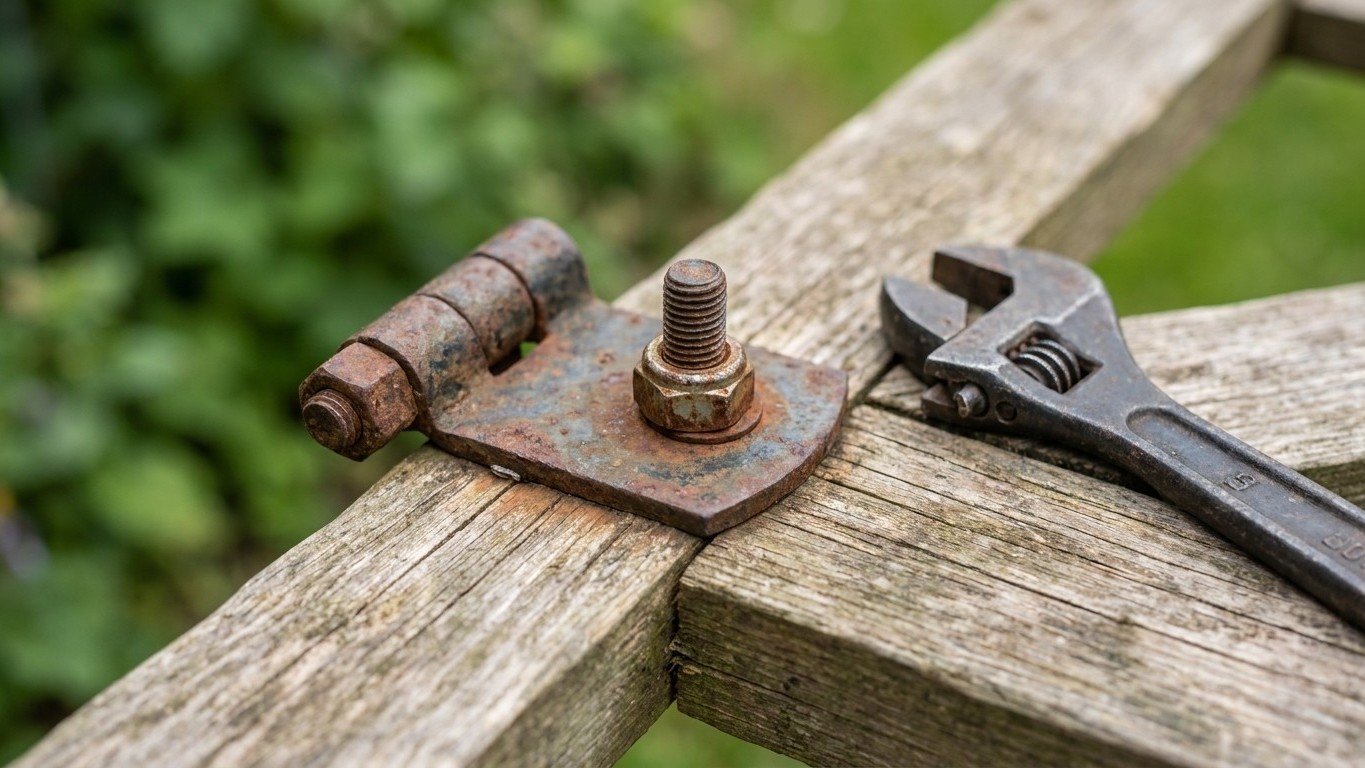
That sagging garden gate scraping along the path isn’t warped timber, more often than not. Underneath the lock nut on the hinge, there’s a threaded pin, bushing or barrel that’s simply worn loose, and once you know where to look, the fix takes minutes rather than a full weekend of carpentry.
I’ve lost count of the number of readers who’ve written to me convinced their beautiful oak gate had twisted itself out of shape overnight. Nine times out of ten, when I ask them to have a proper look, the timber’s dead straight. The real culprit is hiding in plain sight, tucked inside the hinge assembly, right under that nut you’d normally never think to touch.
Key takeaways
- What homeowners mistake for warped timber is usually a simple hinge adjustment—hidden right under the lock nut
- A three-point diagnosis takes two minutes and reveals whether your problem is the hinge or the frame itself
- One overlooked adjustment and a dab of grease can save you from replacing an entire gate
The part everyone blames first (and why they’re usually wrong)
A gate is really just a rectangle hanging off two points, and every time it swings, gravity tugs on the far corner, away from the hinges. A wood gate is essentially a rectangle held together at the corners, and every time it swings, the weight of the gate pulls down on the far corner from the hinges, gradually racking the frame out of square. Given enough seasons of this pulling and releasing, that stress loosens joints, warps boards, and eventually the whole gate settles into a diamond shape instead of a square one, which causes the gate to drag, scrape the post, or stop latching cleanly.
So yes, genuine warping does happen, particularly with cheaper softwood left unpainted through a British winter. But before you reach for new timber, it’s worth remembering that this is often not a hinge failure at all, the hinges are holding exactly where they were installed, and it’s the gate itself that has moved. The trouble is, plenty of “warped gate” cases are actually hinge cases wearing a warped gate’s disguise, and the only way to tell them apart is to inspect the hinge itself rather than eyeballing the frame.
What’s actually hiding under that lock nut
On heavier gates, especially metal ones or chunky wooden five-bar gates, you’ll usually find what’s called an adjustable hinge. Heavy-duty adjustable hinges, frequently used on larger or metal gates, are identifiable by their threaded bolts and nuts, and these hinges are designed to allow for horizontal and sometimes vertical movement after installation. That external nut you can see is essentially a lock, holding a hidden pin or bolt firmly in whatever position it’s been wound to.
Sometimes called a J-bolt hinge, the mechanism is straightforward once you picture it. It consists of a long threaded bolt that passes through a barrel or sleeve welded to the gate frame, with nuts on either side of the barrel allowing for vertical and sometimes horizontal adjustment. Loosen that lock nut, and there’s often play in the bolt itself, tiny grooves worn smooth, a bushing gone slack, or rust creeping into threads that were never properly greased. That wear is what lets the leaf drop by a centimetre or two, which is more than enough to make it catch on the path.
Spring-loaded self-closing hinges hide something slightly different under their fittings, a coiled tension spring inside a barrel, but the principle of a hidden mechanism doing the real work is the same. After achieving the desired vertical alignment, the external lock nut must be securely tightened against the post plate to lock the adjustment in place. If that nut’s been left loose, even by a whisker, vibration from wind and daily use will walk the whole assembly out of position over months.
Sorting it yourself, without buying a new gate
Start with a proper diagnosis rather than guesswork. Check the gate post with a level to see if it has tilted, inspect the hinge pins and bolts for any play, rust, or bending, and finally sight along the top rail; if the post is straight and the hinges are tight, the frame itself has likely warped or racked out of square. This little three-point check takes two minutes and saves you buying materials you don’t need.
If the hinge is your culprit, the adjustment itself is refreshingly simple. Loosen the lock nut with a spanner, work the barrel or threaded rod up a notch or two to lift the leaf back level, then tighten the nut hard against the post plate again. A squirt of penetrating oil the night before helps enormously if things have seized, and I’d always suggest doing both top and bottom hinges together, since adjust both the top and bottom hinges to the same tension to ensure a balanced and smooth closing action.
Where the hinge has genuinely worn out, rather than simply needing tightening, whole replacement pins and bushings are sold cheaply at any hardware shop, no need to fork out for an entirely new gate over a two-pound part. For gates without any adjustment built in at all, like plain strap or T-hinges, a slim shim slipped behind the top hinge plate can lift the whole leaf just enough to clear the path, a trick joiners have used for generations before adjustable hinges were ever invented.
Stopping it happening again
A dab of grease on hinge pins once or twice a year is the cheapest insurance you’ll ever buy for a gate. Gate hinges need to be greased at least once a year, and if your gate gets more use than normal, you might need to lubricate more frequently. Rust is the quiet enemy here, working its way into threads long before you notice anything’s wrong, and by the time the gate visibly sags, that wear has usually been building for a good while.
One thing worth knowing: farm and paddock gates suffer far worse than garden ones simply because of scale. A standard sixteen-foot steel tube gate or a heavy wooden paddock gate can easily weigh over a hundred pounds. That’s an enormous amount of leverage pulling on a single hinge pin day after day, which is exactly why farmers check their gate hardware far more often than the rest of us ever think to check ours.
Sources : thejimbosliceworkshop.com | engineerfix.com